
- GEO
- AI visibility tracking
AthenaHQ: see which sources AI assistants cite, and what to fix to get cited
Good tool
When ChatGPT, Perplexity or Gemini answer a question about your industry, AthenaHQ records who they recommend, how they describe them and, above all, which pages they rely on. The platform asks the main assistants hundreds of questions, benchmarks your brand against its competitors, then turns those findings into specific tasks: a piece of content to rewrite, a third-party site to target, a technical setting to revisit. A recent arrival in the GEO market, it stands apart from more established platforms by betting on action rather than on a dashboard alone.
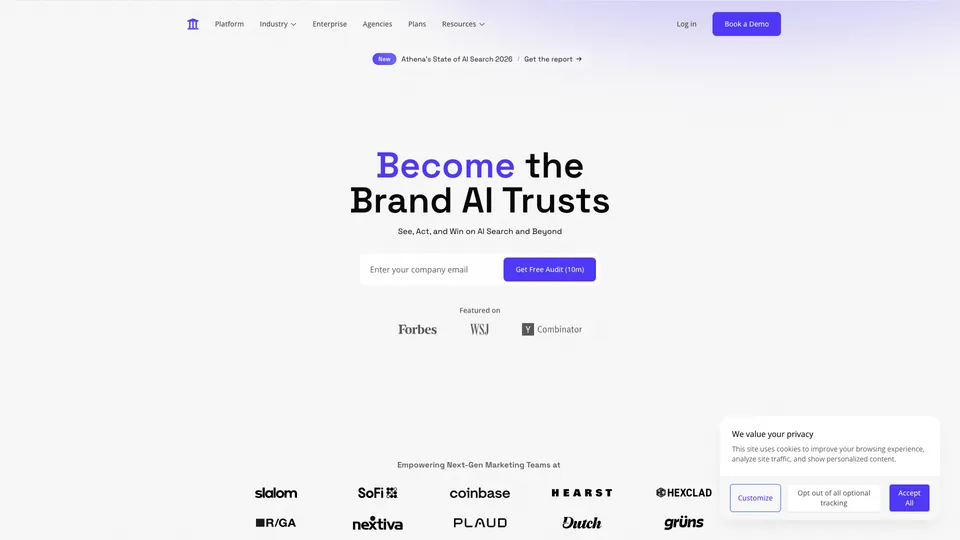
What is AthenaHQ?
It all starts with a list of questions, or prompts, that your customers might ask an AI: “which payroll software for a small business?”, “best mineral sunscreen”… AthenaHQ runs them regularly through ChatGPT, Perplexity, Gemini, Copilot and Google’s AI-generated answers, and up to eleven models on paid plans, including Claude, Grok, DeepSeek, Meta AI and Mistral. Each answer collected uses one credit. From there, the tool works out your share of voice against competitors, the tone used about you, any factual errors and, most importantly, the list of pages and domains the AI models cite to build their answers.
Those citations power the most ambitious part of the platform. Its recommendation engine matches the passages AI models actually reuse against your own pages, then suggests actions on your site (structure, content, markup) and off it (media outlets, comparison pages, directories where you should appear). A writing agent helps you apply that advice, and a chat assistant, Ask Athena, answers questions about your data in plain language. On top of that come an estimate of how many questions people ask AI about a topic, management of robots.txt and llms.txt files for AI crawlers, and integrations with Google Analytics, Search Console, Shopify and Webflow.
AthenaHQ was founded in 2025 in San Francisco by Andrew Yan, a former Google Search product manager who also worked at DeepMind, and Alan Yao, who came from ServiceNow. The startup went through the Y Combinator accelerator in the first half of 2025, then raised a $2.2 million seed round that summer from Y Combinator, several funds and SEO figures such as Eli Schwartz. It now claims large customers in finance, retail and software.
AthenaHQ at a glance
- Type
- Online GEO platform (SaaS)
- Founded
- 2025
- Founders
- Andrew Yan and Alan Yao
- Origin
- United States
- Headquarters
- San Francisco
- Funding
- $2.2M seed round (2025), Y Combinator
- AI models tracked
- 5 on the free plan, 11 on paid plans
- Free plan
- Yes, 300 credits, 5 AI models
- Starting price
- $295/month ($245 billed annually)
What is AthenaHQ used for?
-
Measure your presence in AI answers
how often ChatGPT, Gemini, Perplexity or Google’s AI answers mention your brand, question by question.
-
Spot the sources AI models cite
the pages and sites the answers rely on, so you know where you need to be present.
-
Benchmark yourself against competitors
your share of voice against the brands cited instead of you, with no cap on competitors on the paid plan.
-
Fix your content
recommendations for your pages and for off-site work, with an agent that helps draft the changes.
-
Monitor what AI says about you
the tone of the answers, inaccurate information and sensitive mentions, so you can react quickly.
-
Query your data in plain language
Ask Athena explains, for example, why a competitor shows up ahead of you on a set of questions.
-
Control AI crawler access
a robots.txt file managed from the platform to allow or block each AI crawler, plus an llms.txt generator, a file no major assistant has confirmed using to date.
-
Connect AI visibility to traffic
integrations with Google Analytics, Search Console, Shopify and Webflow, plus BI tools on Enterprise.


AthenaHQ review
Good tool
AthenaHQ doesn’t stop at a visibility score. Knowing that you show up in some ChatGPT answers is one thing; understanding why a competitor shows up more often is another, and that is where the tool does its work: it shows the pages AI models draw their answers from and turns them into a to-do list, on your site and elsewhere. For a marketing team that wants to move from diagnosis to an action plan without spending weeks on it, that is a real gain, especially since the interface stays clear and the analyses are easy to use.
What AthenaHQ measures calls for careful reading. Like every GEO tool, it queries AI models with questions chosen in advance; it doesn’t see real users’ conversations. And answers change from one day to the next, from one wording to another, from one model to another. Visibility percentages are therefore trends to follow over time, not an exact measure of your audience, and they are only as good as the list of questions behind them. The recommendations, for their part, are leads to validate: nothing guarantees that a reworked page will be cited the following month.
AI crawler management deserves the same caution. The robots.txt file has a real effect, provided you target the right crawler: blocking GPTBot stops OpenAI from training its models on your content, not ChatGPT search, which relies on OAI-SearchBot. The llms.txt file, on the other hand, is still a gamble: no major assistant has said it reads it, and Google has stated that no AI system uses it. Generating one costs nothing; expecting a citation from it would be optimistic.
Price settles the question quickly. The free plan lets you see the tool run on five AI models, but its 300 credits, one answer each, run out fast once you track a few dozen questions. The next tier jumps straight to $295 a month, with a single country tracked, and API access and extra credits are billed separately at unpublished rates. The budget is hard to forecast, and the platform is clearly aimed at brands and startups that already have a sizable marketing budget.
Finally, keep in mind how young the product is: it launched in 2025. New features ship at a fast pace, and both the interface and the plans still change often. It is a tool to re-evaluate in a few months rather than a set-and-forget choice.
Strengths
- A detailed analysis of the sources AI models cite, rare at this level of detail.
- Concrete recommendations, on your site and off it, rather than a simple score.
- Eleven models tracked on the paid plan, including Claude, Grok and DeepSeek.
- Unlimited prompts, topics, competitors and users on the Starter plan.
- A free plan to test on five AI models before paying.
- Useful integrations with Google Analytics, Search Console and Shopify.
Weaknesses
- Numbers based on simulated questions, which swing from one day to the next.
- A steep jump from free to $295 a month, with no tier in between.
- A credit model that is hard to plan for, with API access and extra credits priced on request.
- A single country tracked on Starter: multilingual tracking is reserved for Enterprise.
- A young product, with some features still being fine-tuned.
- Pricing in dollars only, with no detail on taxes.
Is AthenaHQ worth it?
Yes, if you are a brand or an agency that has already measured its presence in AI answers and now wants to know what to do to improve it: which pages to rework, which media outlets or comparison pages to target. That is where the citation analysis and the recommendations really pay off, and the free plan lets you judge how relevant they are for your own market before committing budget.
Not necessarily, if you only want to check now and then whether ChatGPT talks about you, or if your tool budget runs to a few dozen dollars a month. Asking questions by hand or using a lighter tracking tool is enough to get started, and a small business will struggle to find the money for a plan that costs close to $300.
As for alternatives, Profound targets very large companies with custom-quoted plans, while Peec AI and Otterly.AI focus on simpler, cheaper tracking of your own questions. Ahrefs Brand Radar and Semrush now build AI visibility into their SEO suites, which may be enough if you already pay for one of them. AthenaHQ sits between these two worlds: more action-oriented than simple tracking tools, easier to start with than quote-only platforms.
How much does AthenaHQ cost?
AthenaHQ publishes its pricing in dollars and builds it around credits: one credit equals one AI answer analyzed. There are three plans, from a free version to try the tool to a custom-quoted Enterprise offer, with a 17% discount on the Starter plan when billed annually.
| Plan | Per month | Per month, billed yearly | Credits (AI answers) | Who it's for |
|---|---|---|---|---|
| Essential | $0 | — | 300 credits, 5 AI models tracked | Testing the tool on a few questions |
| Starter | $295 | $245 | 3,600 a month, 11 AI models, one country | Brands and agencies tracking one market |
| Enterprise | Custom pricing | Custom, multiple countries and languages | Large companies, multi-brand groups | |
Source: official AthenaHQ pricing page, checked on October 31, 2026.
- API access and extra credits are paid add-ons on Starter, priced on request.
- The page doesn’t say whether the free plan’s 300 credits renew every month.
- No free trial of the Starter plan is advertised; the Essential plan serves that purpose.
- The Enterprise plan adds single sign-on (SSO), audit logs, dashboards for BI tools and dedicated support.
FAQ
Answers to questions about AthenaHQ
Is AthenaHQ free?
Partly. The Essential plan is free, with 300 credits and five AI models tracked (ChatGPT, Perplexity, Gemini, Copilot and Google’s AI-generated answers). For eleven models and regular tracking, you need Starter, at $295 a month or $245 a month billed annually.
What is a credit in AthenaHQ?
One credit equals one AI answer analyzed. A question tracked on five models therefore uses five credits each time it runs: the number of questions, the number of engines and how often you track them determine your usage.
Which AI models does AthenaHQ track?
ChatGPT, Perplexity, Gemini, Copilot and Google AI Overviews on every plan. Starter adds Google AI Mode, Claude, Grok, DeepSeek, Meta AI and Mistral, and other models are available on request.
Who is behind AthenaHQ?
A young San Francisco company founded in 2025 by Andrew Yan, a former Google Search product manager, and Alan Yao, formerly at ServiceNow. It came out of Y Combinator and raised $2.2 million in 2025.
Information checked on October 31, 2026