
- GEO
- AI visibility tracking
Profound: the platform big brands use to manage their visibility in AI
Reference
Profound measures how much room a brand takes up in the answers from ChatGPT, Perplexity, Gemini, Claude or Google’s AI Overviews. Every day, the platform puts a list of questions representative of a market to the assistants, then calculates how often the brand is mentioned, its rank, the tone used, the sources cited and its share of voice against competitors. On top of that it adds the volume of questions people actually ask AI, crawler activity on the site and agents that write the content to publish. Built for large companies and their agencies, it is one of the most prominent players in GEO, generative engine optimization.
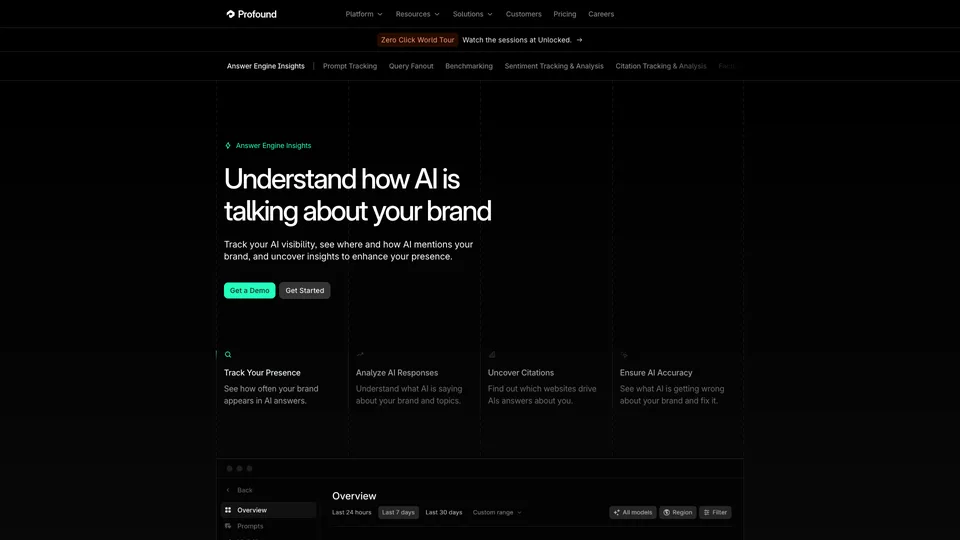
What is Profound?
At the heart of the tool is Answer Engine Insights, the tracking module. You enter your brand, your competitors and a set of prompts, the questions a customer might ask an assistant. Profound reruns them every day on the engines you pick, up to nine on the Enterprise plan (ChatGPT, Perplexity, Gemini, Microsoft Copilot, Claude, DeepSeek, Google AI Overviews, AI Mode and Exa Search). One distinctive point the company stresses: answers are captured in the assistants’ consumer interface, the way a user sees them, rather than through the models’ APIs. From that, the dashboard builds a visibility score per platform, the pages cited as sources, sentiment and, since July 2026, a check for inaccurate claims about the brand.
Several building blocks sit around that core. Prompt Volumes estimates what people actually ask AI, based on a panel of conversations from consenting users, updated weekly. Agent Analytics plugs into your host or CDN (Cloudflare, Akamai, Vercel, WordPress…) to show when GPTBot and its peers crawl the site and how many visits come from assistants. A Shopping module tracks products in ChatGPT Shopping. Finally, the AI Marketer and its agents, billed in credits, write content and reports based on the brand’s context: Profound now presents itself as a full marketing platform more than a simple measurement tool.
The company, Cooper Square Technologies, was founded in New York in August 2024 by James Cadwallader, its CEO, who came from the influencer agency Kyra, and Dylan Babbs, its CTO, a former Uber engineer. Funding rounds followed in quick succession: a $35 million Series B led by Sequoia in August 2025, a $96 million Series C at a $1 billion valuation in February 2026, then a $180 million Series D, co-led by Sequoia and Kleiner Perkins, at $1.8 billion in September 2026. The company claims more than 1,000 brand customers, including Walmart, Target, U.S. Bank, Zoom and MongoDB.
Profound at a glance
- Type
- Online GEO platform (SaaS)
- Founded
- August 2024
- Founders
- James Cadwallader and Dylan Babbs
- Headquarters
- New York (United States)
- Funding raised
- More than $300M (Series D in 2026)
- AI engines tracked
- Up to 9, including ChatGPT, Gemini and Claude
- Audience
- Large companies and agencies
- Free plan
- No (7-day trial)
- Starting price
- Custom quote (agencies: $99/month)
What is Profound used for?
-
Track your prompts every day
your brand’s mentions, rank, sentiment and visibility score, engine by engine.
-
Measure your share of voice
where your brand stands against competitors in the answers, topic by topic.
-
Know what people ask AI
the volume and intent of the questions put to assistants, so you can choose the prompts that matter.
-
See AI crawlers and visitors
the pages assistants’ crawlers explore and the traffic they send you.
-
Correct what AI says about you
the inaccurate claims detected and the sources feeding them.
-
Track your products in ChatGPT Shopping
how visible your products are against competing merchants and retailers.
-
Produce the content to publish
agents that write pages, FAQs and reports based on your brand’s context.


Profound review
Reference
Profound is built for enterprise accounts, and it shows from the dashboard on. Where most GEO tools stop at counting mentions on three or four assistants, it covers up to nine engines, cross-references answer tracking with question volumes, the crawlers visiting the site and the traffic they send back, and adds agents to act on it all. For a marketing department that has to report on its presence in AI across several brands, several countries and dozens of competitors, few offerings go this far today, and you can feel it in the depth of the analysis.
Still, its numbers should be read with some distance, as is true across GEO. The visibility score depends entirely on the prompts being tracked: these are questions chosen and rerun by the tool, not what real users actually do. AI answers vary from one day to the next and from one phrasing to another, so a rise of a few points is sometimes more noise than real progress. Capturing answers in the consumer interface brings the measurement closer to what a user sees, and Prompt Volumes gives a sense of demand, but from a panel whose representativeness is hard to judge. This data is useful for following a trend and spotting the sources that carry weight, not for sizing an audience.
Price, for its part, settles the question for many. On the brand side, the pricing page now shows only a seven-day trial, on fixed prompts, and an Enterprise plan on quote: there’s no way to get a sense of the budget without talking to sales, and the platform is clearly positioned above self-serve GEO tools. Agencies get a published entry point, but each client workspace costs extra. For a small business or a brand new to the topic, it’s a lot of tool and a lot of money for a measurement that is still young.
Strengths
- Some of the broadest coverage on the market, up to nine AI engines, Claude, Copilot and DeepSeek included.
- Answers captured the way users see them, not through the models’ APIs.
- Volumes of the questions asked to AI, to choose which prompts to track.
- Tracking of AI crawlers and the traffic they send, connected to the main hosting providers.
- Features designed for enterprise accounts: multiple brands, multiple countries, API, SSO, unlimited seats.
- A well-funded company that is evolving the tool very quickly.
Weaknesses
- Quote-based pricing for brands, with no published price.
- A short, restricted trial: seven days, fixed prompts, no history or export.
- A cost that puts it out of reach for small businesses and brands just starting with GEO.
- Measurement that depends on the prompts chosen and on volatile answers.
- A conversation panel whose representativeness is hard to assess.
- A platform expanding fast into agents and advertising, at the risk of spreading itself thin.
Is Profound worth it?
Yes, if you manage the visibility of a major brand or a portfolio of brands, with many competitors, several markets and a marketing budget to match. Profound then gives you a very complete view, from the question the user asks all the way to the visit on the site, and large agencies get a multi-client setup designed for how they work.
Not necessarily, if you are a small business, a freelancer or a brand that simply wants to know whether AI mentions it. Tracking a few dozen prompts on the main assistants is enough to get started, and that can be had for far less.
Peec AI and Otterly.AI, with published, self-serve pricing, cover most daily tracking needs for midsize brands. Ahrefs Brand Radar lets you compare brands across a whole market thanks to its huge prompt database, and Semrush subscribers already have its AI module at hand, with no extra tool. Profound stands out for the breadth of its coverage and data: it’s for teams for whom GEO has become a strategic priority, not a curiosity.
How much does Profound cost?
Profound publishes few prices, and only in dollars. Brands can choose between a seven-day free trial and an Enterprise plan on quote; agencies get a self-serve plan at $99 a month, plus client workspaces on top, and an Enterprise plan that is also quote-based. No annual pricing is shown.
| Plan | Per month | Included | Who it's for |
|---|---|---|---|
| Trial | $0 | 7 days, 50 fixed prompts tracked daily on ChatGPT, Gemini and Google AI Overviews, 1 language, 1 region, limited agent credits | Brands that want to see the tool before a demo |
| Enterprise | Custom pricing | Custom prompts, up to 9 AI engines, ChatGPT Shopping, full history, exports, API, SSO, dedicated support | Major brands managing their visibility in AI |
| Agency Growth | $99 | 10 pitch workspaces per month (25 prompts, 7 days), 5 agency seats; client workspaces extra | Agencies launching a GEO offering |
| Agency Enterprise | Custom pricing | Custom client and trial workspaces, dedicated sales and support | Large agencies and networks |
Source: official Profound pricing, checked on October 31, 2026.
- On Agency Growth, each client workspace costs an extra $399 a month (100 prompts tracked daily on ChatGPT, Perplexity and Google AI Overviews, 400 agent credits a month); five additional trial workspaces cost $199 a month.
- AI Marketer agents use credits based on their complexity; beyond the allowance, usage is either billed as overage or paused, depending on what you agree with the company.
- The free trial doesn’t let you edit prompts and offers no history, export or support. Seats are unlimited for brands.
FAQ
Answers to questions about Profound
Is Profound free?
No. There is only a seven-day free trial, with 50 fixed prompts tracked on ChatGPT, Gemini and Google AI Overviews. Ongoing use requires a paid plan.
How much does Profound cost?
For brands, the Enterprise plan is quote-based. Agencies can sign up for Agency Growth at $99 a month, plus $399 a month for each client workspace.
Which AI engines does Profound track?
Up to nine on the Enterprise plan: ChatGPT, Perplexity, Gemini, Microsoft Copilot, Claude, DeepSeek, Google AI Overviews, AI Mode and Exa Search. The trial and the agency plan are limited to three engines.
How does Profound measure visibility in AI?
Every day it asks the assistants a list of questions, capturing the answers in their consumer interface, then records the brand’s mentions, its rank, the tone used and the sources cited. The result therefore depends on the questions being tracked.
Is Profound a good fit for a small business?
Rarely. Its quote-based pricing and depth of features are aimed at large companies. A small business will find enough tracking for less with tools such as Peec AI or Otterly.AI.
Information checked on October 31, 2026