
- SEO
- SEA
- GEO
- SEO suites
Semrush: the all-in-one toolkit for SEO and online visibility
Reference
Semrush is one of the most popular online tools (SaaS) for analyzing how visible a website is. Keyword research, competitor research, backlink analysis, technical audits, Google rank tracking: it brings most of an SEO’s toolbox into a single interface, and has since expanded into Google Ads, social media and, more recently, how brands show up in answers from ChatGPT and other AI assistants. Agencies, consultants and marketing teams use it every day, and it has become one of the industry’s reference tools.
What is Semrush?
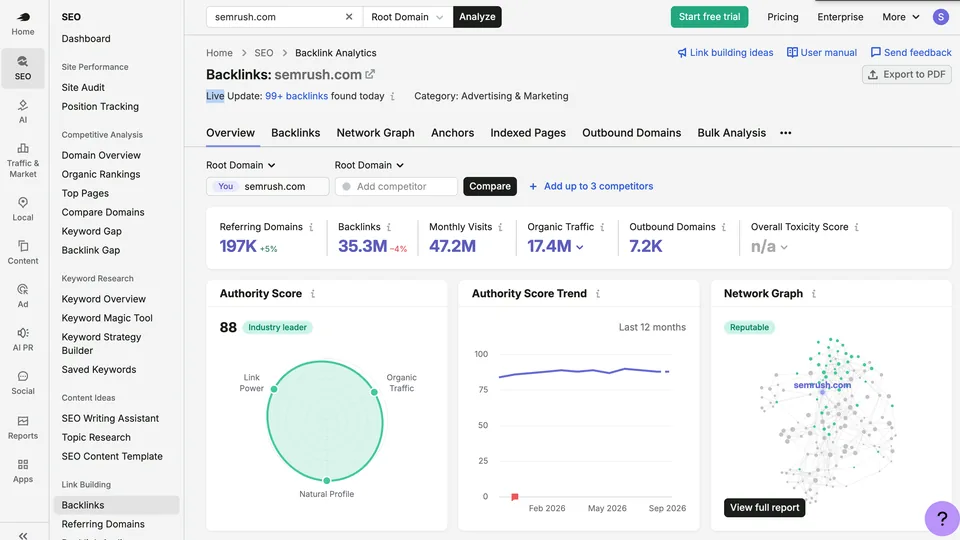
Semrush is an analytics platform that runs in the browser, on a subscription basis. You enter a domain or a keyword, and the tool shows what it knows about it: the searches a site ranks for on Google, the traffic it gets from them, the sites linking to it and its direct competitors. That information comes from Semrush’s own databases, updated continuously, not from the private analytics of the site being analyzed. That is what makes it possible to study any website, including a competitor’s.
The tool grew out of SEOquake, a browser extension built by its two founders, Oleg Shchegolev and Dmitri Melnikov, and launched in 2008. Semrush went public on Wall Street in 2021, left Russia in 2022 after the invasion of Ukraine, and was then acquired by Adobe: the deal, worth about $1.9 billion, closed on April 28, 2026.
Semrush at a glance
- Type
- Online software (SaaS)
- Founded
- 2008
- Founders
- Oleg Shchegolev and Dmitri Melnikov
- Nationality
- American (Russian-born founders)
- Headquarters
- Boston, United States
- Owner
- Adobe, since April 2026
- Revenue
- $443.6M (2025)
- Free plan
- Yes, limited
- Starting price
- $139.95/month
What is Semrush used for?
-
Find the right keywords
what people actually type into Google, with estimated search volume, keyword difficulty and search intent.
-
Keep an eye on competitors
the searches they rank for, their estimated traffic and the pages that bring them the most visitors.
-
Analyze backlinks
the links pointing to a site, and the ones your competitors benefit from.
-
Audit a website
crawl errors, slow pages, missing tags: everything that holds back your search rankings.
-
Track your rankings
how your keywords move in Google, day after day.
-
Break down Google Ads
the ads your competitors run and the keywords they bid on.
-
Measure your visibility in AI answers
how often your brand appears in ChatGPT, Gemini and Google’s AI Overviews, through the Semrush AI Visibility Toolkit.



Semrush review
Reference
Almost twenty years after it launched, Semrush is still the reference tool in SEO. But it isn’t built for everyone. It was designed for professionals: agencies, consultants and companies with an in-house SEO lead or team. That is where it pays off, when you juggle several sites, keep tabs on the competition and run organic search and paid ads from the same dashboard.
Its first strength is its data. Semrush draws on a database of about 29 billion keywords across 142 countries, a crawler that visits close to 10 billion pages a day to map backlinks, and a panel of more than 200 million anonymous internet users. Few competitors can say the same. Still, keep in mind that the numbers it shows, search volume and traffic alike, are estimates. They are valuable for spotting trends and comparing sites, much less reliable for small sites, niches and local markets. To know a site’s real traffic, nothing beats Google Search Console and a web analytics tool.
The same caution applies to Authority Score and keyword difficulty. These are metrics Semrush calculates with its own formula. They help you compare two sites or two keywords inside the tool, but they don’t match any Google measurement and can’t be compared with the scores from Ahrefs or Moz.
For a small business, a freelancer or a small agency, the math is different. The subscription is expensive, and the tool quickly feels oversized when you only use part of it: paying for the full suite to track a handful of keywords makes little sense. Some people would rather combine several cheaper, specialized tools that each cover one need. And the free plan is often enough to dig up a few keywords and take a first look at the competition.
One sore point remains: billing. The free trial requires a credit card and turns into a paid subscription unless you cancel before it ends, and getting a refund after the fact is rarely easy. The cancel option isn’t easy to find in the interface either, so make sure the cancellation has actually gone through. If you try the tool, note the end date, cancel in time and keep the cancellation confirmation.
Strengths
- A very complete suite: SEO, ads, competitor research and AI visibility in one place.
- One of the largest keyword and domain databases on the market.
- Detailed research into competitors and their Google Ads, which cheaper tools rarely offer.
- The agency standard: client reports, multiple projects, team collaboration.
- A free plan to learn the ropes.
Weaknesses
- A high price, hard to justify for a freelancer or a small agency, plus extra users and some add-ons on top.
- Estimated data: right on trends, often rough on small sites and niches.
- A dense interface that takes time to learn.
- Widely criticized billing: credit card required for the trial, automatic charge when it ends, a hard-to-find cancel option and difficult refunds.
- An oversized tool if you only use part of it, especially for a small business with a single website.
Is Semrush worth it?
Yes, if you are an agency, a consultant or a marketing team managing several sites, monitoring competitors or running SEO and paid search side by side. Spread across several clients, the subscription pays for itself quickly, and the tool saves real time every day. It is also one of the tools behind our SEO audits.
Not necessarily, if you are a small business with a single website. Google Search Console, which is free, already gives you your real numbers, and the free version of Semrush lets you run a few keyword searches or size up the competition. To go further without breaking the bank, SE Ranking, Mangools or Ubersuggest cover the essentials, and nothing stops you from combining two or three specialized tools. As for Ahrefs, its main rival, it sits in the same price range.
How much does Semrush cost?
Semrush isn’t cheap. Paid plans start at $139.95 a month, and the most complete ones come close to $300. Paying yearly brings the bill down by 16 to 17%.
| Plan | Per month | Per month, billed yearly | Who it's for |
|---|---|---|---|
| Free | $0 | — | 1 project, 10 reports a day |
| SEO | $139.95 | $117.33 | 5 sites, 500 tracked keywords |
| Starter | $199 | $165.17 | SEO + AI tracking (50 prompts) |
| Pro+ | $299 | $248.17 | 15 sites, 1,500 keywords, historical data |
| Advanced | Custom pricing | Large teams, API | |
Source: official Semrush pricing page (US version), checked on October 31, 2026.
- Each additional user is billed on top of the plan.
- The Local, Content and Traffic & Market add-ons are sold separately.
- The free trial lasts 7 days but requires a credit card: if you don’t cancel before it ends, the subscription is charged automatically.
FAQ
Answers to questions about Semrush
Is Semrush free?
Partly. The free plan gives you one project and ten reports a day: enough to discover the tool, not enough to work with it every day.
Is Semrush data accurate?
It is reliable for spotting trends and comparing sites. Search volume and traffic are still estimates, though: for your own numbers, Google Search Console is the source of truth.
Semrush or Ahrefs?
Both are on par for SEO and priced similarly. Semrush covers more ground, with Google Ads, social media and AI visibility; many SEOs still prefer Ahrefs for backlink analysis.
Who owns Semrush?
Adobe, which closed the acquisition on April 28, 2026. Founded in 2008, the company is headquartered in Boston.
How do I cancel Semrush?
From your account settings, before the renewal date. The option is hard to find and refunds after a charge are rarely granted, so note the end date of your trial or commitment and keep the cancellation confirmation.
Information checked on October 30, 2026