
- GEO
- AI visibility tracking
Peec AI: track your brand’s visibility in AI answers, every day
Good tool
A prospect asks ChatGPT, Gemini or AI Mode which software to choose, which shoe brand to buy or which agency to call, and nothing guarantees your name will show up in the answer. Every day, Peec AI asks the main assistants a list of questions you define, then measures how often your brand appears, in what position, in what tone, against which competitors and on the strength of which sources. It is now one of the reference tools in GEO, the craft of showing up in the answers of generative engines.
What is Peec AI?
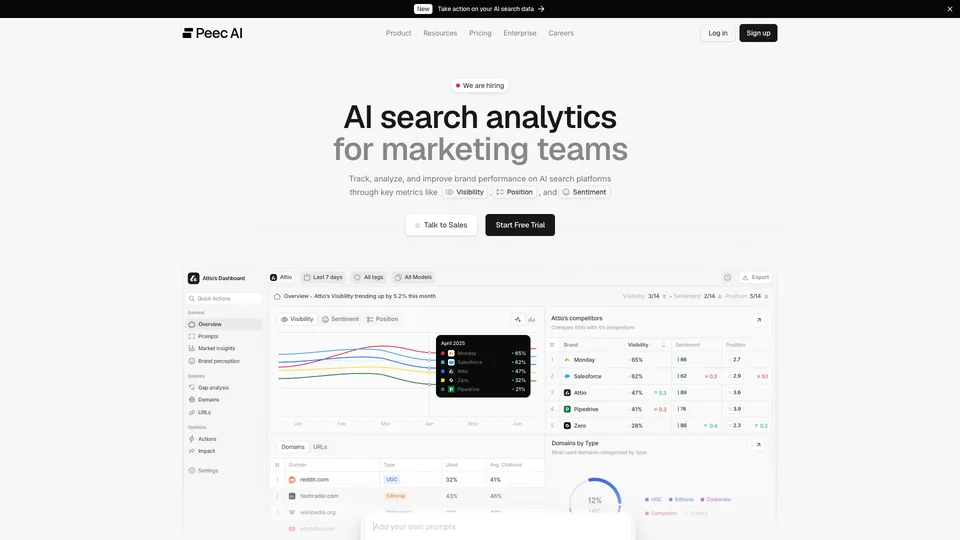
Peec AI is online software (SaaS) built around one simple unit: the prompt. You start by describing your brand, your competitors and your markets, then you draw up the list of questions to monitor, written by hand, imported in bulk or taken from the tool’s suggestions, which also proposes topics and competitors. Every day, Peec runs those questions through the web interface of the selected assistants, as a logged-out user would, and records the full answers. Three models are active on the standard plans, chosen from ChatGPT, Google’s AI Mode and AI Overviews, Gemini, Microsoft Copilot and Naver AI; Perplexity, Claude or Grok are available as add-ons or on the custom plan.
From those answers, the tool derives four main metrics: visibility (the share of answers that mention your brand), share of voice against the competitors you track, average position in the answer and a sentiment score out of 100. A second module analyzes sources: the domains and pages cited, sorted by type (competitor, media, community content…), and above all those that mention your rivals without talking about you. Over the months, the tool has added an agent that suggests actions, tracking of AI crawler visits from server or CDN logs, fact-checking of what AI models claim about your brand, a module for online store product pages, an API and a Data Studio connector.
Behind the tool is a young Berlin startup, Peec AI GmbH, founded by Marius Meiners, Tobias Siwonia and Daniel Drabo, who met in the Antler incubator program. Its growth has been fast: €7 million raised in pre-seed and seed rounds in 2025, then a $21 million Series A led by the Singular fund in November of that year, and annualized revenue that topped $10 million in May 2026, according to TechCrunch.
Peec AI at a glance
- Type
- Online software (SaaS)
- Launched
- 2025
- Founders
- Marius Meiners, Tobias Siwonia, Daniel Drabo
- Origin
- Germany
- Headquarters
- Berlin
- Funding
- $21M Series A (November 2025)
- AI models tracked
- ChatGPT, AI Mode, AI Overviews, Gemini, Copilot…
- Free plan
- No, free trial only
- Starting price
- $95/month ($80 billed annually)
What is Peec AI used for?
-
Measure your visibility in AI answers
the share of answers that cite your brand, its position and the tone used, prompt by prompt and model by model.
-
Benchmark yourself against competitors
a ranking of the brands cited on your questions, with each one’s share of voice and how it moves day after day.
-
Spot the sources that matter
the domains and pages AI models cite, and those that talk about your competitors without mentioning you.
-
Pick the right questions
prompt and topic suggestions drawn from your market, with a demand index rated from 1 to 5.
-
Monitor AI crawlers
visits from OpenAI, Google or Perplexity crawlers to your pages, and the traffic coming from assistants.
-
Share the results
shareable dashboards, CSV exports, an API from the Pro plan up and a Data Studio connector on the higher plans.


Peec AI review
Good tool
Among the tools that promise to tell you what AI says about your brand, Peec AI is one of the most pleasant to use. Setup is quick, the prompt suggestions help you build a credible first list, and the dashboards get straight to the point: who is cited, how often, and which sources the AI models rely on. The source analysis is actually its most useful part, because it leads to concrete actions, whether that is an article to write, a comparison page to get into or a media outlet to approach. Agencies and marketing teams also benefit from unlimited users on every plan.
The limit lies in the method, shared by Peec and its competitors. The tool doesn’t see what your customers actually ask: it asks the questions you chose itself, from an anonymous session, and records what comes out. Change a prompt’s wording, the country or simply the day, and the answer can vary significantly; a logged-in user, with their history and memory, will often get something else. So it is not unusual for an executive to test a question in their own ChatGPT and not find what the dashboard says. A visibility of 40% means your brand appears in 40% of the answers to your sample of prompts, not in 40% of the conversations in your market. The demand index, rated from 1 to 5, is also a relative estimate, not a search volume.
Read as a trend, over several weeks and on a stable, well-built list of prompts, these metrics are still useful: they show whether you are gaining ground on competitors and which sources to work on. They become misleading when presented as an exact measurement, or when they are turned into a client’s goal without explaining their limits.
Then there is the price. The entry plan limits tracking to 50 prompts, three models and a single country, enough to test a brand, not to cover a market; as soon as you want several countries, several projects or Perplexity on top, the bill runs to hundreds of dollars a month. For a small business that only wants to know whether ChatGPT knows about it, a few questions asked by hand already give a good idea.
Strengths
- Quick to get started with a clear interface, without feature overload.
- Prompt, topic and competitor suggestions so you never start from a blank page.
- An analysis of cited sources that leads to concrete actions.
- Daily tracking, across countries and languages, with a history of full answers.
- Unlimited users on every plan, a plus for agencies.
- Features that are expanding fast: AI crawlers, agent, API, Data Studio connector.
Weaknesses
- Metrics based on prompts chosen and asked by the tool, not on real AI usage.
- Answers that swing from one day to the next, to be read as trends rather than exact figures.
- Results that sometimes differ from what a logged-in user sees in their own assistant.
- Only three models on the standard plans, Perplexity as an add-on and Claude reserved for Enterprise.
- An entry plan limited to 50 prompts and one country, and a bill that climbs quickly.
- No free plan, and the trial length isn’t shown on the website.
Is Peec AI worth it?
Yes, if you are an established brand, a marketing team or an agency that needs to track its presence in AI answers over time, compare it with its competitors’ and decide which sources to work on. It is also a good entry point for an agency launching a GEO offering: the tool is easy to show a client, as long as you explain what the numbers are worth.
Not necessarily, if you are a small business or a niche brand, for whom the budget is hard to justify and a few manual tests are often enough. Nor if you are looking for an exact measure of the audience coming from AI: for that, you are better off looking at the traffic they send you in your web analytics tool, Google Analytics for example. That only works if the tool can recognize them: by default, Google Analytics 4 files these visits under the “referral” channel, mixed in with other referring sites. You need to create a custom channel group that isolates the assistants’ domains (chatgpt.com, perplexity.ai, gemini.google.com, copilot.microsoft.com…) to get a readable number, keeping in mind that some AI-driven visits arrive without a referrer and stay invisible.
Alternatives: Otterly.AI, built on the same tracked-prompt principle, with a lighter entry-level plan; Profound, designed for large companies; Ahrefs Brand Radar, which relies on a huge database of prompts derived from Google searches to compare brands across a whole market; and Semrush’s AI visibility tracking, a logical choice if you already pay for that suite.
How much does Peec AI cost?
Peec AI is sold by subscription, monthly or yearly, and an annual commitment costs about 15 to 16% less depending on the plan. The price mainly depends on the number of prompts tracked, each one asked every day to the three models you chose; the pricing page shows dollars in the United States and euros in Europe. Every plan includes unlimited users, languages and competitors.
| Plan | Per month | Per month, billed yearly | Prompts and coverage | Who it's for |
|---|---|---|---|---|
| Starter | $95 | $80 | 50 prompts, 3 models, 1 country, 1 project | A brand trying AI visibility tracking for the first time |
| Pro | $245 | $205 | 150 prompts, 3 models, 3 countries, 2 projects, API | SEO and marketing teams |
| Advanced | $495 | $420 | 350 prompts, 3 models, 3 countries, 5 projects, Data Studio | Several brands or markets to track |
| Enterprise | Custom pricing | Unlimited prompts, models, countries and projects, SSO | Large international brands | |
Source: official Peec AI pricing page, checked on October 31, 2026.
- Each additional model (Perplexity, for example) is available as a paid add-on, priced according to the plan.
- A free trial is offered, but its length isn’t stated on the website; there is no permanent free plan.
- Agencies get a bundled offer to split their prompts across several clients.
FAQ
Answers to questions about Peec AI
Is Peec AI free?
No. It offers a free trial, then a subscription starting at $95 a month, or $80 a month billed annually, for 50 prompts tracked every day.
Where does Peec AI’s data come from?
Every day, Peec AI itself asks the assistants you selected the questions you defined, through their web interface and without logging in, then analyzes the answers. It doesn’t see users’ real conversations.
Why do my results in ChatGPT differ from Peec AI’s?
AI answers vary with the wording, the country, the day and the user’s account, with its history and memory. Peec AI measures answers obtained without an account, on a sample of prompts: its numbers should be read as trends, not as what every user sees.
Which AI models does Peec AI track?
On the standard plans, three models of your choice among ChatGPT, AI Mode, AI Overviews, Gemini, Microsoft Copilot and Naver AI. Perplexity is available as an add-on; Claude, Grok, DeepSeek or Mistral are reserved for the Enterprise plan.
Information checked on October 31, 2026