
- GEO
- SEO
- Content for AI search
AirOps: the platform that scales content built for AI search
Good tool
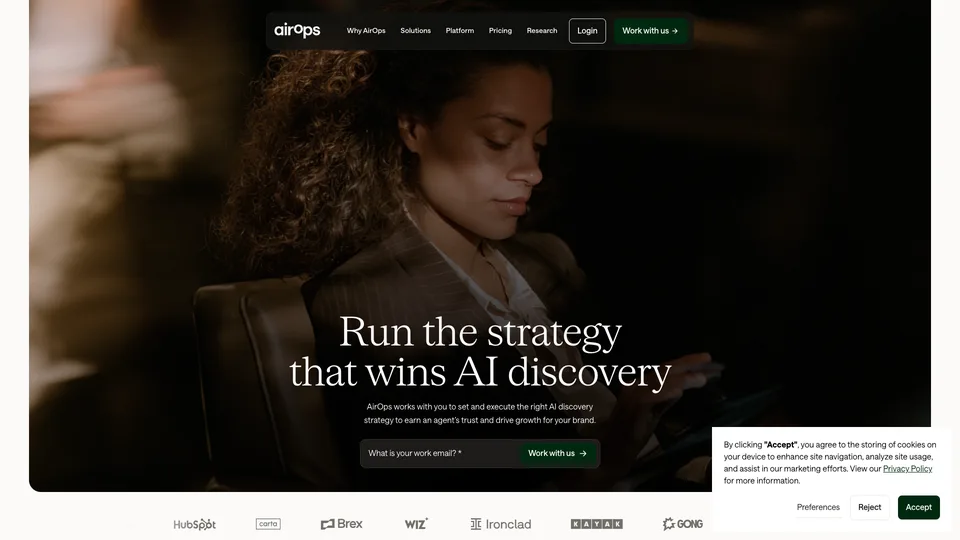
AirOps connects two things most GEO tools keep apart: knowing how a brand shows up in answers from ChatGPT, Gemini, Perplexity or Claude, and producing the content meant to improve that presence. The platform spots the questions where competitors get cited more often, then agents write, refresh and publish the matching pages, with a human review before anything goes live. Popular with marketing teams at fast-growing US startups, it is aimed first at structured content teams that have made AI visibility a goal they track.
What is AirOps?
The platform is built around two main areas. The first, called Insights, runs a list of questions (the “prompts”) every day across nine engines, including ChatGPT, Gemini, Perplexity, Claude, Microsoft Copilot and Google’s AI answers, varying the country and the profile of the simulated buyer. It shows how visible the brand is compared with its competitors, which sites the AIs cite, the tone they use about it and, if you connect your hosting provider’s logs, how often AI crawlers visit your own site. The second area, Actions, is where you act on it: Playbooks, written in plain language, hand off research, writing or content updates to agents, while Grids, a kind of spreadsheet, run those jobs on hundreds of pages at once and push the results to WordPress, Webflow, Contentful or Sanity. A brand kit and knowledge bases frame what the models produce, and every piece of content gets a quality score before it reaches a human editor.
Founded in 2022 by Alex Halliday, a former product leader at Teespring and MasterClass, together with Matt Hammel and Berna Gonzalez, the American company first sold generative AI tools for office work, then refocused on content marketing and later on AI search. It raised $7 million in 2023, $15.5 million in 2024 and then $40 million in November 2025 in a Series B led by Greylock. Today, AirOps sells a service as much as software: its strategists can define and run the client’s visibility strategy.
AirOps at a glance
- Type
- Online GEO content platform (SaaS)
- Founded
- 2022
- Founders
- Alex Halliday, Matt Hammel, Berna Gonzalez
- Origin
- United States
- Funding
- $40M Series B (2025, Greylock)
- AI engines tracked
- 9, including ChatGPT, Gemini, Perplexity and Claude
- Free plan
- No, 14-day trial
- Starting price
- Not published
What is AirOps used for?
-
Track your presence in AI answers
a list of questions run every day on ChatGPT, Gemini, Perplexity, Claude or Copilot, by country and by buyer profile.
-
See who gets cited instead of you
your competitors’ share of voice, the domains and pages that AI engines pick up, and the discussions they cite.
-
Create and refresh your content
agents that write or update your pages based on your brand kit, with a quality score and a review before publishing.
-
Process hundreds of pages at once
grids where each row is a page to create or update, with scheduled triggers or triggers tied to a drop in visibility.
-
Publish straight to your CMS
connectors for WordPress, Webflow, Contentful and Sanity, Search Console and Google Analytics, plus an API and an MCP server.
-
Watch AI crawlers on your site
visits from AI crawlers and assistants, read from Cloudflare, Vercel, Netlify or CloudFront logs.
-
Monitor ads in ChatGPT
a library of the ads spotted in ChatGPT answers, plus tracking for your own campaigns.


AirOps review
Good tool
AirOps starts from a simple observation: measuring your visibility in ChatGPT is pointless if you don’t then publish the right pages and keep them up to date. Most GEO tools stop at the dashboard. AirOps chains diagnosis, writing, review and publishing in the same workspace. For a team that manages hundreds of pages and wants to bring them up to standard on a regular basis, the time savings are real, all the more so because the content still goes through human approval before it goes live.
Its numbers, on the other hand, need to be read for what they are. Like all its competitors, AirOps measures visibility by asking the AIs questions itself, not by observing what real users ask. And the same question never gets quite the same answer, from one day to the next or from one wording to another: a visibility score should be read as a trend, never as an audience. The vendor more or less admits as much when it encourages you to judge the brand’s presence with the buyers you target rather than through an overall score.
On the production side, the agents are only as good as what you give them. Without a brand kit, a well-kept knowledge base and an editor, you quickly end up with interchangeable copy. Building effective Playbooks takes time and real editorial discipline: this is not an automatic writer you plug in on Monday to collect citations on Friday.
There is also a risk worth naming. Since 2024, Google has penalized content produced at scale without added value, whatever the method, and several sites that industrialized AI writing learned that the hard way during algorithm updates. AirOps Grids make that slip easy. It is better to keep them for updating pages that already exist and bring something to the reader, to keep a real review step, and not to confuse the volume you publish with the visibility you gain, in Google and in AI answers alike.
Budget is the trickiest part. No price is listed, and task-based billing makes the bill hard to predict: every tracked question is rerun every day, on every engine, in every country and for every profile, and a Claude answer counts four times as much as any other. The company’s growing focus on large accounts and hands-on services confirms the diagnosis: AirOps is aimed at structured marketing teams, not freelancers or small businesses.
Strengths
- AI visibility tracking and content production combined in one tool.
- Bulk processing, useful for refreshing hundreds of existing pages.
- Human review and brand kit checks built into the workflow.
- Nine AI engines tracked, with variations by country and buyer profile.
- Direct publishing to the main CMSs, plus an API and an MCP server.
- A team of experts available to build the strategy with the client.
Weaknesses
- No published prices, not even for the entry-level plans.
- Task-based billing that is hard to estimate and climbs with every engine, country or profile you add.
- Visibility scores based on simulated questions, to be read as trends.
- A long ramp-up: the agents need a brand kit, sources and editors.
- The Solo plan limits tracking to ChatGPT and a single user.
- No free plan: you have to decide after a 14-day trial.
Is AirOps worth it?
Yes, if you lead a content or growth team that has to produce and refresh pages at volume, visibility in AI engines has become a goal reviewed by leadership, and you have the time to build serious Playbooks. It is one of the few tools that turn a visibility finding into published pages without switching environments.
Not necessarily, if you only want to know whether your brand comes up in ChatGPT, or if you write a few articles a month. A pure GEO tracking tool such as Profound or Ahrefs’ Brand Radar is enough for measuring, and Meteoria offers a French alternative. To optimize a piece of copy by hand, Surfer SEO or YourTextGuru remain simpler, with published prices.
How much does AirOps cost?
AirOps describes three plans without showing a single price: Solo and Pro start with a free trial, Enterprise with a call with the sales team. The price depends mostly on task volume, the unit that counts every content generation, every data extraction and every tracked AI answer.
| Plan | Per month | Included | Who it's for |
|---|---|---|---|
| Solo | Custom pricing | 35,000 tasks a month, tracking on ChatGPT only, 1 brand kit, 3 knowledge bases, 1 user | A freelancer working on a single brand |
| Pro | Custom pricing | 100,000 tasks a month, all AI engines tracked, 1 brand kit, 5 knowledge bases, unlimited users | A small team on one brand or project |
| Enterprise | Custom pricing | Custom tasks, tracked questions and pages, unlimited brand kits and knowledge bases, custom agents, dedicated contact | Large marketing teams, multiple brands |
Source: official AirOps pricing page (plans described, no prices published), checked on October 31, 2026.
- 14-day free trial with no credit card; a workspace that stays on the free tier then gets only one task.
- Beyond the quota, extra tasks are billed: $0.025 each on the Solo plan.
- Each tracked question uses one answer per day, per engine, per country and per buyer profile; a Claude answer counts as four.
- You can connect your own AI model API keys, as an option on Solo.
FAQ
Answers to questions about AirOps
Is AirOps free?
No. A 14-day trial gives access to the paid features without a credit card, but a free workspace then keeps only one task, which is not enough to do any real work.
How much does AirOps cost?
The vendor does not publish any prices. The cost of the Solo, Pro and Enterprise plans depends mostly on the volume of tasks used each month, and you find it out when you sign up or by talking to the sales team.
Which AI engines does AirOps monitor?
ChatGPT, Gemini, Perplexity, Claude, Microsoft Copilot, Grok and Muse Spark, as well as Google’s AI Mode and AI Overviews. The Solo plan is limited to ChatGPT.
Does AirOps publish content on its own?
It can publish directly to WordPress, Webflow, Contentful or Sanity, but the workflow includes review steps where a team member approves or edits the text before it goes live.
Information checked on October 31, 2026