
- SEO
- Content optimization
YourTextGuru: know which words to use so a piece of content ranks on Google
Good tool
YourTextGuru is used to prepare and review content written for search. You enter the target query, the tool studies the pages Google ranks at the top and turns them into a guide: the terms to use, in order of importance, and a score that rises as you write. Web writers, content agencies and website publishers use it to brief, write and then check an article. It shares this semantic optimization niche with a few French competitors, 1.fr and SERPmantics, and with Surfer SEO for English-language content.
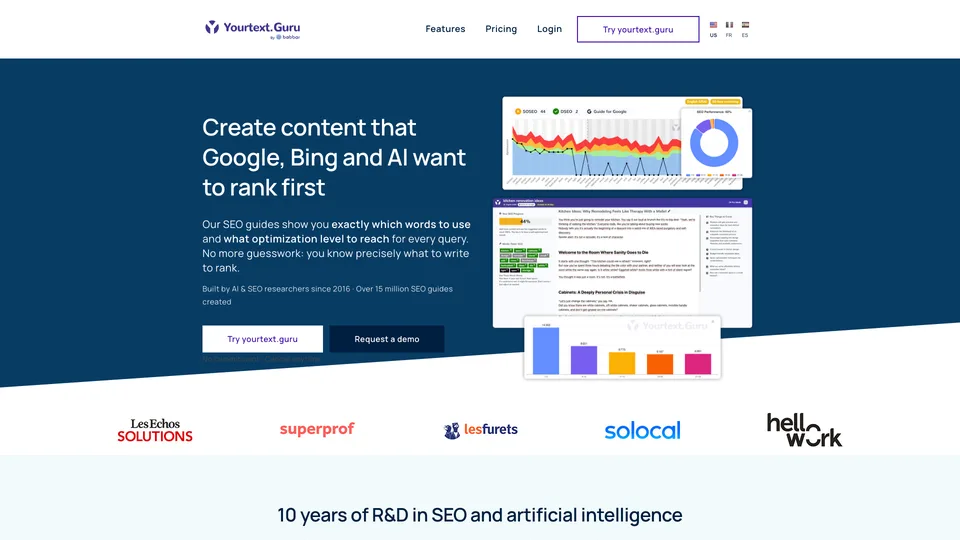
What is YourTextGuru?
The heart of the service is the guide. For a given query and language, YourTextGuru analyzes Google’s top results, then compares the weight of each term in those pages with its general frequency on the web: this “differential corpus” brings out the vocabulary specific to the topic rather than the most common words. The guide ranks about twenty priority terms, named entities and groups of two or three words that naturally go together. You then write in the built-in editor, or paste your text into it, and two in-house scores react live: SOSEO, from 0 to 300%, measures the level of optimization, while DSEO, from 0 to 200%, warns of over-optimization. A Zen mode sums everything up in a single gauge; the Pro mode details the curve for each term.
Around this core, the tool has grown: keyword research, content gap analysis against competitors, topic cluster (“semantic cocoon”) and internal linking design, checks for broken links and cannibalization, daily rank tracking, AI text generation and, more recently, recommendations for getting picked up by generative engines. Guides cover nine languages, from French to English by way of Spanish, German or Portuguese, with country variants. The company claims more than 15 million guides created.
YourTextGuru was launched in 2016 by Sylvain and Guillaume Peyronnet, two brothers well known among French SEOs for the training courses they have run since 2013. It is now published by Babbar, a company based in Évreux, France, co-founded in 2019 by Sylvain Peyronnet, former chief scientist of the Qwant search engine, and Guillaume Pitel. Babbar, which raised €2.1 million in 2021, also publishes Babbar.tech, a link analysis tool. In October 2023, a complete overhaul did away with the former unlimited subscription in favor of the current pricing.
YourTextGuru at a glance
- Type
- Online semantic optimization software (SaaS)
- Launched
- 2016
- Founders
- Sylvain and Guillaume Peyronnet
- Nationality
- French
- Company
- Babbar, Évreux (Normandy, France)
- Guide languages
- 9, including French, English, Spanish, German
- Free plan
- No, 7-day trial on request
- Starting price
- $107/month excl. tax, $98 billed yearly
What is YourTextGuru used for?
-
Optimize a text for a query
a guide to the expected terms and two scores that change as you write, so you know when the text is complete enough without overdoing it.
-
Brief your writers
a brief and guest access to a specific guide, so an outside writer can work directly with the right instructions.
-
Find topics and queries
a keyword explorer and an idea generator to spot the content worth writing.
-
See what your pages are missing
a content gap analysis between your page and the ones that outrank it on Google.
-
Build a topic cluster
your pages organized by theme, with internal linking recommendations to strengthen each one.
-
Track your rankings
a daily Google ranking check for the main query of each tracked guide.
-
Generate a first draft with AI
texts and briefs produced by AI from the guide, to be reworked by hand afterward.


YourTextGuru review
Good tool
Above all, YourTextGuru brings method to anyone who wants to write an article with a chance of ranking. In a few seconds, the guide tells you what the pages already ranking well are talking about, and the score gives the writer a simple benchmark: as long as the gauge has not reached its target, some concepts are missing. For an agency that hands dozens of articles to outside writers, it is an effective way to frame the assignment and check the copy, and that is precisely the audience that gets the most out of it.
That doesn’t mean you should take the score as a promise. It reflects how close the vocabulary is to that of the top pages, nothing more: the site’s authority, its links and the real value of the text matter just as much for ranking. Pushing SOSEO to the max quickly produces sentences that pile up terms and read badly; DSEO is there to put on the brakes, provided you actually look at it. The suggestions have their limits too: singular and plural treated separately, no way to exclude an off-topic result from the analyzed set, less relevant terms in niches where Google shows few pages. The tool is at its best in French, its original language.
Pricing has changed since the 2023 overhaul: the unlimited subscription is gone, and the entry plan starts at $107 a month excluding tax for 50 guides, while several French competitors do most of the job for much less. Token packs are a good option for occasional use, as long as you write quickly: a guide can no longer be analyzed after 50 days, and no canceled subscription is refunded. AI generation and the site analysis features, for their part, add little to what specialized tools already do.
Strengths
- Fast, readable guides, useful for briefing as much as for reviewing.
- An over-optimization score that keeps you from stuffing a text with keywords.
- A method grounded in natural language processing research.
- Team management with guest access for outside writers.
- Token packs with no subscription for occasional use.
- Nine languages covered, with country variants.
Weaknesses
- A first subscription at $107 a month excluding tax, with no lasting free version.
- A score that measures vocabulary, not the real ability to rank.
- Suggestions that are sometimes imprecise, especially on niche topics.
- Guides that expire after 50 days and monthly tokens that are partly lost.
- No refund on cancellation, and no native CMS integration, only a browser extension.
Is YourTextGuru worth it?
Yes, if you produce SEO content at volume, in an agency, at a website publisher or with a team of writers, and want a consistent way to brief and check articles. The Essential plan, with its guest seats, fits that way of working well. Token packs also suit a freelancer who optimizes a few pages per quarter.
Not necessarily, if you write a few articles a month for your own site: $107 a month excluding tax is a lot for that kind of use. The French tools 1.fr, SERPmantics and Thot SEO play on the same field, often with a lower entry price, as does NeuronWriter. For content mostly in English, Surfer SEO remains the international benchmark. And for a complete SEO strategy, keywords, links, audits, a suite such as Semrush or Ahrefs will do more for you than a writing-focused tool.
How much does YourTextGuru cost?
YourTextGuru is sold by subscription, in dollars excluding tax, and its three plans give access to the same features; what changes is the number of guides, members, guests, tokens (the AI generation credit, not to be confused with the credits that pay for guides) and rank checks. An annual commitment saves a little under 10%. Credit packs and API subscriptions round out the pricing.
| Plan | Per month | Per month, billed yearly | Guides and team | Who it's for |
|---|---|---|---|---|
| Lite | $107 | $98 | 50 guides a month, 2 members, 25,000 AI tokens, 50 rank checks a day | Freelancers, web writers |
| Essential | $247 | $227 | 375 guides a month, 5 members and 2 guests, 187,500 AI tokens, 375 rank checks a day | Marketing teams, small agencies |
| Enterprise | $431 | $396 | Unlimited guides (3 per minute at most), 10 members and 4 guests, 400,000 AI tokens, 800 rank checks a day | SEO agencies, high content volumes |
Source: official YourTextGuru pricing page (English version, in dollars), checked on October 31, 2026.
- With an annual commitment, the bill comes to $1,176, $2,724 or $4,752 excluding tax depending on the plan.
- Without a subscription, credit packs valid for one year range from 3 to 400 guides, with fewer features (guides, Zen and Pro modes, briefs, topic clusters).
- A guide costs 5 credits and can no longer be analyzed after 50 days. A subscription’s credits are valid for one month; 70% of unused credits roll over as long as the subscription continues.
- API subscriptions are also available, reserved for use through development.
- No free version: a 7-day trial can be requested after signing up. Canceling does not trigger any refund; the current month remains due.
FAQ
Answers to questions about YourTextGuru
Is YourTextGuru free?
No. There is no permanent free version, only a 7-day trial to request after creating an account. Subscriptions start at $107 a month excluding tax, or $98 a month with an annual commitment, and credit packs are available for occasional use.
What do the SOSEO and DSEO scores mean?
SOSEO, from 0 to 300%, measures how closely the text uses the vocabulary expected for the query; above 100%, optimization is considered high. DSEO, from 0 to 200%, flags the risk of over-optimization. The ideal is a sufficient SOSEO with a low DSEO.
Does a good score guarantee a good ranking?
No. The score shows that the text covers the topic with the expected words. Ranking also depends on the site’s popularity, its links, the competition and the real value of the content.
Does YourTextGuru work in English?
Yes. Guides cover nine languages, including English for several countries (United States, United Kingdom, Australia, Canada, India…), Spanish, German, Italian, Portuguese, Dutch, Polish and Romanian. Still, the tool was born in French and is mostly used for French content.
Who is behind YourTextGuru?
The tool was launched in 2016 by Sylvain and Guillaume Peyronnet, SEO trainers. It is published by Babbar, a company based in Évreux, in Normandy, France.
YourTextGuru or 1.fr?
Both tools analyze Google’s top pages to suggest the expected vocabulary. 1.fr sticks to the essentials, the guide and a score, and takes a few minutes to learn. YourTextGuru adds an over-optimization score, team management with guests, topic clusters and rank tracking, which makes it better suited to agencies and high content volumes.
Information checked on October 31, 2026