
- SEO
- GEO
- SEO suites
- Backlinks
Ahrefs: the SEO pro’s tool for dissecting backlinks and competitors
Reference
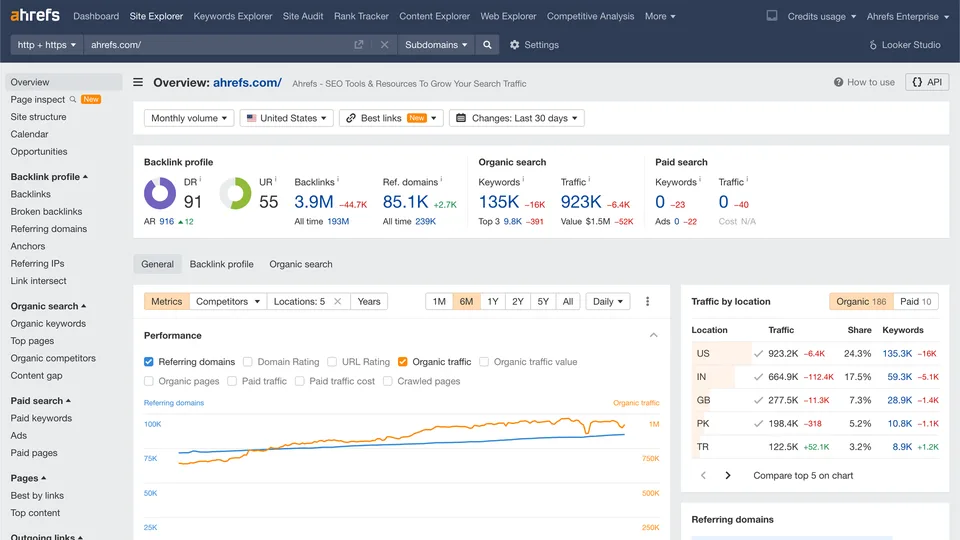
When an SEO wants to understand why a competitor outranks them on Google, Ahrefs is often where they go looking for the answer. You enter a URL, and the tool lays out the links pointing to that site, the keywords that bring it visitors, its strongest pages and its direct competitors. Around that explorer, Ahrefs has added keyword research, technical audits, rank tracking and a way to measure how a brand shows up in AI answers. Consultants, agencies and SEO teams count it among the two big suites on the market, with a reputation all its own for backlink analysis.
What is Ahrefs?
Everything at Ahrefs starts with its own data. Its crawler, AhrefsBot, scans the web nonstop (the company says it crawls 5 million pages every minute) and ranks among the most active after Google’s. It records the links between sites, which the backlink index picks up every 15 to 30 minutes, while a database of 29 billion keywords across more than 200 countries and territories is used to estimate search volume and traffic. It all runs in the browser, on a subscription, through several modules: Site Explorer to analyze a domain, Keywords Explorer for keywords, Site Audit, Rank Tracker, Content Explorer and Brand Radar for AI. On the entry-level plans, most reports are paid for in credits, deducted every time you load or filter a report.
Behind the tool is Dmytro Gerasimenko, a Ukrainian developer who started building his crawler and index in 2010 and launched a first paid offer the following year. He moved the company to Singapore in 2012, where it is still headquartered. Ahrefs has grown without outside investors, which is rare at this level: the company is private and doesn’t publish its financials, but trade press already credited it with about $100 million in annual revenue in 2021. Today it reports 148 employees around the world, and it also develops Yep, its own search engine, which shares the same infrastructure.
Ahrefs at a glance
- Type
- Online software (SaaS)
- Founded
- 2010
- Founder
- Dmytro Gerasimenko (Ukraine)
- Headquarters
- Singapore
- Funding
- Independent, no outside investors
- Team
- 148 employees (2026)
- Crawler
- AhrefsBot, 5 million pages per minute
- Free plan
- Yes, for your verified sites
- Starting price
- $29/month (Starter)
What is Ahrefs used for?
-
Dissect a link profile
referring domains, anchor text, new, lost or broken links, for your site as well as any other.
-
See what works for a competitor
the pages that bring them the most visits, the keywords they own and the ones where you’re missing.
-
Choose your topics
estimated volume, difficulty, related questions and the pages already ranking for each query.
-
Spot your technical issues
a crawl of your site that lists error pages, redirects, missing tags and broken internal links.
-
Track your rankings
how your keywords move in Google, against the competitors you choose.
-
Measure your place in AI answers
with Brand Radar, the mentions and citations of your brand in ChatGPT, Gemini, Perplexity, Copilot or Google’s AI Overviews.
-
Measure your audience
Web Analytics, Ahrefs’ own analytics tool, included up to one million events per project in the free plan.


Ahrefs review
Reference
Ahrefs is first and foremost a tool for specialists. If you do link building, audit link profiles or have to explain to a client why a competitor is pulling ahead, you’ll find the best there is for digging into backlinks, in an interface that is quick to pick up despite the sheer amount of information. No surprise there: the company was built around its crawler, and that is still where it makes the difference.
Ahrefs is also where Domain Rating and URL Rating come from, those scores out of 100 that have become the currency of link building. They measure the strength of a link profile according to Ahrefs’ model, not how much Google trusts a site: a high DR can be manufactured with low-quality links, and Google doesn’t use it. Handy for quickly sorting sites, these scores are no substitute for looking at the real traffic and the topic of the site that would link to you.
Its numbers still call for some perspective. The link index, fed continuously, is among the largest and freshest on the market; traffic and search volume, on the other hand, are estimates built from rankings and statistical models. On a large site, they track trends well; on a small site or in a niche, the gap with reality can be wide, and very specialized keywords are covered less thoroughly than common queries. For your own numbers, Google Search Console and your web analytics tool are the source of truth. One more thing worth knowing: the technical audit relies on a separate crawler, AhrefsSiteAudit, which firewalls and bot protection sometimes block; the report then flags errors that aren’t really there. It’s best to allow it explicitly on your site, which doesn’t mean you have to let in AhrefsBot, the crawler behind the link index, which some site owners prefer to keep out.
The bill is another matter. Ahrefs offers no trial and no discounts, and its Lite plan, at $129 a month, runs on a credit allowance that drains fast once you start stringing searches together. Long history, Content Explorer or unlimited credits mean moving up a tier, and several modules (reports, AI, content) cost extra: the real bill often ends up above the sticker price. And you pay for a whole suite you often use only part of. As for Starter, at $29, it lets you explore the tool more than work with it, since it gives you only 200 credits a month and no exports.
For a freelancer or a small business, Ahrefs is often more than you need. The good news is its free plan: once your site is verified, you get the technical audit, part of Site Explorer and audience measurement. That’s enough to clean up technical issues and keep an eye on the essentials, as long as you don’t need to watch the competition. To find a few topic ideas, a general-purpose AI assistant now does part of the job; it can’t replace link and ranking data, though. That breadth is also what makes Ahrefs hard to leave once you’ve adopted it: few tools cover as much ground.
Strengths
- A very large backlink index, updated continuously by its own crawler.
- Coverage so broad that it is hard to replace with any single other tool.
- A clear interface that makes link and competitor analysis quick to learn.
- Keyword research, audits, rank tracking and competitor analysis in the same suite.
- A free plan that is genuinely useful for auditing and monitoring your own sites.
- Built-in AI visibility tracking, with a few checks included from Lite up.
Weaknesses
- A usable subscription that starts at $129 a month, with no trial and no discounts.
- A credit system that holds back the smaller plans and makes the bill hard to predict.
- Long history, Content Explorer and unlimited credits reserved for the higher tiers.
- Traffic estimates sometimes far from real numbers, and thinner coverage of niche keywords.
- Paid modules that inflate the subscription, for a suite rarely used in full.
- A crawler that sometimes gets blocked, causing false alerts in the audit.
Is Ahrefs worth it?
Yes, if link building and competitive research are at the heart of your work: SEO consultant, agency, website publisher or a team that has to keep a close watch on a few competitors. Used every day, Ahrefs pays for itself quickly, ideally on the Standard plan, which removes the credit limit. Along with Semrush, it is one of the tools behind our SEO audits.
Not necessarily, if you manage a single site or do SEO only now and then. Ahrefs Free and Google Search Console then cover the essentials without spending a dime, and SE Ranking or Mangools offer keyword research and rank tracking for far less. If all you need is link data, Majestic remains a specialized alternative.
Against Semrush, its direct rival, it all depends on what you do. Their first full plans are close in price ($129 a month at Ahrefs, $139.95 at Semrush), and both hold up well for organic search. Ahrefs bets on the depth of its link index and a more straightforward interface; Semrush goes further on Google Ads, local SEO and social media, and lets you try it for free. An SEO focused on organic search and link building will often lean toward Ahrefs; a marketing team that wants to run everything from one place will find Semrush more complete.
How much does Ahrefs cost?
Ahrefs pricing comes in two layers: the subscription, then the credits, users and modules added on top. The first full plan, Lite, costs $129 a month, and the lineup climbs to $449 for Advanced. Paying yearly saves up to 17%, and the Enterprise plan is sold on annual terms only.
| Plan | Per month | Per month, billed yearly | Included | Who it's for |
|---|---|---|---|---|
| Ahrefs Free | $0 | — | Site Audit, limited Site Explorer and audience measurement, for your verified sites | Site owners |
| Starter | $29 | — | 200 credits a month, 1 month of history, 50 tracked keywords, no exports | Getting to know the tool |
| Lite | $129 | $107.50 | 1 user, 750 tracked keywords, 6 months of history, limited credits | Freelancers and small businesses |
| Standard | $249 | $207.50 | Unlimited credits, 2,000 tracked keywords, 2 years of history, Content Explorer | Consultants and agencies |
| Advanced | $449 | $374.17 | 5,000 tracked keywords, 5 years of history, Data Studio | Marketing teams |
| Enterprise | — | $1,499 | From 3 users, API, SSO, unlimited history, annual commitment | Large companies |
Source: official Ahrefs pricing page (US dollar version), checked on November 6, 2026.
- Additional users: $40 a month on Lite (up to 2), $60 on Standard (up to 5), $80 on Advanced (up to 10).
- Optional modules: Report Builder at $99 a month, Brand Radar AI from $199 a month, AI prompt packages from $50 to $250 a month.
- No free trial and no discounts: Ahrefs Free, limited to your verified sites, serves as the way to get acquainted.
- Starter renews monthly only and doesn’t accept extra credits or additional users.
- Enterprise: $1,499 a month with a mandatory annual commitment, or $17,988 a year.
FAQ
Answers to questions about Ahrefs
Is Ahrefs free?
Partly. Ahrefs Free gives you free access to the technical audit, part of Site Explorer and audience measurement, for the sites you prove you own. Analyzing a competitor requires a subscription.
Can I try Ahrefs for free?
No, Ahrefs offers no free trial and no discounts. The Starter plan, at $29 a month with no commitment, lets you explore the interface, with strict limits.
What is an Ahrefs credit?
A unit used up every time you load or filter a report in Site Explorer, Keywords Explorer or Content Explorer. Starter includes 200 a month, Lite 1,000 per user; from Standard up, they are unlimited.
Ahrefs or Semrush?
It depends on what you do. For organic search and link building, Ahrefs often has the edge thanks to its link index. To run SEO, Google Ads, local SEO and social media side by side, Semrush is more complete. Their first full plans cost $129 and $139.95 a month, respectively.
Who is behind Ahrefs?
Dmytro Gerasimenko, a Ukrainian developer who started the project in 2010. The company, independent and without outside investors, is headquartered in Singapore.
Information checked on October 31, 2026