
- GEO
- AI visibility tracking
Qwairy: the French suite for tracking and improving your visibility in AI
Good tool
When someone asks ChatGPT, Gemini or Perplexity which software to choose or which brand to go with, who gets mentioned? Qwairy asks those questions for you, at regular intervals and across a dozen assistants, then measures where your brand stands against your competitors, which sources the AIs rely on and the tone they use. The platform doesn’t stop at the findings: it then suggests content to write, sites where you could earn links and technical fixes. Up against the foreign GEO specialists, Qwairy is the French contender, with a range of covered engines rarely matched.
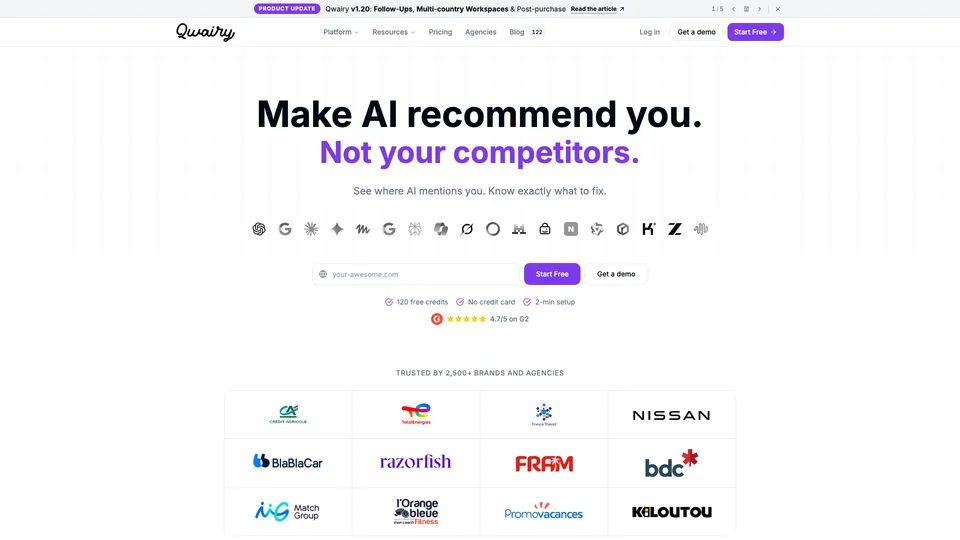
What is Qwairy?
You start by entering your brand, your competitors and a list of prompts, the typical questions a customer might ask an assistant. Qwairy then sends them to the engines you choose, every day, week or month, for the country and language you want. For ChatGPT, Gemini, Perplexity, Copilot, Grok or Google’s AI answers, the tool reads the assistant’s public interface, the one a regular user sees; the Enterprise plan adds models queried via API, from OpenAI, Anthropic, Google, Mistral or Chinese providers. Each answer is broken down: is your brand mentioned, in what position, alongside whom, with which pages as sources and in what tone. Everything is paid for in credits: an answer collected on a standard engine costs one, an article written in the Content Studio fifty.
Around this tracking, the platform is organized into modules that follow a consultant’s process: a summary dashboard, an analysis of brand perception, an action center (topics to cover, link opportunities, assisted writing), a check of how accessible the site is to AI crawlers, and then the measurement of results: impressions and clicks pulled from Search Console and Bing Webmaster Tools, where Google’s and Bing’s AI answers aren’t separated from the rest, visits coming from the assistants, reported separately, and visits from their crawlers. An API, an MCP server and a Data Studio connector let you take the data elsewhere.
Qwairy is published by Qwairy SAS, a Paris-based company registered in May 2025. It was founded by three French entrepreneurs: Luca Fancello, an SEO consultant who worked at Skyscanner, Nicolas Ilhe, who leads the technical side and chairs the company, and Aimé Dushimire, a former co-founder of CallDesk. The company says it hosts its data in the European Union, claims more than 2,500 brands and agencies as customers and states its ambition to become the most complete and most affordable GEO suite on the market.
Qwairy at a glance
- Type
- Online GEO platform (SaaS)
- Founded
- 2025
- Founders
- Luca Fancello, Nicolas Ilhe, Aimé Dushimire
- Origin
- France
- Headquarters
- Paris
- Publisher
- Qwairy SAS, independent
- Engines tracked
- 12 assistants via their interface, 9 model families via API
- Free plan
- No, 120 credits to try it out
- Starting price
- $89/month ($74 billed annually)
What is Qwairy used for?
-
Track your brand in AI
your prompts sent to ChatGPT, Gemini, Perplexity, Copilot or Google’s AI answers, with mention rate, position and trends over time.
-
Measure your share of voice
the competitors mentioned in the same answers, compared with you on every engine, country and topic.
-
Understand what AIs say about you
the tone of the answers, the strengths and weaknesses they attribute to you, and the claims worth checking.
-
Find the sources that matter
the pages and sites the assistants cite in your market, and the ones where it would be worth getting mentioned.
-
Produce the missing content
topics to cover drawn from the analyzed answers, then briefs and articles written in the Content Studio.
-
Open your site to AI crawlers
a diagnosis of how well OpenAI, Anthropic or Perplexity crawlers can access and read your pages.
-
Measure traffic from AI
the visits sent by the assistants and the activity of their crawlers, matched with data from Search Console and Bing.
-
Report to your clients
PDF reports, shareable links, a Data Studio connector and, on the Enterprise plan, a white-label platform.


Qwairy review
Good tool
Among tools that track visibility in AI, Qwairy has chosen to do a lot. Several competitors stop at the findings; Qwairy adds the explanation and the action plan: which sources carry weight, what content is missing, what is blocking things on the technical side, and then what all of it brings in as visits. For an agency selling GEO to its clients or an SEO team that has to turn a dashboard into a work plan, that is a real advantage, especially since the tool covers a rare number of engines at this price and lets you fine-tune country, language and frequency.
Still, you need to know what you are measuring. As with all its competitors, the numbers come from questions asked by the platform, not from real user conversations: they depend on the prompts you chose, and the same question can get different answers from one day to the next. A mention rate is a trend barometer, useful for comparing periods or competitors, not an audience measurement. It is best cross-checked against the visits the assistants actually send, which is exactly what Qwairy lets you do.
Then there is the product’s youth. The company is not yet two years old, new features ship fast and several engines, including Claude, are still in beta. The credit system also takes some arithmetic: the 2,500 credits of the Starter plan cover about thirty prompts tracked daily on three engines, hardly more, so broad daily tracking quickly pushes you toward the higher plans. Finally, the tool’s richness has a downside: it takes time to get the most out of it, and a small business that simply wants to know whether ChatGPT mentions it doesn’t need all of this.
Strengths
- A complete process, from tracking answers to recommending content, links and fixes.
- A wide choice of engines, countries and languages from the first plan.
- Measurement of visits and crawlers coming from AI, connected to Search Console and Bing.
- Unlimited prompts and credits that roll over as long as the subscription runs.
- A French team, data hosted in the European Union and public pricing.
- API, MCP server and Data Studio to use the data elsewhere.
Weaknesses
- Measurements based on simulated prompts, sensitive to their wording and to the volatility of the answers.
- A credit system to calibrate: daily tracking across several engines uses them up fast.
- A young tool that changes fast, with several engines still in beta.
- A longer learning curve than simple tracking tools.
- A single workspace on Starter, and API-queried models reserved for the custom-quote offer.
Is Qwairy worth it?
Yes, if you are an agency or an SEO lead who wants to make GEO a real project: tracking several brands or markets, understanding why a competitor gets mentioned, then producing the content and earning the mentions that will move the results. Its features-to-price ratio is one of the best right now, and dealing with a French company with data hosted in Europe matters to many clients.
Not necessarily, if you are only looking for a simple indicator for one brand and a handful of questions, or if your budget is tight: the 120 free credits are enough to get an idea, but not to track over time. A lighter tracking tool will do the job, and the number will have to be read as a trend anyway.
As for alternatives, Peec AI and Otterly.AI are references for prompt tracking, with a more straightforward learning curve; Meteoria, another French tool, focuses more on monitoring. Profound targets large enterprises, while Ahrefs Brand Radar and Semrush’s AI module will suit those already paying for these SEO suites. Qwairy stands out for the breadth of its engines and for its “action” side, which goes further than most of its rivals.
How much does Qwairy cost?
Qwairy is sold by subscription, with three public plans that differ mainly in the number of credits and workspaces, plus a custom-quote offer. Prompts are unlimited: credits are what set the tracking volume. An annual commitment means paying for ten months out of twelve.
| Plan | Per month | Per month, billed yearly | Included | Who it's for |
|---|---|---|---|---|
| Free | $0 | — | 120 credits, no credit card | Getting a first snapshot |
| Starter | $89 | $74 | 2,500 credits a month, 1 workspace, Content Studio, MCP server | One brand, a consultant |
| Growth | $229 | $190 | 10,000 credits a month, 2 workspaces, REST API | Several markets, small agencies |
| Business | $519 | $432 | 30,000 credits a month, 5 workspaces, AI crawler analysis, Data Studio | Agencies, brand portfolios |
| Enterprise | Custom pricing | Custom capacity, API-queried models, SSO, white label | Large accounts | |
Source: official Qwairy pricing page (dollar version), checked on October 31, 2026.
- An answer collected on a standard engine costs 1 credit; according to the company, the 2,500 Starter credits cover about 190 prompts tracked weekly on three engines, or about 27 tracked daily.
- Packs of 2,500 to 50,000 extra credits are available to paid subscribers.
- Unused credits roll over as long as the subscription runs, and are lost when you cancel. On annual billing, the whole year’s credits are granted at once.
- Payment by card or SEPA direct debit, cancel anytime, effective at the end of the billing period.
FAQ
Answers to questions about Qwairy
Is Qwairy free?
No. Signing up gives you 120 credits with no credit card, enough to test the tool on a few prompts. Regular tracking requires a subscription, starting at $89 a month or $74 a month billed annually.
Which AIs does Qwairy monitor?
Every plan covers, among others, ChatGPT, Gemini, Perplexity, Microsoft Copilot, Grok, Meta AI and Google’s AI Overviews and AI Mode, with Claude still in beta. The Enterprise plan adds models queried via API, such as those from Mistral or Qwen.
Who is behind Qwairy?
Qwairy SAS, a French company based in Paris and registered in 2025, founded by Luca Fancello, Nicolas Ilhe and Aimé Dushimire.
Do Qwairy’s numbers reflect what users actually see?
Only in part. They come from questions asked by the platform, at a given moment and for a given country, whereas assistants’ answers vary with the wording, the user and the day. They are useful for following a trend and benchmarking against competitors, not for counting audiences.
Information checked on October 31, 2026