
- GEO
- AI visibility tracking
Semrush AI Visibility Toolkit: track your brand in AI answers without leaving your SEO tool
Good tool
When people ask ChatGPT, Gemini or Google which product to choose, does your brand show up in the answer, and how is it described? The AI Visibility Toolkit, the Semrush module built around that question, calculates an AI visibility score, compares your presence with your competitors’, tracks the prompts you choose every day and checks that your site stays readable by AI assistants’ crawlers. What sets it apart is less its features than where they live: they appear in the same interface you already use for keywords and rank tracking. It is a major SEO player’s answer to the rise of GEO, up against Ahrefs Brand Radar and a generation of tools built for this purpose alone.
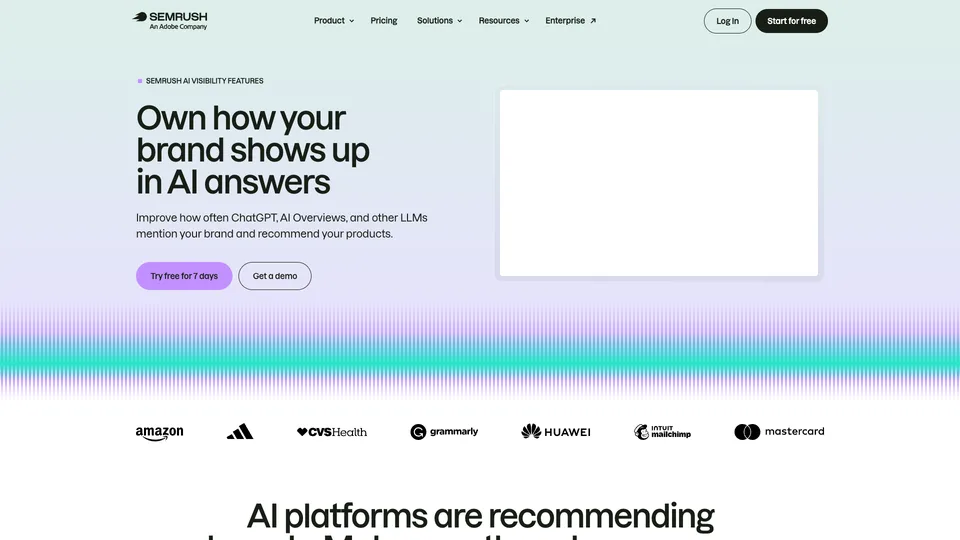
What is Semrush AI Visibility Toolkit?
The toolkit brings together six reports. The overview, competitor research and prompt research draw on a database Semrush builds itself: more than 317 million prompts and answers, spread across 117 regional databases, collected from ChatGPT, Gemini, and Google’s AI Overviews and AI Mode. According to Semrush, the questions come from browsing data on AI engines (clickstream) and from its keyword database, and the answers are captured the way a real user would see them, not through the models’ APIs. This data is refreshed continuously, every day. The volume assigned to each topic, however, remains an estimate, calculated from third-party data and statistical models.
The other three reports focus on your own brand. Brand Performance asks ChatGPT, Gemini, Perplexity and AI Mode a set of common questions every week, then derives your share of voice, the sentiment used and the arguments associated with your name. Prompt tracking borrows the mechanics of Semrush’s rank tracking: you set questions, a country and a platform, and the tool checks daily whether you are cited. Finally, a dedicated audit makes sure your site is properly open to eight AI crawlers, including OpenAI’s.
Semrush, a US company based in Boston and owned by Adobe since April 2026, introduced a first “AI Toolkit” in March 2025, focused on share of voice and brand perception in ChatGPT, Gemini and Perplexity. Its AI tools are now gathered in the AI Visibility Toolkit, which is sold on its own, per domain. Since late October 2025, it has also been bundled with the SEO suite in the Semrush One plans (Starter, Pro+ and Advanced). For the company itself, see our Semrush review.
Semrush AI Visibility Toolkit at a glance
- Type
- Semrush module, online (SaaS)
- Publisher
- Semrush (Adobe), Boston
- First AI tools
- March 2025
- Prompt database
- More than 317 million
- Platforms
- ChatGPT, Gemini, AI Overviews, AI Mode, Perplexity
- Tracked prompts
- 25 (standalone), 50 to 200 (Semrush One)
- Sold separately
- Yes, per domain
- Free plan
- Preview in the free account
- Starting price
- $99/month (billed yearly)
What is Semrush AI Visibility Toolkit used for?
-
Get an AI visibility score
how often AI assistants mention your domain, or any other, in their answers.
-
See who is ahead of you
the brands cited instead of yours and the topics where they gain the upper hand.
-
Explore the questions people ask AI
prompts related to your topic, with an estimated volume, the way you would dig through a keyword database.
-
Track your prompts every day
your brand’s presence on a list of chosen questions, by country and platform.
-
Read your image in AI answers
share of voice, sentiment and the arguments assistants associate with your brand, every week.
-
Open your site to AI crawlers
an audit that spots what prevents assistants’ crawlers from reading your pages.


Semrush AI Visibility Toolkit review
Good tool
Its best argument comes down to one word: proximity. For a team that opens Semrush every morning, seeing AI visibility next to Google rankings means one less tool, one less login and one less client report to piece together by hand. The module is quick to learn, because it follows the logic of reports you already know: a domain, a regional database, competitors, trends.
You do need to know what these numbers measure, though. Like every tool in the category, Semrush asks AI assistants questions and counts the citations; it doesn’t see what people actually ask ChatGPT in their conversations. Answers vary from day to day and with the wording, so the score shows a direction, not the truth. The 317-million-prompt database gives depth for comparing brands across a market; in a niche or a small local market, the sample thins out and the measurement loses precision. Daily tracking, for its part, covers only the 25 questions in the base plan, an allowance that fills up fast as soon as you track several product lines or countries.
Compared with tools built for GEO, the module remains a notch below in answer analysis: cited sources, prompt-by-prompt reading and client reports are more thorough there. The entry price looks reasonable, but the bill climbs as soon as you add a domain, prompts or a colleague. And caution is in order with Semrush’s billing: the Semrush One trial converts into a subscription without a reminder, and refunds are often refused on monthly plans. Make a note of the trial’s end date.
For anyone already paying for Semrush, or who wants to run SEO and AI visibility from one place, it is a good choice, with a signal that is reliable for trends. To make it the core of a GEO strategy, a specialized tool will go further.
Strengths
- AI visibility and classic SEO in the same interface.
- A database of more than 317 million prompts, across 117 regional databases.
- Any domain can be analyzed with no setup, competitors included.
- An audit that checks AI crawlers’ access to the site.
- A moderate entry price for a vendor this size, and you can buy it without the SEO suite.
Weaknesses
- Only 25 tracked prompts in the base plan.
- A score that reflects questions asked by the tool, not real-world AI use.
- Less thorough analysis of answers and sources than GEO specialists offer.
- Add-ons (domains, prompts, users) that quickly inflate the bill.
- A Semrush One trial that turns into a subscription without a reminder, and strict refund terms.
- Claude isn’t among the platforms covered.
Is Semrush AI Visibility Toolkit worth it?
Yes, if you already work in Semrush, at an agency or in-house, and want to add AI visibility to your reports without switching tools. The Semrush One Starter and Pro+ plans include it, with 50 or 100 tracked prompts: if you subscribe to one of them, you have it at no extra cost. For a first measurement of your presence against competitors, the standalone module does the job too.
Not necessarily, if GEO is at the heart of your business: tracking hundreds of questions, detailed analysis of the sources AI assistants cite, in-depth client reports. Nor if you don’t use Semrush otherwise: its main advantage disappears.
Several alternatives exist. Ahrefs Brand Radar follows the same massive-index logic, with a larger database but an index billed per platform. Among the specialists, Otterly.AI starts at $29 a month with a free trial, Peec AI at $95 for 50 prompts, and Profound, quote-based, targets large companies with more engines covered. All of them start from your own questions and put more care into answer analysis; Semrush bets on continuity with SEO.
How much does Semrush AI Visibility Toolkit cost?
There are two ways into Semrush’s AI tracking. The standalone toolkit costs $99 a month per domain, billed yearly. The Semrush One plans, which bundle it with the SEO suite, start at $199 a month, or $165.17 billed yearly.
| Plan | Per month | Per month, billed yearly | Included | Who it's for |
|---|---|---|---|---|
| AI Visibility (standalone toolkit) | — | $99 | 1 domain analyzed in depth, 25 prompts tracked daily, 300 reports a day, AI site audit | Brands that want to measure their presence in AI |
| Semrush One Starter | $199 | $165.17 | SEO suite (5 sites, 500 keywords) and AI toolkit, 50 tracked prompts | Teams running SEO and GEO side by side |
| Semrush One Pro+ | $299 | $248.17 | 15 sites, 1,500 keywords and 100 tracked prompts | Agencies and multiple sites |
| Advanced and Enterprise | Custom pricing | Large numbers of prompts, several brands, API and SSO | Large teams and groups | |
Source: official Semrush pricing page, checked on October 31, 2026; dollar amounts from Semrush’s official knowledge base (toolkit) and US pricing page (Semrush One).
- The standalone toolkit is only listed with yearly billing; no month-to-month price appears on the pricing page.
- Extra domains and prompts are paid add-ons, as is each additional user.
- The standalone toolkit has no free trial; Semrush One plans can be tried for 7 days, with an automatic charge if you don’t cancel before the end.
- The free Semrush account gives access to a few AI visibility reports, within the limit of 10 reports a day.
FAQ
Answers to questions about Semrush AI Visibility Toolkit
What is the difference between the AI Visibility Toolkit and Semrush One?
The AI Visibility Toolkit is the AI visibility module, sold on its own per domain. Semrush One bundles that module and the SEO suite in a single plan, with more tracked prompts: 50 on Starter, 100 on Pro+.
Which AI platforms does the toolkit track?
ChatGPT, Gemini, Google’s AI Overviews and AI Mode, plus Perplexity for brand analysis. Claude isn’t included.
Can you try it for free?
The free Semrush account gives a preview limited to 10 reports a day. The standalone toolkit has no trial; Semrush One plans can be tried for 7 days, but the subscription starts automatically if you don’t cancel in time.
Semrush or a specialized tool like Peec AI or Otterly.AI?
Semrush suits anyone who wants to measure AI visibility alongside SEO, in a tool they already use. Peec AI, Otterly.AI or Profound go further in tracking your own questions and analyzing answers.
How much does the AI Visibility Toolkit cost?
$99 a month per domain, billed yearly, for the standalone module. It is also included in Semrush One, from $165.17 a month billed yearly.
Information checked on October 31, 2026