
- Website creation
- Business software sites
Odoo Website: the website that plugs straight into your company’s ERP
Good tool
With Odoo Website, the company website becomes one more app in its business management software. You build it by dragging blocks onto the page, without code, and then every completed form lands in the CRM, every online order in sales and inventory, every registration in the events calendar. It isn’t the most widespread website builder on the market, but it is the natural entry point for companies that have chosen Odoo, one of the ERPs most widely used by small and midsize businesses.
What is Odoo Website?
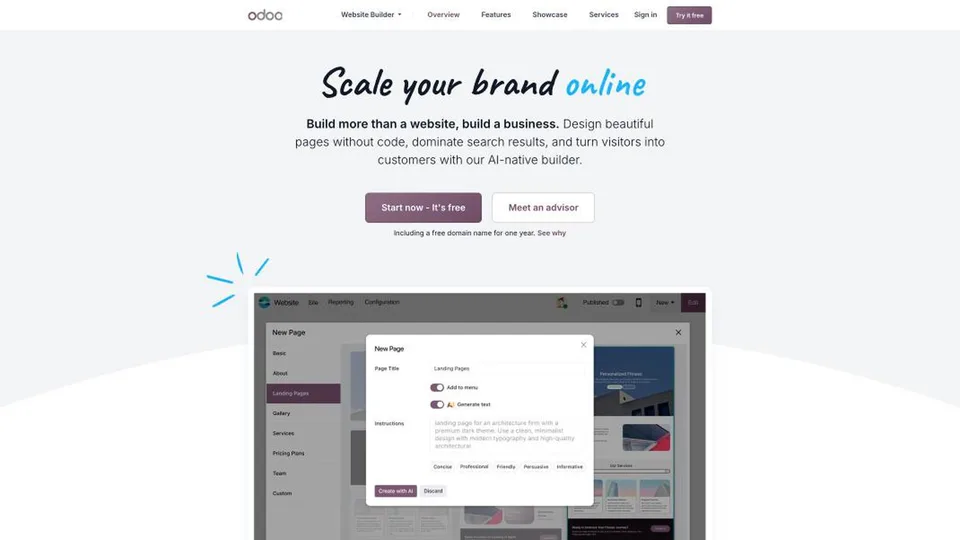
Odoo Website works as a module of the Odoo ERP, and that is what sets it apart from traditional website builders. The editor opens directly on the live page: you drop in ready-made blocks (text, images, forms, testimonials, pricing), pick a theme and a color palette, then fine-tune animations and the mobile view. To get started, a four-step assistant asks for your business, colors, logo and theme, then AI generates a first version and can write or rephrase the copy. The module also handles translations, several websites in the same database, page-by-page SEO settings, a traffic dashboard and the connection to Google Search Console. Everything else comes from Odoo’s other apps: online store, blog, events, eLearning, appointment booking, job postings or live chat, all connected to the same database of customers, products and invoices.
The site can be hosted by Odoo on its Odoo Online platform, with an odoo.com subdomain or a domain name free for the first year, or installed on your own servers. The module is part of the Community edition, free and open source under the LGPLv3 license, while the paid Enterprise edition adds proprietary apps and the Studio customization tool.
Behind the software is Odoo SA, a Belgian company based in Grand-Rosière, in Walloon Brabant. Fabien Pinckaers wrote the first version in 2005 under the name TinyERP, which became OpenERP in 2008, then Odoo in 2014. Still run by its founder, who owns more than half of it, the company generated about €620 million in revenue in 2025 and claims 28 million users. In the website market, its weight remains modest: W3Techs detected Odoo on 0.2% of websites whose CMS is identified in October 2026.
Odoo Website at a glance
- Type
- Website builder built into the Odoo ERP
- Publisher
- Odoo SA
- Founded
- 2005 (TinyERP), named Odoo since 2014
- Founder
- Fabien Pinckaers
- Headquarters
- Grand-Rosière (Belgium)
- Revenue
- About €620 million in 2025
- License
- Community open source (LGPLv3), paid Enterprise
- Free plan
- Yes, one app, unlimited users
- Starting price
- €24.90/user/month billed yearly, all apps
What is Odoo Website used for?
-
Build your site without code
blocks to drag onto the page, themes, color palettes and mobile display settings, right in the visual editor.
-
Get started with AI
an assistant generates a first version of the site from your business and your logo, then helps you write or rephrase the copy.
-
Sell online
the eCommerce app relies on the same product records, the same inventory and the same invoicing as the rest of the ERP.
-
Turn visitors into leads
forms and live chat feed the CRM, where your sales team picks up the request without retyping anything.
-
Take care of your SEO
title, description and keywords for each page, editable URLs and a connection to Google Search Console.
-
Publish in several languages
each page can be translated from the editor, and a single database can run several separate websites.
-
Add other online services
blog, event ticketing, eLearning, appointment booking and job postings are added as Odoo apps.
-
Host the site with Odoo
hosting, backups and updates included on Odoo Online, with a domain name free for the first year.
-
Track your visits
a built-in dashboard shows the site’s traffic, and a link tracker measures your campaigns.


Odoo Website review
Good tool
The appeal of Odoo Website isn’t the website itself, but what sits behind it. For a company that already manages its quotes, inventory or invoices in Odoo, having the website in the same software removes an entire layer of tools and duplicate data entry. A prospect who fills in a form shows up in the CRM, an online order reduces inventory, and customers find their invoices in their portal. No connector to maintain between a CMS and an ERP, no double entry, and a non-technical team that updates its pages in a pleasant editor.
On its own, however, the builder doesn’t outclass anyone. The themes are clean but quickly start to look alike, layouts stay within the limits of the blocks on offer, and the extension ecosystem is nothing like WordPress’s. SEO is properly covered for a business website, without the finesse that specialized CMSs allow. And if you want to go beyond the framework, you need Odoo development, a rarer and more expensive skill than a WordPress developer. You also have to be able to install it: Odoo Online hosting, the one used by the One App Free and Standard plans, accepts no third-party modules or custom code, only Odoo’s own apps and Studio. Themes and modules from the Odoo Apps Store, like any custom development, require Odoo.sh or your own server, and therefore the Custom plan or the Community edition.
Choosing the website as your only app means getting it for nothing, hosting included and with no limit on users, and the online store falls under the same terms. But Odoo designs it as a gateway: as soon as a second app is installed, the CRM for example, every internal user moves to the Standard price. Setting up a full ERP just to get a website is therefore a bad idea, and the bill can climb quickly with major version upgrades, price increases at renewal and frequent reliance on an implementation partner, whose quality varies a lot.
Odoo Website suits companies that already live in Odoo or plan to move there; for a simple brochure site with no integrated management project, there are more flexible and simpler options.
Strengths
- Native integration with the CRM, sales, inventory and invoicing, with no connector.
- A pleasant visual editor, within reach of a team with no technical skills.
- A website, and even an online store, free if it is the only app you use.
- Hosting, backups and updates included on Odoo Online.
- Several languages and several websites managed in a single database.
- An open source version you can install on your own servers.
Weaknesses
- Little appeal for anyone who doesn’t use, or doesn’t plan to use, the rest of Odoo.
- Themes and layouts less varied than with specialized website builders.
- A switch to per-user pricing as soon as a second app is installed.
- Advanced customization that requires Odoo developers, who are rare and expensive.
- Heavy dependence on the Odoo ecosystem and its version changes.
- A small market share, so fewer resources and fewer providers specialized in the website side.
Is Odoo Website worth it?
Yes, if your company already runs on Odoo, or is about to move to it for sales, inventory or accounting. The website then becomes the direct showcase of your data: catalog, prices, availability, contact requests and orders flow through without retyping. For a small business starting out with a website or a small online store that wants to keep the door open to an ERP, the free one-app offer is also an interesting starting point.
Not necessarily, if you are only looking for an attractive brochure site or a blog, or if SEO and content are at the heart of your strategy. WordPress remains more flexible and better supported, Wix or Squarespace simpler for a turnkey site, Webflow or Framer freer on design, and Shopify more complete for a pure online store. Among business management software with a built-in website, Bitrix24 and Zoho Sites play in the same category as Odoo, with a different scope.
How much does Odoo Website cost?
Odoo doesn’t sell its website module on its own: it is part of the suite’s plans, billed per internal user per month, in euros. The “One App Free” offer lets you use a single app, the website for example, at no cost and with no limit on users; the apps it needs to run are free too, so an online store, which relies on the website and invoicing, stays free. As soon as you install a second app, you move to the Standard plan, which unlocks every app for a single per-user price. The Custom plan adds Studio, multi-company, the external API and a choice of hosting. Website visitors, store customers and portal users don’t count as paid users.
| Plan | Per month | Per month, billed yearly | Included | Who it's for |
|---|---|---|---|---|
| One App Free | €0 | — | A single app (and its dependencies), unlimited users, Odoo Online hosting | Companies that only want a website or an online store |
| Standard | €31.10 | €24.90 | Every app, price per user per month, Odoo Online hosting | Small businesses running their website, sales and operations in Odoo |
| Custom | €56.90 | €44.90 | Every app, plus Studio, agentic AI, multi-company, external API, hosting on Odoo Online, Odoo.sh or on-premises | Companies with custom development or several legal entities |
Source: official Odoo pricing page, checked on October 31, 2026. Odoo displays its prices in euros, including on the English version of the page.
- The prices shown are list prices per user per month. Odoo is currently offering a 12-month discount for the users in the initial order: €19.90 billed yearly or €24.90 billed monthly for Standard, €35.90 or €44.90 for Custom.
- A “light” user, limited to a few functions (time off, expenses, point of sale as an employee…), is listed at €7.90, on quote from an Odoo advisor.
- Free trial of the paid plans. Hosting, daily backups, updates and weekday email support are included.
- Not included: Odoo.sh hosting for custom development, implementation by Odoo or a partner, in-app purchase credits (SMS, AI…) and maintenance of custom code.
- The domain name offered free for the first year then renews at the registrar’s price. The open source Community edition can also be installed for free on your own servers, with hosting and maintenance at your expense.
FAQ
Answers to questions about Odoo Website
Is Odoo Website really free?
Yes, as long as the website is the only app you use: the One App Free offer covers an unlimited number of users, with hosting on Odoo Online. The online store benefits too, since the apps it depends on are free. As soon as a second app is installed, every internal user moves to the Standard price.
How much does Odoo Website cost with the rest of the ERP?
The Standard plan costs €24.90 per user per month billed yearly, or €31.10 billed monthly, for every app. Odoo is currently applying a 12-month discount on these prices for the users in the initial order. Website visitors and store customers aren’t counted.
Can I use my own domain name?
Yes. An existing domain name can be connected to the site hosted by Odoo, and Odoo also offers free registration of a new domain for the first year; renewal is paid after that.
Is Odoo Website good for SEO?
It covers the basics of a business website: title and description for each page, editable URLs, translated versions and a connection to Google Search Console. It also has its limits: product and blog post URLs end with a numeric ID that can’t be removed, structured data is limited to the essentials, and redirects are managed one by one in the website settings. For an ambitious content strategy, a specialized CMS like WordPress offers more finesse and more extensions.
Who is behind Odoo?
Odoo SA, a Belgian company based in Grand-Rosière and founded by Fabien Pinckaers, who launched it in 2005 under the name TinyERP. It generated about €620 million in revenue in 2025.
Odoo Website or WordPress?
WordPress remains more flexible for design, content and SEO, with an ecosystem of plugins and service providers like no other. Odoo Website takes the lead as soon as the site has to talk to the CRM, inventory or invoicing without a connector. For a brochure site or a blog, WordPress; for the website of a company that runs on Odoo, the built-in module.
Information checked on October 31, 2026