
- Website creation
- No-code website builders
Squarespace: a polished business website or portfolio, without touching code
Good tool
Squarespace lets you build a business website, a portfolio or a small online store starting from a template that is already laid out, which you then fill with your own text and images. Hosting, SSL certificate, domain name, visitor analytics and online payments are included in the subscription: there is nothing to install or update. Photographers, architects, artists, freelancers and small shops have made it one of their favorite tools, and it ranks among the most widely used website builders in the world, alongside Wix.
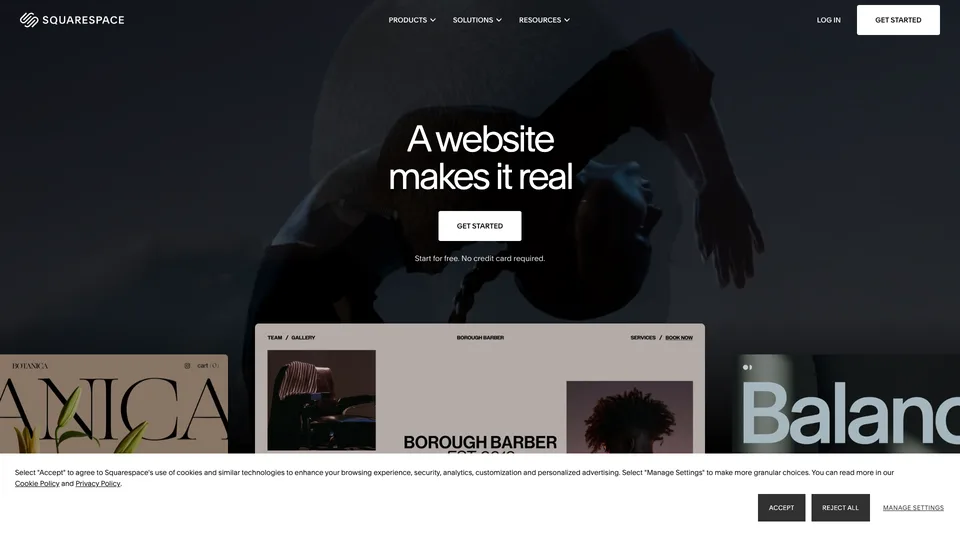
What is Squarespace?
Everything happens in the browser. You pick a template from the catalog, or let Blueprint AI, the in-house design assistant, suggest a first version based on a few questions about your business. You then edit the layout with Fluid Engine, the drag-and-drop editor of version 7.1: prebuilt sections, blocks you place freely on a grid, global settings for fonts, colors and buttons. Every site automatically adapts to mobile. Around the editor, the platform has added over the years an online store, appointment scheduling (from the acquisition of Acuity Scheduling), invoicing, email campaigns, courses and paid member areas, as well as domain name sales. To go beyond the built-in settings, plans from Core up accept CSS, JavaScript and code injection.
Squarespace was born in 2003 in Anthony Casalena’s dorm room at the University of Maryland, before its public launch in January 2004. The New York–based company went public in May 2021 through a direct listing on the New York Stock Exchange, then took over Google Domains’ assets in 2023, about ten million domains. It didn’t stay listed for long: the private equity firm Permira bought it for about $7.2 billion, in a deal that closed on October 17, 2024 and took it private. Anthony Casalena stayed on as CEO and one of its main shareholders. The company claims more than 1,760 employees, with offices in Dublin and in Aveiro, Portugal.
Squarespace at a glance
- Type
- Hosted website builder (SaaS)
- Founded
- 2003, launched in 2004
- Founder
- Anthony Casalena, still CEO
- Headquarters
- New York (United States)
- Owner
- Permira, since October 2024
- Revenue
- $1.01 billion (2023)
- Share of websites
- 2.4% (October 2026)
- Free plan
- No, 14-day trial
- Starting price
- $19/month, billed annually
What is Squarespace used for?
-
Build your site from a template
designer-made templates you adapt block by block with the Fluid Engine editor, or a first version generated by Blueprint AI.
-
Sell online
unlimited physical products, digital products or services, gift cards, subscriptions, abandoned cart recovery and a catalog synced with Facebook and Instagram.
-
Get paid by your customers
card, Apple Pay or Klarna payments with Squarespace Payments, Stripe or PayPal, plus payment links and invoices sent with no transaction fees.
-
Take appointments
an online booking calendar, inherited from Acuity Scheduling, for coaches, therapists, salons or consultants.
-
Host your site and domain
hosting, unlimited bandwidth and SSL certificate included, with a free domain name for one year on annual plans.
-
Send newsletters
email campaigns that match your site’s look, fed by visitor sign-ups and store data.
-
Track your visits
traffic sources, pages viewed, visitor locations and, from Core up, conversion metrics.
-
Monitor your brand in AI answers
a recent module that asks AI assistants questions to see whether your site is cited, currently limited to English-language accounts.


Squarespace review
Good tool
What makes people choose Squarespace is how it looks. Its templates are among the most elegant on the market, with real magazine-style layouts, refined typography and plenty of room for images. For anyone whose business depends on image, that is a decisive advantage: in a few evenings, you get a professional-looking site without hiring a designer or writing a line of code. And once the site is live, there is nothing left to watch over: no updates, no plugins, no backups.
In return, the editor guides you a lot, and you quickly run into the limits of your template as soon as you try to step outside it. The extension catalog is thin next to WordPress’s; a multilingual site requires a paid third-party service beyond one language and 2,000 words, or pages duplicated by hand, without automatic hreflang tags; and the export only recovers part of the content, without bulk images. So it is best to assume that a Squarespace site will stay on Squarespace.
There is no free plan, only a fourteen-day trial. The Basic plan is enough for a portfolio, but it takes 2% of every sale and doesn’t allow custom code: for a business that sells, Core quickly becomes the real starting point. Support usually answers quickly in writing, but reaching someone about an account or billing issue can take patience. None of this is a deal-breaker for a well-designed business site, as long as you know what you are buying.
Strengths
- Beautifully designed templates built to showcase images.
- An all-in-one service: hosting, SSL, domain, analytics and payments, with no technical maintenance.
- A visual editor non-specialists can use, with automatic mobile display.
- Store, appointments, invoices and newsletters in a single account.
- A free domain name for one year on annual plans.
Weaknesses
- No free plan, only a 14-day trial.
- Layout freedom bounded by the template, and few extensions.
- A partial export that makes moving to another platform laborious.
- A multilingual site that relies on a third-party service, paid beyond one language.
- A Basic plan that takes 2% of sales and blocks custom code.
Is Squarespace worth it?
Yes, if you want a business website or a portfolio that looks good, goes live fast and doesn’t need looking after: photographer, artist, architect, consultant, restaurant or small brand. For a few dozen dollars a month, the result looks like a professional site, as long as you stay within the template’s framework.
Not necessarily, if your project needs to grow in unexpected directions, open up to several languages or stay entirely in your hands. WordPress, open source and with a huge choice of extensions, offers more freedom in exchange for regular maintenance; Webflow will appeal to designers who want to control every detail of the layout. Wix, its most direct competitor, has a free plan to get started, and for a store with a large catalog, Shopify remains better equipped.
How much does Squarespace cost?
Squarespace offers four plans, billed monthly or yearly, with annual billing bringing the monthly price down significantly. On the US page, prices run from $25 to $139 a month on monthly billing, or $19 to $99 a month billed annually. Every plan lets you sell; what separates them is mainly the fees taken on sales, custom code and advanced commerce tools.
| Plan | Per month | Per month, billed yearly | Included | Who it's for |
|---|---|---|---|---|
| Basic | $25 | $19 | 2 contributors, 30 min of video, 2% fee on product sales (7% on digital content and memberships) | Portfolio or simple business website |
| Core | $39 | $29 | Unlimited contributors, CSS and JavaScript, free year of Google Workspace, email campaigns, 0% fee on products (5% on digital content and memberships) | Freelancers and small businesses that sell |
| Plus | $65 | $49 | Lower card rates, 50 hours of video, 1% on content and memberships | Stores and creators who sell regularly |
| Advanced | $139 | $99 | Lowest card rates, unlimited video, 0% on content and memberships | Established online stores, courses and memberships |
Source: official Squarespace pricing page (US version), as archived on November 4, 2026.
- Prices in dollars from the US page; visitors in Europe see a euro price list instead.
- 14-day free trial, no credit card required. You can change plans or cancel at any time, effective at the end of the paid period.
- Card payments with Squarespace Payments in the US: 2.9% + $0.30 on Basic and Core, 2.7% + $0.30 on Plus, 2.5% + $0.30 on Advanced, with surcharges for premium and international cards.
- Digital content and membership sales: 7% fee on Basic, 5% on Core, 1% on Plus, none on Advanced.
- After the first year, the free domain name renews at the standard rate; translating the site beyond one language and 2,000 words requires a separate Weglot subscription.
FAQ
Answers to questions about Squarespace
Is Squarespace free?
No. Squarespace has no free plan: every site starts with a 14-day trial, with no credit card required, after which you need to choose a subscription, starting at $19 a month billed annually.
Who owns Squarespace?
The private equity firm Permira, which bought the company for about $7.2 billion in October 2024 and took it off the New York Stock Exchange. Its founder, Anthony Casalena, stayed on as CEO and one of its main shareholders.
Squarespace or Wix: which is better for a business website?
Squarespace focuses on more consistent, highly polished templates, ideal for a portfolio. Wix gives you more freedom in placing elements and has a free plan to get started. The best way to decide is still to try both for free.
Is it easy to leave Squarespace?
Not really. The export produces a WordPress-format file that includes pages, a single blog and galleries, but not all the content, and not the images in one go. Switching platforms therefore takes a good deal of manual rework.
Is Squarespace good for SEO?
It covers the expected basics: title and description tags, customizable URLs, an automatic sitemap, an SSL certificate and mobile display. That is enough for a business website, but advanced technical settings remain limited: robots.txt can’t be edited, structured data is limited to what the platform generates unless you use code injection, blog URLs are imposed, and pages, weighed down by the platform’s scripts and images, often score poorly on Google’s speed metrics. To find out what an existing Squarespace site can still gain, an SEO audit sorts out what the platform allows from what it blocks.
Information checked on October 31, 2026