
- Website creation
- Business software sites
Bitrix24: build your company website inside your CRM
Worth a look
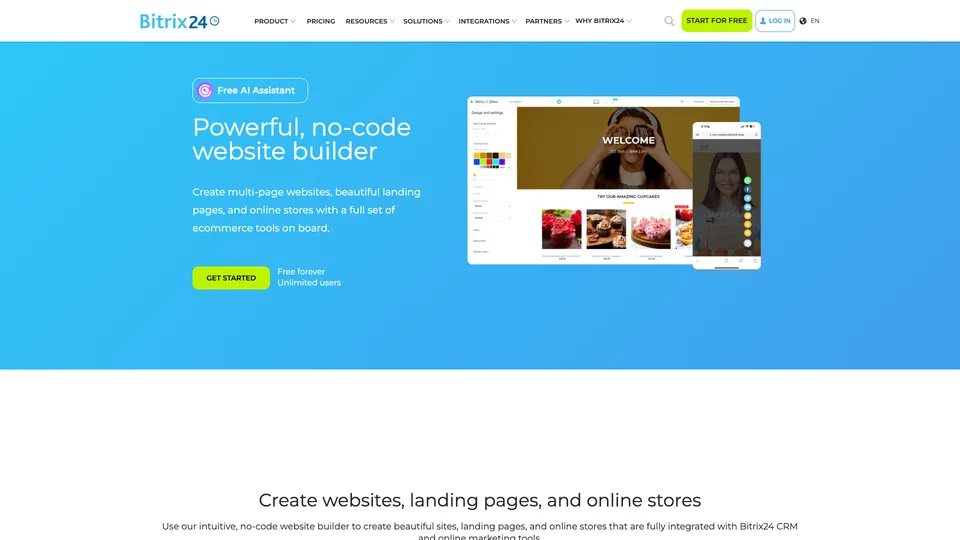
Bitrix24 brings together, in a single online workspace, a CRM, tasks, internal chat, video calls and a no-code website builder. You can put together a business website, a landing page or a small online store from ready-made blocks, with help from an AI assistant, and every form submission, phone call or chat message lands straight in the CRM as a lead or a deal. For a small or midsize business, the website is one building block among many rather than the heart of the product.
What is Bitrix24?
The name “Bitrix” covers two products that are easy to mix up. Bitrix24 is an online collaboration platform: you open an account and get a CRM, a project manager, a shared calendar, messaging, HR and automation tools, plus a “Sites and Stores” module. That module is built around a block editor: you pick a template, stack your sections, adjust colors and copy, then publish on the hosting provided. The CoPilot assistant can generate a first version of a website or landing page from a simple prompt, copy and images included. On the sales side, the module handles the catalog, inventory, orders, shipping and online payments, and everything that happens on the site feeds into the CRM.
1C-Bitrix: Site Management (“Управление сайтом”) is a true CMS, written in PHP, that you install on your own server or with a hosting provider. It is used to build corporate websites, portals and above all online stores, with a license bought once and then renewed every year to keep receiving updates. Deeply rooted in Russia, where it bills itself as the number one commercial CMS and claims more than 375,000 business customers and 14,000 partner agencies, it is sold only in rubles, in Russian-speaking markets. For an English-speaking reader, then, Bitrix24 is the product within reach, and it is the one this review covers.
Both products share the same origin: Bitrix, a company founded in 1998 by Sergey Ryzhikov and two partners, which in 2007 set up 1C-Bitrix, a 50/50 joint venture with the Russian software publisher 1C, based in Kaliningrad. Bitrix24 launched publicly in April 2012 and now says it has more than 15 million client organizations. Outside Russia, the service is provided by the Alaio companies, based in Cyprus for Europe and in the United States for most other countries, which exclude Russia and several neighboring countries from their territory.
Bitrix24 at a glance
- Type
- Online collaboration platform with a website builder
- Launched
- April 2012
- Created by
- Bitrix, founded in 1998 by Sergey Ryzhikov
- Origin
- Russia
- Provider in Europe
- Alaio Cloud Limited (Limassol, Cyprus)
- Client organizations
- More than 15 million (according to the company)
- Sister product
- 1C-Bitrix, a CMS sold in Russian-speaking markets
- Free plan
- Yes, 1 to 2 users, no publishing of new sites
- Starting price
- $49/month billed annually (5 users)
What is Bitrix24 used for?
-
Build a site without code
templates and blocks to assemble into a multi-page business website or a landing page, with a mobile preview.
-
Generate a first draft with AI
CoPilot suggests a structure, copy and images from a simple description of your business.
-
Open a small store
catalog, inventory, orders, shipping and online payments are managed in the same place as your customers.
-
Send every inquiry to the CRM
forms, calls and messages from the site’s chat become leads or deals followed up by your sales team.
-
Publish without shopping for hosting
hosting comes with the builder, and you publish straight from your Bitrix24 workspace.
-
Re-engage your visitors
email campaigns, Facebook or Google Ads advertising and automation workflows build on the contacts collected by the site.


Bitrix24 review
Worth a look
People rarely pick Bitrix24 for its website builder. They adopt it first as a CRM or an intranet, then discover that it can also put a website, a landing page or a small catalog online. That is the setting where it makes sense: the contact form, the chat and the callback button feed directly into the same customer records as emails and calls, with no connector to install and no extra tool to pay for.
On its own, the editor gets the job done without standing out. The templates and blocks are enough for a clean company website or a one-off campaign, but layout freedom and SEO options fall well short of what a real CMS like WordPress or a dedicated builder like Webflow or Wix offers. The site is also tightly tied to the subscription: when you move down to a lower plan, you sometimes have to unpublish sites or remove your custom HTML.
You also have to live with the whole package. The platform is very rich, and therefore dense: a small team that only wants a website can easily get lost in menus designed to run an entire company. The free plan, which the pricing page now limits to one or two users, no longer lets you publish new sites, so expect to pay at least $49 a month on an annual commitment. On the company side, support is often slow to respond and subscription renewals are hard to stop, which is a good reason to read the cancellation terms before signing up.
Strengths
- A website wired directly into the CRM, forms and chat, with no integration to plan.
- A flat price per company, not per user, which pays off as the team grows.
- An AI assistant that quickly produces a first draft of a site or landing page.
- Hosting, online store and payments included in the paid plans.
- An interface available in English, with a partner network for setup.
Weaknesses
- A builder that is less flexible and less complete for SEO than a CMS or a dedicated tool.
- No more publishing of new sites on the free plan.
- A dense platform that takes time to learn if all you want is a website.
- A site tied to the subscription: changing plans can force you to unpublish part of it.
- Slow support, and subscription cancellations that call for vigilance.
Is Bitrix24 worth it?
Yes, if your company already uses Bitrix24, or plans to, for sales and internal organization. The website then becomes a natural extension of the CRM: landing pages for a campaign, quote request forms, a small catalog, all with no additional subscription and with inquiries tracked from start to finish.
Not necessarily, if you mainly want a good-looking, well-ranked website that you can evolve freely. WordPress remains the most open choice, Wix or Squarespace the simplest for getting started on your own, Webflow the most flexible for a designer, and Shopify the most robust for a real online store. Companies in Russian-speaking markets that want a CMS installed on their own server will turn to 1C-Bitrix rather than Bitrix24.
How much does Bitrix24 cost?
Bitrix24 is priced per company, not per user: each plan includes a set number of users and amount of storage, billed monthly or with a discount of about 30% on an annual commitment. The website builder is part of the subscription at no extra cost.
| Plan | Per month | Per month, billed yearly | Users and storage | Who it's for |
|---|---|---|---|---|
| Free | $0 | — | 1 to 2 users, 5 GB | Trying the CRM and preparing a site without publishing it |
| Basic | $69 | $49 | 5 users, 24 GB | Freelancers and small teams who want a site connected to the CRM |
| Standard | $144 | $99 | 50 users, 100 GB | Small and midsize businesses adding email campaigns and advertising |
| Professional | $289 | $199 | 100 users, 1 TB | Companies relying on advanced automation |
| Enterprise | $579 | $399 | From 250 users, 3 TB | Large organizations and networks of subsidiaries |
Source: official Bitrix24 pricing page (US version), checked on October 31, 2026.
- A 15-day free trial of the higher plans can be activated from your account, with no credit card.
- The Enterprise plan scales in tiers up to 10,000 users, or $11,499 a month, $7,999 a month on an annual commitment.
- “Vibe+” plans, with unlimited AI and custom apps, cost from $89 a month (Basic) to $399 a month (Professional), less when billed annually.
- A version to install on your own servers, Bitrix24 On-Premise, is sold separately under an annual license, starting at 50 users.
- The 1C-Bitrix CMS is sold separately, in rubles, with a license from 7,100 to 1,950,000 rubles depending on the edition, then 25% of the price each year for updates.
FAQ
Answers to questions about Bitrix24
What is the difference between Bitrix24 and 1C-Bitrix?
Bitrix24 is an online platform that combines a CRM, project management, messaging and a website builder, sold by subscription worldwide. 1C-Bitrix Site Management is a CMS you install on your own server, bought as a license and aimed at Russian-speaking markets. Both come from the same original company.
Can you build a website for free with Bitrix24?
You can build and edit it on the Free plan, but publishing new sites is now blocked there. To put a site online, you need a paid plan, starting at $49 a month on an annual commitment.
Is the Bitrix24 website connected to the CRM?
Yes, that is its main advantage: forms, calls and chat messages from the site create leads or deals directly in the Bitrix24 CRM.
Is Bitrix24 a Russian tool?
The platform was created by the Russian company Bitrix, which became 1C-Bitrix. Outside Russia, it is provided by the Alaio companies, based in Cyprus for Europe and in the United States, and where your data is hosted depends on the domain zone chosen when you create the account: an account opened on bitrix24.com is hosted in the United States, one on bitrix24.eu in Germany. It is a choice to make when you sign up.
Information checked on October 31, 2026