
- Website creation
- CMS
Drupal: the open source CMS for building complex, custom websites
Good tool
Drupal is a free, open source content management system designed for websites that go well beyond a simple brochure site: government portals, university websites, media outlets, multilingual platforms or intranets where every content type, every role and every translation has to be organized precisely. You install it on your own server, model your content, then assemble the site from modules. Far less widespread than WordPress, it has carved out a solid place with government agencies, large organizations and the agencies that work for them.
What is Drupal?
Where other CMSs start from a blog, Drupal starts from a toolbox. Written in PHP on the Symfony framework, it stores everything in a database (MySQL, MariaDB, PostgreSQL or SQLite) and lets you define your own content types, with their fields, taxonomies, access rights and approval workflows. Multilingual support, fine-grained role management and an API to deliver content to an app or another website are built in from the start, and thousands of modules round out the package. The flip side is that a Drupal site is built more than it is installed: you need PHP hosting, Composer to manage dependencies and, in most cases, a developer.
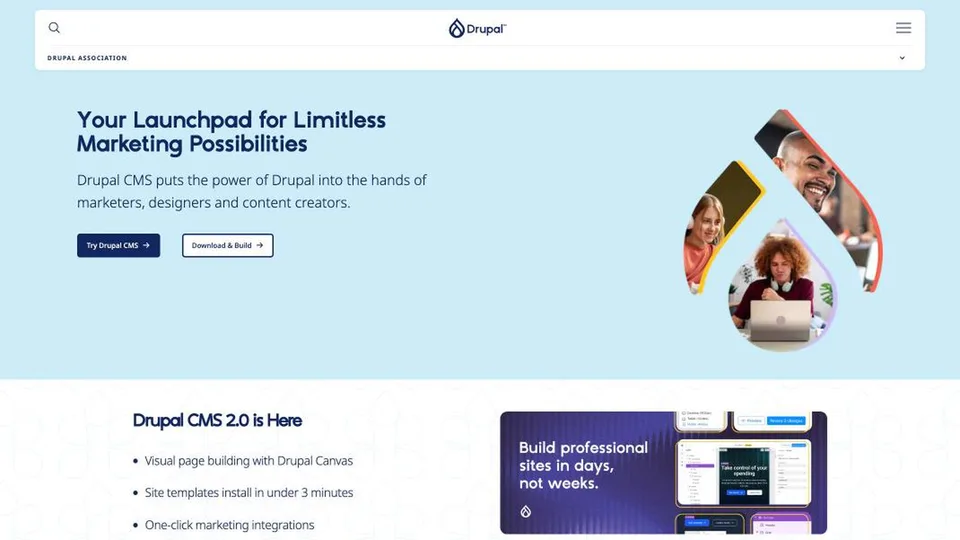
To make the software more approachable, the project has offered Drupal CMS since January 15, 2025, a ready-to-use version aimed at marketing teams and site builders. Its version 2.0, released in January 2026, added Drupal Canvas, a visual page builder, along with site templates you can install in minutes, “recipes” of preconfigured modules and optional artificial intelligence tools. Drupal core, the bare foundation, remains meant for developers starting from a blank page; its 11 branch is the stable release, and Drupal 12 was in beta at the end of October 2026.
The project dates back to 2001. Dries Buytaert first wrote it as a student at the University of Antwerp, to run a small message board among friends; the name comes from the Dutch word druppel, meaning drop, hence the logo. Drupal is distributed under the GPL, developed by a large community of contributors and companies, and supported by the Drupal Association, a nonprofit based in Portland, Oregon. According to W3Techs, it powers 0.6% of websites as of October 31, 2026.
Drupal at a glance
- Type
- Self-hosted open source CMS (PHP, Symfony)
- Founded
- 2001
- Founder
- Dries Buytaert
- Origin
- Belgium
- Project backer
- Drupal Association, Portland (United States)
- License
- GPL v2 or later
- Market share
- 0.6% of websites (W3Techs, October 2026)
- Free plan
- Yes, the entire software
- Starting price
- Free, excluding hosting and development
What is Drupal used for?
-
Build a custom website
content types, fields, views and menus are defined in the admin, and Drupal Canvas lets you assemble pages visually.
-
Publish in several languages
the interface, content and menus can be translated without a paid extension, with a version per language for every page.
-
Organize editorial work
detailed roles and permissions, drafts, approval workflows and revision history for large teams.
-
Deliver your content through an API
JSON:API and REST let you feed a mobile app, another website or a separate front end from the same back office.
-
Rely on AI, if you want to
Drupal CMS offers optional AI tools to write or structure content, with rules to govern how they are used.
-
Add a store
modules such as Drupal Commerce bolt a catalog, cart and payments onto an existing site, for projects where content stays central.


Drupal review
Good tool
Drupal is excellent software, best handled as a construction tool rather than a turnkey publishing tool. Its structure is its strength. When a site has to manage dozens of content types, several languages, different permissions for different departments and content reused elsewhere through an API, it holds up where a simpler CMS ends in a pile of plugins. That explains its presence at universities, government agencies and large enterprises, which also find a serious security policy, with a dedicated team and regularly published fixes.
You do, however, have to accept its complexity, which is not just a perception. There are many concepts to master, the admin remains less intuitive than that of its mainstream competitors, and even an experienced developer needs time to get back up to speed when returning to a project left aside. Drupal CMS and its Canvas builder are a step in the right direction and make getting started smoother, but they don’t turn it into a tool for beginners.
The software is free; the project isn’t. The real budget lies in development, hosting and above all maintenance: security updates, major version upgrades and modules to keep up with, not to mention the need to keep a service provider on hand who knows the tool, and there are fewer of them than for WordPress. For a small brochure site run by someone without technical skills, it is clearly overkill. For an institutional website meant to last and grow, it is one of the most solid open source foundations on the market.
Strengths
- Very fine-grained content modeling: types, fields, taxonomies and views without hacks.
- Built-in multilingual support, roles and approval workflows, up to the needs of large organizations.
- A built-in API that makes it a good back office for an app or a decoupled site.
- A dedicated security team and regularly published fixes.
- Free and open source, with no license fee, and site templates that are free too.
- Drupal CMS and Canvas, which finally make getting started more accessible.
Weaknesses
- A steep learning curve, even for PHP developers.
- A project that almost always requires a developer or a specialized agency.
- Major version upgrades and maintenance to budget for over time.
- A much smaller pool of service providers and themes than WordPress.
- Overkill for a blog or a small brochure site.
Is Drupal worth it?
Yes, if you are planning a content-rich website that is meant to last: an institutional site, a university, a local government, a media outlet, a multilingual platform or an intranet, with several teams publishing and security or accessibility requirements. It is also a good choice as the back office for an app or a separate front end, provided you have a technical team or an agency used to the tool.
Not necessarily, if you want a brochure site, a blog or a small store that you manage yourself: the development time and budget aren’t justified. WordPress, also free, does the job with a much larger ecosystem, and hosted services such as Wix, Squarespace or Webflow spare you any technical maintenance.
Alternatives: WordPress for most websites, Joomla and TYPO3 among other open source CMSs of comparable scale (TYPO3 is also popular with large organizations), Webflow for a custom site with no server to manage, and headless CMSs such as Contentful or Strapi for a decoupled architecture.
How much does Drupal cost?
Drupal sells no subscription: Drupal CMS and Drupal core alike can be downloaded for free from drupal.org, with no limit on sites, users or pages. The cost of a project lies in what you need to add around it: PHP-compatible hosting, a domain name, building the site and maintaining it, which weigh much more than with a simpler CMS.
| Plan | Per month | Included | Who it's for |
|---|---|---|---|
| Drupal CMS | $0 | Ready-to-use Drupal: Canvas, site templates, recipes, optional AI | Marketing teams, site builders, agencies |
| Drupal core | $0 | The bare foundation of the software, assembled module by module | Developers and custom projects |
Source: official Drupal download page, checked on October 31, 2026.
- The site templates offered on drupal.org were all free as of October 31, 2026.
- Drupal CMS can be tried online from drupal.org or with a desktop app, without installing a server.
- As an optional security add-on, Drupal Steward is a paid Drupal Association service that blocks certain critical vulnerabilities until you can update; its price depends on traffic, under $20 a month at around one million requests a month.
- Hosting, development and maintenance are paid separately, to a hosting provider or an agency. Large organizations often turn to Drupal-focused hosts such as Acquia, founded by the project’s creator, Pantheon or Platform.sh, whose plans have nothing in common with shared hosting.
FAQ
Answers to questions about Drupal
Is Drupal free?
Yes. The software is open source, under the GPL, and can be downloaded for free, whether Drupal CMS or Drupal core. You do, however, have to pay for hosting, the domain name and, most of the time, building and maintaining the site.
What is the difference between Drupal CMS and Drupal core?
Drupal core is the foundation of the software, which developers extend module by module. Drupal CMS, launched in January 2025, is a ready-to-use version built on that foundation, with a visual page builder (Canvas), site templates and default settings to get started faster.
Drupal or WordPress?
WordPress suits most websites and is much quicker to learn, with far more themes, plugins and service providers. Drupal makes sense for complex projects: many content types, advanced multilingual needs, permissions by department, content delivered through an API.
Do you need to know how to code to use Drupal?
To publish content on a site that is already built, no. To create the site, host it and maintain it, technical skills are almost always needed, even though Drupal CMS and Canvas make the first steps easier.
Who uses Drupal?
Mostly government agencies, universities, media outlets and large organizations, for whom content modeling, multilingual support and permissions by department matter more than a quick start. Its market share, modest next to WordPress, reflects this niche positioning.
Information checked on October 31, 2026