
- Website creation
- CMS
Joomla: the open-source CMS for structured, multilingual websites
Worth a look
Joomla is a free, open-source content management system (CMS): you install it on your own hosting to build and run a website, whether it is a business site, a nonprofit portal, an intranet or an institutional site in several languages. Where others rely on extensions, it ships out of the box with multilingual management, fine-grained access rights by user group and custom fields. Long one of the big names in open-source web software alongside WordPress and Drupal, it now holds a more modest place, but keeps a loyal community among web developers and public bodies.
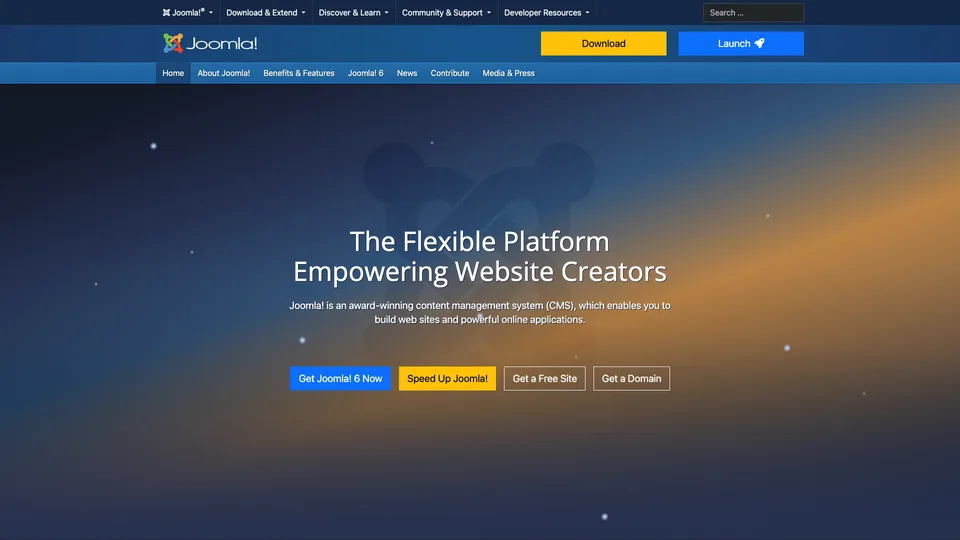
What is Joomla?
Technically, Joomla is a PHP application backed by a MySQL, MariaDB or PostgreSQL database, which you upload to a web server. The site is managed from a separate admin interface, where you organize articles into categories, build pages with modules placed in the template’s positions and set up menus that decide what appears at each URL. Everything sits on a model-view-controller architecture, so Joomla also works as a framework for building full-fledged web applications. The core natively handles multiple languages, user groups with their access levels, a content approval workflow and, since version 6.1, a visual editor for that workflow. For everything else, the official extensions directory lists several thousand components, modules and templates, most of them free, some commercial.
The project was born in August 2005, when most of Mambo’s development team left that CMS over a disagreement with the new structure imposed by the trademark holder. Andrew Eddie, who took the lead, Brian Teeman, Johan Janssens and Jean-Marie Simonet are among the co-founders. The name comes from the Swahili word jumla, “all together.” Joomla is developed by volunteers under the GNU GPL, and its name and trademarks belong to Open Source Matters, Inc., which provides the project with legal, organizational and financial support. Releases come at a steady pace: Joomla 6 came out in October 2025, version 6.2 on October 13, 2026, the same day as the final bug-fix release of the 5.x branch.
Joomla at a glance
- Type
- Open-source CMS to install on your own hosting
- Founded
- 2005, fork of the Mambo CMS
- Co-founders
- Andrew Eddie, Brian Teeman, Johan Janssens, Jean-Marie Simonet…
- Trademark owner
- Open Source Matters, Inc.
- License
- GNU GPL v2 or later
- Technology
- PHP and MySQL
- Share of websites
- 1.1% (W3Techs, 10/31/2026)
- Free plan
- Yes, the entire software
- Starting price
- Free (hosting extra)
What is Joomla used for?
-
Build and manage your site
articles organized into categories, menus, modules and templates, all run from a dedicated admin interface.
-
Publish in several languages
the core links each article, menu or module to its translations, with no extension to add.
-
Assign your team’s permissions
user groups and precise access levels to decide who writes, who approves and who sees what.
-
Organize content approval
a configurable publishing workflow that version 6.1 lets you map out in a visual editor.
-
Take care of your SEO
readable URLs, title and description tags for each page, built-in redirects; an XML sitemap, however, requires an extension.
-
Extend your site
several thousand extensions and templates to add a store, a directory, forms or a members’ area.
-
Try it without hosting
Joomla Launch puts a free site online on a subdomain, to be renewed every 30 days.


Joomla review
Worth a look
On paper, Joomla covers out of the box many needs that WordPress leaves to extensions. A site in three languages, a members-only area, an editorial team that separates authors, reviewers and editors: all of that can be built with the core software alone, without stacking third-party modules whose compatibility you will then have to keep an eye on. For a nonprofit, a local government body or a small business managing lots of content and varied permissions, that is a real comfort, and the software has gained polish over versions 5 and 6.
That richness comes at the price of complexity. The logic of menus, modules and positions takes some getting used to, more than with all-in-one website builders or even WordPress. Joomla is aimed first at web developers, or at site owners willing to roll up their sleeves in the admin panel.
The trickiest issue is its weight in the market. With about one website in a hundred, Joomla has lost much of its audience, and it shows: fewer recent templates, extensions whose developers have thrown in the towel, fewer agencies able to take over a site. Major version upgrades were painful for a long time, the move from 3 to 4 above all, when entire extensions stopped working. The project has learned its lesson, since the jump from 5.4 to 6 is presented as a simple upgrade, but you should still check your extensions before switching branches.
Free, yes, but not without cost: a serious Joomla site needs hosting, regular updates and often a paid template or a few paid extensions. The hosted trial offer is handy for discovering the tool, much less so for a production site.
Strengths
- Multilingual support, access rights and custom fields available right after installation.
- Free, open-source software, with no license or mandatory subscription.
- A content approval workflow suited to editorial teams.
- A project that is still active, with regular releases and an upgrade from 5 to 6 without migration.
- A free trial site in minutes with Joomla Launch.
Weaknesses
- A steeper learning curve than WordPress or a website builder.
- A small market share, which means fewer templates, extensions and agencies.
- Abandoned extensions that can block a major upgrade.
- Hosting, security and backups remain your responsibility.
- A trial offer limited to 500 MB that has to be renewed manually every 30 days.
Is Joomla worth it?
Yes, if your site needs to run in several languages, assign user permissions precisely or serve as the foundation for a small application, and you or your web developer already know Joomla. It is also a logical choice for evolving an existing site rather than rebuilding everything elsewhere.
Not necessarily, if you are starting from scratch with no technical skills and no regular developer. WordPress offers far more themes, extensions and agencies for a comparable use; Drupal goes further for very large structured sites, at the cost of more complexity; and a website builder like Wix or Squarespace spares you all maintenance if you simply want a business site online.
How much does Joomla cost?
The software costs nothing: Joomla can be downloaded freely and installed on the hosting of your choice, which you pay for separately, along with the domain name and any commercial templates or extensions. The project also offers Joomla Launch, a free hosted offer for trying the tool, run by the hosting company CloudAccess.net, with a paid upgrade priced in dollars.
| Plan | Per month | Included | Who it's for |
|---|---|---|---|
| Joomla software | $0 | The full CMS to install, hosting not included | Any production website |
| Joomla Launch free | $0 | .joomla.com subdomain, 500 MB, FTP and phpMyAdmin, renewal every 30 days | Discovering the tool, mockups |
| Joomla Launch upgraded | $5 | No storage or subdomain limits, backups, domain name, SSL, support | A small hosted site without managing a server |
Source: official Joomla Launch pricing page, checked on October 31, 2026.
- The upgrade is advertised “from” $5 a month, presented as a discount from $10.
- The Launch offer is run by CloudAccess.net, an independent hosting company that uses the Joomla trademark under license; signing up requires a phone number.
- Outside Launch, the cost of a site depends on the hosting company you choose and on any paid extensions or templates you add.
FAQ
Answers to questions about Joomla
Is Joomla really free?
Yes, the software is free and open source, under the GNU GPL. You still pay for hosting, the domain name and, if needed, commercial templates or extensions.
Joomla or WordPress?
Joomla comes with built-in multilingual support and detailed access rights, useful for institutional sites or sites with a members’ area. WordPress is easier to learn and has a much larger ecosystem of themes, extensions and agencies.
Is Joomla still maintained?
Yes. Joomla 6 came out in October 2025 and version 6.2 on October 13, 2026. The 5.x branch received its final bug-fix release the same day; it will only get security fixes for one more year. It is best to plan the move to Joomla 6 before then, after checking your extensions.
Can you try Joomla without hosting?
Yes, with Joomla Launch: a free site on a .joomla.com subdomain, limited to 500 MB and renewable every 30 days, with a paid upgrade starting at $5 a month.
Information checked on October 31, 2026