
- Website creation
- CMS
TYPO3: the open source CMS for running large multilingual websites
Good tool
For running a corporate website in several languages, or a whole family of sites from a single installation, TYPO3 is one of the few open source CMSs designed for that job from the start. Editors manage their pages in a tree, with permissions set down to the individual field and, if needed, an approval workflow before publishing; developers extend it with extensions and templates. Very well established in German-speaking countries, it remains a specialist’s choice elsewhere, far behind WordPress in number of sites.
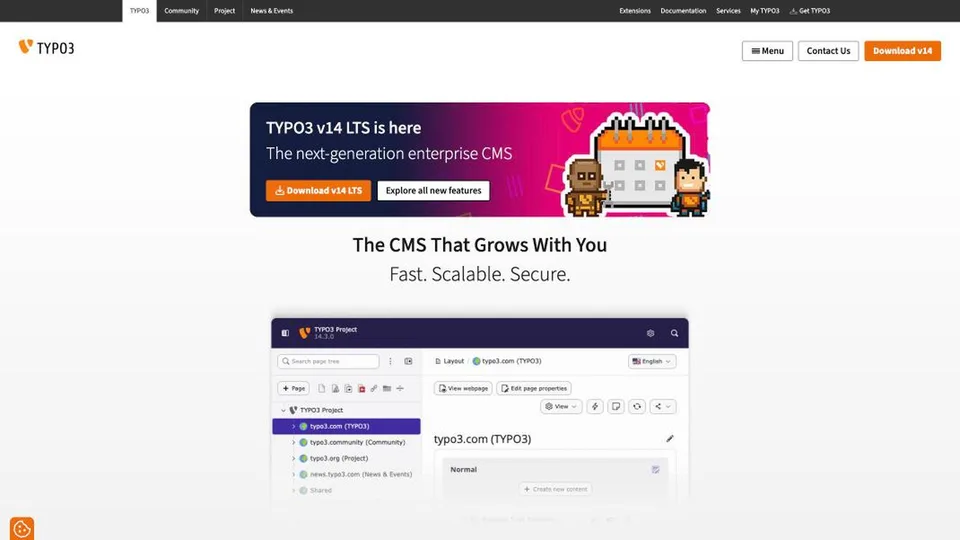
What is TYPO3?
TYPO3 is installed on a server, like WordPress or Drupal: it is a PHP application that runs on MySQL, MariaDB or PostgreSQL, which you host yourself or with a provider. Everything is organized around a page tree, always visible in the admin interface; each page holds content elements, and each language is attached to the original page as a translation. A single installation can run several websites, each with its own domain. Permissions are set precisely by user group, down to the fields an editor is allowed to change, and the Workspaces extension adds drafts and review stages before going live. On the technical side, rendering goes through Fluid templates and TypoScript, a configuration language specific to TYPO3, which accounts for its power as much as its reputation for being difficult.
The software was written from 1997 onward by Dane Kasper Skårhøj, then released in 1998 under the open source GPL license. When its creator stepped back in 2004, the TYPO3 Association took over: a nonprofit based in Baar, Switzerland, with about 1,100 members, which funds development. In 2016, it founded TYPO3 GmbH, its services subsidiary based in Düsseldorf, which notably sells extended support for older versions. The project ships a long-term support (LTS) release roughly every eighteen months: v14 LTS, released on April 21, 2026, brought a redesigned admin interface, a ready-to-use theme and a translation assistant, and receives security fixes until June 30, 2029. Adoption remains limited: according to W3Techs, as of October 31, 2026, TYPO3 powered about 0.5% of websites whose CMS can be identified, or 0.3% of all websites.
TYPO3 at a glance
- Type
- Open source, self-hosted CMS (PHP)
- Created
- 1997, first public release in 1998
- Creator
- Kasper Skårhøj
- Origin
- Denmark
- Governance
- TYPO3 Association, Baar (Switzerland)
- Services company
- TYPO3 GmbH, Düsseldorf (Germany)
- License
- GNU GPL v2 or later
- Free version
- Yes, the entire software
- Starting price
- Free; extended support from €2,800 a year
What is TYPO3 used for?
-
Build a custom website
a page tree, content elements and Fluid templates that your developers adapt to your brand guidelines.
-
Publish in several languages
each page is translated in the interface, with a translation assistant since v14 and the option to plug in a machine translation service.
-
Get approval before publishing
drafts and review stages thanks to the Workspaces extension, so nothing goes live without sign-off.
-
Manage several sites from one installation
a single installation runs several domains, with shared or separate content and users.
-
Extend it with extensions
forms, news, search, JSON output for a decoupled front end: the extension repository covers most needs.
-
Keep a site up to date for years
three years of free fixes per LTS release, then paid extended support if the migration has to wait.


TYPO3 review
Good tool
TYPO3 is a serious CMS, and that is both its strength and its limitation. On an institutional website with dozens of editors, several languages and approval rules, it does what you expect without workarounds: precise permissions, a readable page tree, versions maintained for three years. Few open source solutions offer that level of control without turning to a proprietary suite billed by license.
TypoScript, site configuration and the extension system do, however, demand real expertise; a developer coming from WordPress will need time to find their way around, and major version upgrades are a project in themselves. In practice, a TYPO3 site is almost always entrusted to a specialized agency, which weighs more heavily on the budget than the software itself, which is free.
Geography also matters in the decision. In Germany, Austria or Switzerland, there is no shortage of providers and it is the obvious choice for many institutions. Elsewhere, they are much scarcer and the community smaller: something to weigh before committing for years.
As for extended support, it helps organizations that can’t migrate in time, but its cost, several thousand euros per year per installation, is mostly an argument for keeping pace with new versions.
Strengths
- Free, open source software, with no license to pay however many sites you run.
- Multilingual and multisite out of the box, with no extension to add.
- Very fine-grained permissions and an approval workflow suited to large teams.
- Predictable LTS releases, maintained for three years, with extended support available afterward.
- A project governed by a nonprofit association, with no single vendor dictating its roadmap.
Weaknesses
- A steep learning curve, with TypoScript and TYPO3-specific configuration.
- Providers and a community that are mostly German-speaking, and scarcer elsewhere.
- Major version upgrades that require a real development budget.
- Oversized for a brochure site or a blog run by a single person.
- Expensive extended support, billed per installation per year.
Is TYPO3 worth it?
Yes, if you run a website for a company, university or public body with many pages, several languages and several departments publishing, you have an agency or a technical team that knows the tool, and you want to stay on open source software hosted on your own infrastructure.
Not necessarily, if your site has a few dozen pages, you want to do everything yourself or there is no TYPO3 provider near you. WordPress covers those needs with a much larger ecosystem, and a hosted website builder like Webflow spares you any server maintenance. For a project of the same scale, Drupal remains the most direct open source alternative, with a more international community; on the proprietary side, enterprise CMSs such as Adobe Experience Manager target the same organizations, at a very different price.
How much does TYPO3 cost?
The software costs nothing: TYPO3 is a free download, with no limit on sites or users. The spending comes from elsewhere: hosting, development and maintenance by a provider, and the extended support (ELTS) that TYPO3 GmbH sells in euros for versions whose free maintenance has ended.
| Plan | Per month | Per month, billed yearly | Included | Who it's for |
|---|---|---|---|---|
| TYPO3 CMS | €0 | — | The complete software and three years of fixes per LTS release | Every project that keeps up with updates |
| ELTS TYPO3 12 | — | €266.67 | Security and compatibility fixes until April 30, 2030 | Sites still on v12 after April 2026 |
| ELTS TYPO3 10 and 11 | — | €233.33 | Security and compatibility fixes until October 31, 2027 for v11 (one more year through a partner); v10 in its final year, reserved for partners, until April 30, 2027 | Older sites awaiting migration |
Source: official TYPO3 GmbH pricing, checked on October 31, 2026. TYPO3 GmbH publishes its prices in euros only.
- Price per license per year: €3,200 for v12, €2,800 for v10 and v11. The v12 price applies for the entire extended support period.
- One license covers one installation, including test and development environments, even if it runs several sites; twelve sites installed separately require twelve licenses.
- Silver, Gold and Platinum members get discounts of 25%, 30% and 45%.
- Support is booked in periods of one, two or three years at a time; a fourth year is reserved for TYPO3 partners.
FAQ
Answers to questions about TYPO3
Is TYPO3 free?
Yes. The software is released under the GPL license and can be downloaded at no cost, with no limit on sites. Costs come from hosting, development and, for older versions, the paid extended support from TYPO3 GmbH, starting at €2,800 per year per installation.
How long is a TYPO3 version maintained?
Each LTS release receives free fixes for about three years. v14 LTS, released on April 21, 2026, is covered until June 30, 2029. After that, you need to migrate or sign up for extended support (ELTS).
TYPO3 or WordPress?
WordPress is quicker to learn and relies on a far richer ecosystem: for a brochure site or a blog, it is the most natural choice. TYPO3 makes sense for large multilingual sites, with many editors and approval rules, provided you have a specialized provider.
Who develops TYPO3?
A community of developers, overseen by the TYPO3 Association, a nonprofit based in Baar, Switzerland. Its subsidiary TYPO3 GmbH, in Düsseldorf, sells commercial services around the software, including extended support.
Information checked on October 31, 2026