
- Deliverability and diagnostics
Spamhaus: find out if your IP or domain is blacklisted, and get off the list
Reference
When emails bounce back with a rejection message that mentions Spamhaus, its website is where you need to go. Spamhaus publishes the blocklists that a large share of mail servers check to sort incoming mail, and provides a free checker: you enter an IP address or a domain name and see whether it appears on one of its lists, for what reason, and how to request removal. It is not software you buy but a benchmark of email deliverability: a sender’s reputation depends directly on its verdict.
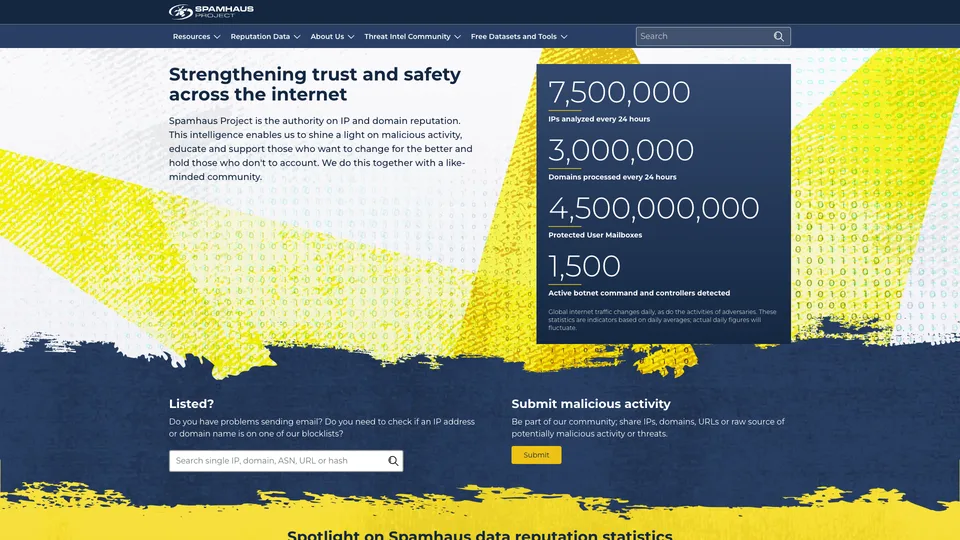
What is Spamhaus?
Behind the name lie, first and foremost, DNS blocklists (DNSBLs). When a server receives a message, it queries these lists in a few milliseconds: if the sender’s IP address or a domain in the message is listed, the mail is rejected, sent to spam or scored more harshly. Each list has its own role. The SBL covers addresses and ranges tied to spam, malicious hosting or botnet command-and-control servers, based on investigations by a team of researchers; it includes the CSS, generated automatically from IPs that send low-reputation mail. The XBL lists compromised machines (malware, open proxies, brute-force login attempts). The PBL groups consumer address ranges that should not send mail directly: being on it is not an accusation, just a sign that you need to go through an authenticated mail server. The DBL, for its part, only targets domain names linked to spam, phishing or malware, including hacked legitimate sites. The ZEN zone combines all the IP address lists into a single query, and the DROP list flags entire networks that should not be routed.
For a sender, the everyday tool is the IP and Domain Reputation Checker (check.spamhaus.org): it shows which list a resource is on, why, and opens the removal form. Delisting is free, and it is the only place to request it for the XBL, CSS, PBL and DBL. It is only granted once the cause has been fixed; otherwise, the address goes straight back on the list. Automatic listings expire on their own once the activity stops (about three days after the last detection for the CSS); for the SBL, it is the hosting provider or ISP responsible for the address that must contact the Spamhaus team.
The project was born in 1998 in London, launched by Steve Linford. The Spamhaus Project, a nonprofit organization now based in Andorra, maintains the lists and the free tools, while Spamhaus Technology, based in London, sells access to the data to businesses and has partnered with abuse.ch, a malware specialist. The organization says it protects 4.5 billion mailboxes and has repeatedly been targeted by spammers, both in court and through a large-scale cyberattack in 2013.
Spamhaus at a glance
- Type
- Anti-spam blocklists (DNSBL)
- Founded
- 1998
- Founder
- Steve Linford
- Origin
- London, United Kingdom
- Headquarters
- Andorra (The Spamhaus Project)
- Commercial arm
- Spamhaus Technology, London
- Status
- Nonprofit organization
- Free plan
- Free checks and delisting for everyone
- Starting price
- Quote-based for commercial use
What is Spamhaus used for?
-
Check an IP or a domain
the checker tells you whether your sending server or your domain is on one of the lists, and which one.
-
Request removal from a list
once the cause is fixed, the removal form is free and handled directly for the XBL, CSS, PBL and DBL.
-
Understand why your emails are rejected
every listing comes with its reason, which helps trace the real cause: an infected machine, sending from a consumer connection, a poorly maintained contact list, or a domain cited in the message body (a link shortener, an email platform’s tracking domain) that is on the DBL even though yours is not at fault.
-
Vet an IP before using it
before sending from a new server, it is wise to check that its address has not inherited a previous customer’s bad reputation.
-
Filter incoming mail
the lists can be queried from your mail server or through SpamAssassin and Rspamd, for free for modest non-commercial use, ideally with a DQS key obtained through a free account: the public mirrors return an error code when there are too many queries or when they come through a public DNS resolver.
-
Follow reputation statistics
public rankings by country, network, domain extension and registrar, updated every month.


Spamhaus review
Reference
Nobody really chooses Spamhaus: you discover it, often on the day a client reports that a message never arrived. Its lists are among the most widely checked by mail servers, and they are the first ones to watch when you send email. Dozens of other blacklists exist, but few of them weigh as heavily on a message’s fate.
The checker does its job well: free and fast, it gives the list involved and a reason. But you have to know how to read it. A PBL listing is not a penalty, just a reminder that a consumer address should not send on its own; an XBL listing almost always points to a compromised machine on the network, not a dishonest sender. For the XBL, requesting removal without cleaning up the machine is pointless; for the PBL, an exclusion is simple to request, provided you run a real mail server on a static address with consistent reverse DNS.
Spamhaus is also demanding, and it does not always distinguish between the sender and its neighbors. A shared IP at a hosting provider, a range of addresses with a bad crowd or a few poorly targeted sends can be enough to get listed. When the listing falls under the SBL, you have to go through your hosting provider, and the exchange with the team can be long and short on explanations. Better to know this before picking a cheap sending server.
The paid offer is not aimed at senders. It targets businesses that filter mail at scale, ISPs, hosting providers or anti-spam vendors, and its prices are only available on quote.
Strengths
- A benchmark followed by a large share of mail servers: its verdict genuinely affects deliverability.
- Free checks and delisting, open to everyone, with no subscription.
- Separate lists, each with a specific reason, that point to the real cause of the problem.
- Automatic listings that expire on their own once the activity stops.
- Free lists to filter your own mail, as long as use stays non-commercial and modest.
Weaknesses
- Strict criteria: good-faith senders get listed because of a shared IP or a neighboring range.
- Listing triggers that are not published in detail.
- Getting off the SBL goes through the hosting provider and can take time.
- No technical support for free accounts.
- No published price for commercial use, only quotes.
Is Spamhaus worth it?
Yes, if you send email from your own server or a dedicated IP, if your messages start getting rejected, or if you manage a company’s email. A Spamhaus check is one of the first things to do, just like a configuration test with Mail-tester, and it costs nothing.
Not necessarily, if you use an email platform such as Brevo or Mailchimp: it manages the reputation of its own servers, and your leverage lies more in domain authentication and the quality of your list. For an overview, MXToolbox queries dozens of blacklists at once, and Google Postmaster Tools shows how Gmail sees your domain. As for the Spamhaus subscription, it only makes sense to filter incoming mail at the scale of a company or a provider.
How much does Spamhaus cost?
Everything a sender needs is free: the IP and domain checker as well as removal requests. Querying the lists to filter your own mail is also free for individuals and small non-commercial organizations with low volumes. Beyond that, commercial access, now called “Blocklists via DNS Query” (formerly Data Query Service), is billed by query volume, with no published price list.
| Plan | Per month | Included | Who it's for |
|---|---|---|---|
| Free | $0 | Checker, delisting, list queries for modest non-commercial use (excluding the HBL list) | Senders, individuals, small non-commercial organizations |
| Blocklists via DNS Query (commercial) | Custom pricing | All lists, including the HBL, for a set query volume | Businesses, hosting providers, ISPs, anti-spam vendors |
Source: official Spamhaus pricing page, checked on October 31, 2026.
- The commercial offer starts with a free 30-day trial, with no credit card; the price is then set based on the number of users and the query volume actually observed.
- Free use of the lists is subject to a fair use policy: no commercial use, a reasonable volume and identifiable queries, which rules out public DNS resolvers that mask where queries come from.
- Removal from a list never costs anything: any offer of paid delisting is a scam.
FAQ
Answers to questions about Spamhaus
How do I know if my IP is listed by Spamhaus?
Just enter the IP address or domain name into Spamhaus’s free checker (IP and Domain Reputation Checker). It shows the list involved, the reason and, where applicable, the steps to request removal.
Does removal from a Spamhaus list cost money?
No. Removal is always free, and Spamhaus states that anyone offering delisting for a fee is a scammer. You do, however, need to have fixed the cause of the listing, or the address will be listed again.
What is the difference between the SBL, XBL, PBL and DBL?
The SBL targets spam sources and malicious networks, the XBL compromised machines, the PBL consumer addresses that should not send mail directly, and the DBL domain names with a bad reputation. The ZEN zone combines the IP address lists.
My IP is on the PBL: am I considered a spammer?
No. The PBL only indicates that the address belongs to a consumer range, which should go through an authenticated mail server. If you run a real mail server on a static IP with consistent reverse DNS, you can ask for it to be excluded.
How much does commercial access to Spamhaus cost?
Spamhaus does not publish prices. After a free 30-day trial, the price is set by quote based on the number of users and the query volume.
Information checked on October 31, 2026