
- SEO
- SEO suites
- Backlinks
Moz: the SEO suite that invented Domain Authority
Good tool
Domain Authority: even people who have never opened Moz know this 1-to-100 score, which has become one of the most quoted benchmarks in SEO for sizing up a website’s strength. Moz Pro, the company’s paid suite, builds the classic SEO tools around it: keyword research, link analysis, rank tracking, technical audits and, more recently, tracking how visible a brand is in AI assistants. Its free toolbar, the MozBar, shows these metrics on any page you visit. Less exhaustive than the industry heavyweights, the suite remains one of the easiest to get started with.
What is Moz?
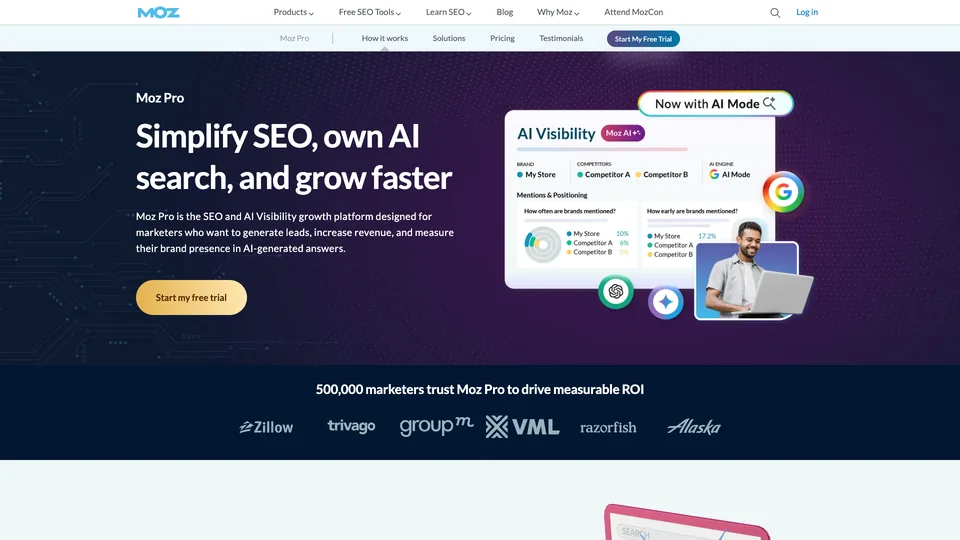
Moz Pro is online software (SaaS) organized into “campaigns”: one per tracked site, with up to three competitors alongside. Within each campaign, the tool tracks rankings for the keywords you choose, crawls the site’s pages every week to spot technical errors and pulls everything together into a dashboard and scheduled reports. Alongside, standalone research modules let you study any domain: Keyword Explorer, which claims more than 1.25 billion keywords, and Link Explorer, backed by an index of more than 40 trillion links. Recent plans add an AI visibility dashboard that tracks prompts in ChatGPT, Gemini and Google’s AI Mode.
Domain Authority is the company’s trademark. Calculated by a machine learning model, mainly from the number and quality of domains linking to a site, it estimates a domain’s ability to rank against its competitors. Moz says so itself: it isn’t a Google ranking factor, but a relative indicator, useful for comparisons. Page Authority applies the same logic to a single page; Spam Score estimates, based on a site’s characteristics, the share of comparable sites Moz has seen penalized by Google, a probability rather than a verdict; and Brand Authority measures how well known a brand is. These scores can be checked for free with a Moz Community account, in Link Explorer and in the MozBar, an extension for Chrome and Firefox installed by 900,000 users on Chrome. The API is sold separately.
The company was born in 2004, as SEOmoz, from a blog launched by Rand Fishkin and Gillian Muessig. Its guides, such as the Beginner’s Guide to SEO, and its Whiteboard Friday videos made it one of the great schools of SEO, before consulting gave way to software. Renamed Moz in 2013, it acquired STAT, a rank-tracking specialist for enterprise clients, in 2018, and was then bought in 2021 by iContact, a subsidiary of the American group J2 Global, now Ziff Davis, for an undisclosed amount.
Moz at a glance
- Type
- Online software (SaaS)
- Founded
- 2004, as SEOmoz
- Founders
- Rand Fishkin and Gillian Muessig
- Nationality
- American
- Headquarters
- Seattle, United States
- Owner
- Ziff Davis, since 2021
- Signature metric
- Domain Authority (1 to 100)
- Free plan
- Yes, free account and MozBar
- Starting price
- $49/month
What is Moz used for?
-
Gauge a site’s authority
Domain Authority, Page Authority and Spam Score show at a glance how strong and trustworthy a domain’s link profile is.
-
Analyze backlinks
Link Explorer lists inbound links, referring domains, anchor text and referring domains gained or lost, for your site and for your competitors’.
-
Find keywords
Keyword Explorer estimates the volume, difficulty and click-through rate of each query, and groups suggestions by search intent.
-
Track your rankings
each campaign records your rankings and those of three competitors, on desktop and mobile.
-
Audit your site
Site Crawl explores your pages every week and ranks technical errors by priority, with advice on how to fix them.
-
Analyze a page from your browser
the MozBar shows the metrics of every page you visit, highlights followed and nofollow links, and checks schema markup, hreflang and robots.txt.
-
Measure your presence in AI answers
dashboards show whether ChatGPT, Gemini or Google’s AI Mode cite your brand.
-
Report to your clients
scheduled reports and, from the Medium plan up, white-label reports.


Moz review
Good tool
For a long time, Moz was where people learned SEO, and it shows in the tool. The interface is clear, campaigns guide you step by step, and every audit error comes with an explanation: for a small business, a freelancer or a small marketing team new to SEO, it is one of the easiest suites to adopt. The dashboard gives a readable overview, and automated reports are more than enough to monitor a site or report to a client.
Its limits come down to the size of its databases. Its keyword database is thinner than Semrush’s or Ahrefs’, especially for long-tail keywords and niches, and its link index, while very large, lists fewer links than its two big rivals. As with them, volumes and scores are estimates. Domain Authority is the best example: valuable for comparing sites or sorting link opportunities, it says nothing about what Google really thinks of a site. Picking a partner site or a link opportunity just because it shows “DA 50” is a bad idea. For your own numbers, Google Search Console is the source of truth.
The entry price is gentler than the competition’s, but the quotas on the first plans quickly feel tight: 300 tracked keywords and 150 keyword searches a month on Standard, enough to push you toward the Medium plan, almost twice as expensive, or toward paid add-ons. Add $49 a month for each extra user, and the gap with the heavyweights narrows.
Billing also calls for vigilance. Moz refunds nothing, neither a forgotten trial that has ended nor a month already started, and you must cancel at least 24 hours before renewal. And if a charge is disputed, support isn’t always quick to respond. If you try the tool, note the renewal date and keep the cancellation confirmation.
Strengths
- A clear, beginner-friendly interface, among the easiest on the market to learn.
- Domain Authority, a benchmark known across the industry, available for free.
- A complete suite: keywords, links, rankings, audits and AI visibility.
- A lower entry price than the big rival suites.
- Useful free tools, led by the MozBar and Link Explorer.
Weaknesses
- Keyword and link databases smaller than Semrush’s or Ahrefs’, especially in niches.
- Proprietary metrics that are often over-interpreted: Domain Authority is not a Google ranking factor.
- Tight quotas on the smaller plans, which quickly push you toward the next tier or add-ons.
- No refunds, and billing that draws frequent criticism after a trial or a cancellation.
- The API isn’t included in the Moz Pro subscription: it is paid separately.
Is Moz worth it?
Yes, if you want a complete but approachable SEO suite for one or a few sites, and a clear interface matters more to you than database size. A small agency, a small business with a marketing manager or a consultant starting out will find all the essentials there, reports included, for less than with the market leaders.
Not necessarily, if your work relies on in-depth competitor analysis, long-tail keywords or large-scale link building: the larger databases of Semrush or Ahrefs will make the difference. And if you only need Domain Authority or a quick look at a site’s links, the free account and the MozBar are enough.
In the same price range, SE Ranking is worth comparing; for judging link quality, Majestic remains a benchmark with its Trust Flow and Citation Flow metrics; and for pure technical audits, Screaming Frog goes much further than Moz’s crawl module.
How much does Moz cost?
Moz publishes its pricing in dollars only. Moz Pro starts at $49 a month with a Starter plan limited to a single site, then ranges from $99 to $299 a month depending on the number of sites, users and tracked keywords. Paying yearly brings the bill down by 20%.
| Plan | Per month | Per month, billed yearly | Included | Who it's for |
|---|---|---|---|---|
| Free account | $0 | — | MozBar, Link Explorer (10 queries a month), limited access to Keyword Explorer | Checking a site’s Domain Authority |
| Starter | $49 | — | Entry plan, a single site | Freelancer with one site |
| Standard | $99 | $79 | 1 user, 3 sites, 300 tracked keywords, 150 keyword searches a month | Small business |
| Medium | $179 | $143 | 2 users, 10 sites, 1,500 tracked keywords, 5,000 keyword searches, white-label reports | Marketing team, small agency |
| Large | $299 | $239 | 3 users, 25 sites, 3,000 tracked keywords, 15,000 keyword searches | Agency, multi-site business |
| Enterprise | Custom pricing | Custom volumes and terms | Large enterprises | |
Source: official Moz Pro pricing page, checked on November 1, 2026.
- Each additional user costs $49 a month, whatever the plan.
- Quotas can be raised à la carte: $10 a month per extra campaign, $20 for 200 tracked keywords, $10 for 10,000 keyword searches, $50 for 100 tracked AI prompts.
- The free trial is offered on the Medium plan; you can cancel at any time and keep access until it ends.
- No refunds: cancellation takes effect at the end of the paid period and must be done at least 24 hours before renewal.
- The Moz API isn’t included in Moz Pro: it has its own pricing, with very limited free access.
FAQ
Answers to questions about Moz
Is Moz free?
Partly. A free account gives you the MozBar, ten queries a month in Link Explorer and limited access to Keyword Explorer. Moz Pro, the full suite, is paid, starting at $49 a month.
What is Moz Domain Authority?
A 1-to-100 score calculated by Moz, mainly from the links pointing to a site, to estimate its ability to rank against competitors. It is meant for comparing sites with each other: it isn’t a factor Google uses. Two things to know before relying on it: the scale is logarithmic, so gaining ten points is much easier at the bottom than at the top, and the score moves with every update of Moz’s index, so a drop doesn’t necessarily signal a problem with the site. Nor can it be compared with Ahrefs’ Domain Rating or Semrush’s Authority Score, which are calculated differently.
Moz, Semrush or Ahrefs?
Moz is easier to learn and cheaper to get started with. Semrush and Ahrefs have larger keyword and link databases and are better suited to in-depth competitor analysis or large-scale link building.
Can you get a refund on a Moz subscription?
No: Moz doesn’t refund any payment, including at the end of a free trial. You must cancel at least 24 hours before the renewal date.
Who owns Moz?
The American group Ziff Davis, which bought it in 2021 through its subsidiary iContact. The company, founded in 2004 as SEOmoz, is headquartered in Seattle.
Information checked on November 1, 2026