
- Web technical
- Web quality and compliance
- Web security
Internet.nl: check whether a website and an email domain meet modern internet standards
Reference
Internet.nl checks in a single scan whether a website is reachable over IPv6, whether its domain is signed with DNSSEC and whether its email is protected against spoofing. You enter a domain or an email address, and the service runs through the standards that make the internet more reliable and secure: HTTPS, security headers, SPF, DKIM, DMARC, encryption between mail servers and routing security. The report gives a percentage, the details of every check and the steps to fix what fails. Free and with no sign-up, it is the reference tool for measuring how well a domain complies with open standards.
What is Internet.nl?
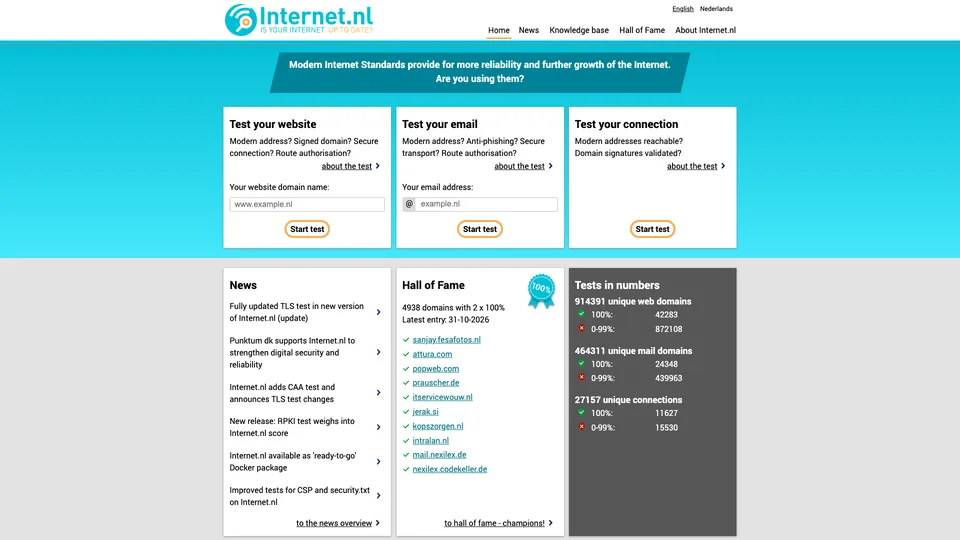
The service offers three tests. The website test checks the IPv6 address of the server and its name servers, the domain’s DNSSEC signature, the HTTPS connection (TLS versions, algorithms, certificate, HSTS), HTTP security headers such as CSP, X-Frame-Options and Referrer-Policy, the security.txt file that tells people whom to report a vulnerability to, and the RPKI validity of the routes leading to the server. The email test repeats IPv6, DNSSEC and RPKI, then checks SPF, DKIM and DMARC against address spoofing, along with STARTTLS and DANE, which encrypt and authenticate traffic between mail servers. The third test looks at the visitor’s own connection: can it reach websites over IPv6, and does the internet provider validate DNSSEC signatures?
The score follows a simple principle: each family of checks carries the same weight as the others, and only the items deemed mandatory count toward the percentage, with recommendations shown separately. The benchmark is demanding. Since April 2026, the TLS section has followed the guidelines published in 2025 by NCSC-NL, the Dutch national cyber security center: a setting rated insufficient fails the test, and a setting due to be phased out triggers a warning. A domain that scores 100% on both the website and email tests enters the “Hall of Fame” and can display a badge.
Internet.nl was launched on April 15, 2015, during Dutch Cyber Week, by the Platform Internet Standards, a partnership between Dutch internet organizations and the government. Its members include the Ministry of Economic Affairs, NCSC-NL, SIDN (the .nl registry), the RIPE NCC, NLnet Labs, which laid the technical foundations of the tool, and SURF, the education and research network. ECP, an association based in The Hague, serves as its secretariat, and a project team from the platform has run the tool since April 2021. The overall budget isn’t published; what is known is that SIDN Fund financed its move to Docker containers in 2023 and that Punktum dk, the Danish .dk registry, has contributed €15,000 a year since late 2025. The code is open, under the Apache 2.0 license, and reused abroad, in Denmark for example. By the end of October 2026, more than 914,000 web domains and 464,000 email domains had been tested.
Internet.nl at a glance
- Type
- Online test, API and open-source software
- Launched
- April 2015
- Publisher
- Platform Internet Standards
- Structure
- Dutch public-private partnership
- Headquarters
- The Hague, Netherlands
- Tests
- Website, email, connection
- Domains tested
- More than 914,000 websites (October 2026)
- Free plan
- Yes, the entire tool
- Starting price
- Free, no account
What is Internet.nl used for?
-
Check IPv6
make sure your website, name servers and mail servers also respond on an IPv6 address.
-
Verify DNSSEC
find out whether your domain is signed and whether the chain of trust is valid.
-
Audit your HTTPS
TLS versions, algorithms, certificate and HSTS compared with NCSC-NL recommendations.
-
Review security headers
Content Security Policy (CSP), protection against framing (X-Frame-Options), enforced file types (X-Content-Type-Options), Referrer-Policy and the security.txt file.
-
Protect your email from spoofing
SPF, DKIM and DMARC checked on your sending domain, policy included: a DMARC record left at p=none or an overly permissive SPF is flagged as insufficient.
-
Secure email in transit
STARTTLS and DANE tested on each of your inbound mail servers.
-
Test thousands of domains
a batch API and a dashboard, reserved for nonprofits, critical sectors, platform members and Hall of Fame hosting providers.


Internet.nl review
Reference
Few tools look at a domain from so many angles at once. Where most free testers stick to the certificate or the headers, Internet.nl covers the website as well as email and the deeper layers, DNS and routing. The report is clear, every item links to an explanation, and the report URL can be forwarded as is to a hosting provider or a contractor. For taking stock of a domain before a redesign or a migration, it is an excellent starting point.
The score, on the other hand, often comes as a surprise the first time. IPv6 and DNSSEC count as much as HTTPS, so a perfectly encrypted site without IPv6 quickly lands around the middle. That isn’t a flaw in the tool so much as a deliberate choice: it measures how widely standards are adopted, not a level of risk. It is better to read the details than to stop at the percentage.
Many fixes are out of your hands. On shared hosting or a consumer email service, IPv6, DNSSEC and DANE are configured by the provider, not in the customer dashboard. The test then becomes an argument for choosing your host, especially since perfect scores remain rare: just over 4% of the web domains tested had reached 100% by the end of October 2026. Finally, the benchmark is the one set by the Dutch cyber security center. It is built on international standards and applies well beyond the Netherlands, but it is stricter than what an ordinary brochure site requires.
A local government, a public institution or a company that wants a flawless domain will keep it close at hand; a small site will mainly use it to spot the real gaps, such as a missing DMARC record, outdated TLS or forgotten headers.
Strengths
- Website, email and connection checked in a single service.
- Rare coverage: DNSSEC, DANE and RPKI on top of HTTPS and headers.
- A detailed report, with an explanation for each check and a shareable link.
- A public benchmark, based on NCSC-NL recommendations.
- Free, no account, backed by neutral organizations, with open code.
Weaknesses
- A strict score, where missing IPv6 or DNSSEC weighs as much as a misconfigured HTTPS setup.
- Fixes that are often out of reach on shared hosting.
- An interface in English and Dutch only.
- A batch API limited to certain audiences, closed to ordinary businesses.
- No continuous monitoring: each test is a one-off.
Is Internet.nl worth it?
Yes, if you manage a domain and want to know, in a few minutes, where it stands on the full range of modern standards, from the website to email. System administrators, hosting providers, agencies and public IT departments will find a free audit and a report they can pass along to get fixes made. It is also a good way to compare hosting providers before choosing one.
Not necessarily, if you only want to fix one specific issue or monitor your domain over time. For dissecting a TLS configuration, Qualys SSL Labs goes further. Mozilla’s HTTP Observatory grades security headers in finer detail. On the email side, MxToolbox adds blocklists and monitoring, and Mail-tester rates the deliverability of a real message. Internet.nl is still the one that gives the broadest overview, for free.
How much does Internet.nl cost?
Internet.nl doesn’t sell anything. All three tests are open to everyone, with no account and no stated limit, and the software can be installed on your own servers at no cost. Only the batch API is reserved for certain audiences, also for free.
| Plan | Per month | Access | Who it's for |
|---|---|---|---|
| Online test | $0 | Website, email and connection, no account | Anyone who manages a domain |
| Batch API and dashboard | $0 | On request, 3 accounts per organization | Nonprofits, critical sectors, members and Hall of Fame hosting providers |
| Self-hosted installation | $0 | Open-source code, Docker image | Technical teams that want their own instance |
Source: official Internet.nl website (official service page, no paid plan), checked on October 31, 2026.
- The batch API is limited to two submissions a week and 5,000 domains per submission, with no uptime guarantee; an account left unused for twelve months is deleted.
- It can’t be used as the basis for a commercial service offered to third parties.
- The code is released under the Apache 2.0 license; the Internet.nl name and logo are not included.
FAQ
Answers to questions about Internet.nl
Is Internet.nl free?
Yes. The website, email and connection tests run with no account and at no cost. The batch API is free too, but reserved for certain organizations.
Do I need to be in the Netherlands to use it?
No. Any domain can be tested, whatever its country. The standards checked are international; only the TLS grading follows the recommendations of the Dutch cyber security center.
Why is my score low when my site uses HTTPS?
Each family of checks counts as much as the others. A site without IPv6, DNSSEC or security headers loses points even if its certificate is perfect. The detailed report shows what is missing.
What should I do if my host offers neither IPv6 nor DNSSEC?
These settings are handled by your hosting provider or your domain registrar. Send them the report link. If they don’t offer them, weigh the issue at stake: a missing DMARC record or outdated TLS genuinely exposes your domain, whereas missing DANE on hosted email is common and doesn’t, on its own, justify switching providers.
Does Internet.nl monitor my domain continuously?
No. Each test is a one-off: you need to run it again after making a change. To be alerted to a problem, you need a monitoring tool.
Information checked on October 31, 2026