
- Website creation
- E-commerce
PrestaShop: the open-source software to build and run your own online store
Good tool
PrestaShop is online store software that you install on your own hosting: catalog, product pages, cart, payment, shipping, invoices and order management are all handled from a full-featured admin panel. Free and open source, it can be extended with thousands of modules and themes to fit almost any project. It is one of the most widespread ecommerce solutions in France and Southern Europe, where agencies and merchants use it for small shops and for catalogs of several thousand products alike.
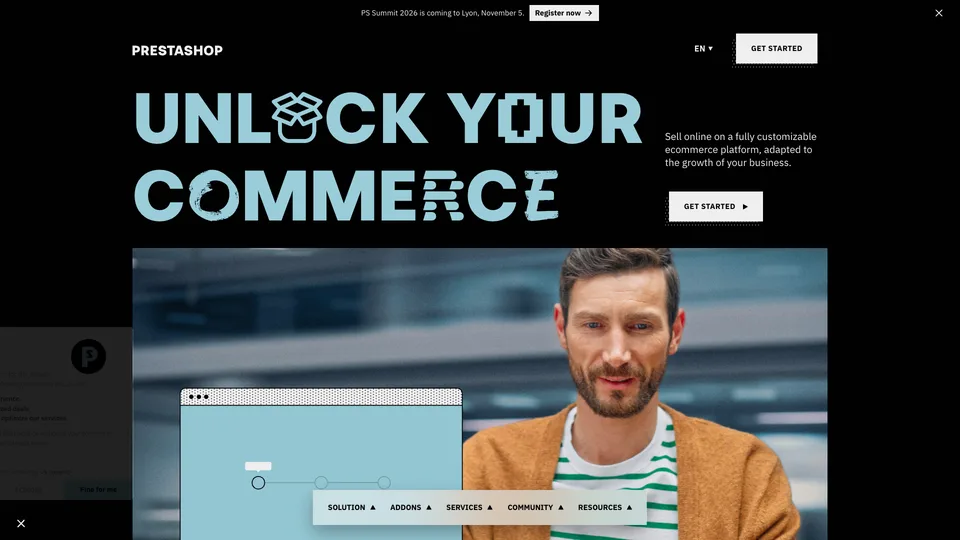
What is PrestaShop?
Unlike a subscription platform such as Shopify, PrestaShop comes as source code you download. You install it with the host of your choice, on a PHP server with a MySQL database, and get two spaces: the storefront customers see, styled by a theme, and a back office where you manage products, variants, inventory, customers, carriers, taxes, promotions and orders. The software natively handles multiple languages, multiple currencies and even multiple stores from a single admin. Everything else goes through modules: payments (PrestaShop Checkout, built with PayPal, but also Stripe or Alma), shipping, advertising on Google or Facebook, email marketing. The official marketplace, PrestaShop Addons, claims more than 3,200 themes and modules, largely sold by independent developers. Those who don’t want to deal with the server can choose the Hosted offer, which delivers a store that is already installed and hosted, with support.
The project was born in 2005 at Epitech, a Paris computer science school, under the name phpOpenStore. The company PrestaShop was founded in Paris in 2007 by Igor Schlumberger and Bruno Lévêque, and the software has stayed open source from the start (OSL 3.0 license for the core, AFL 3.0 for modules). The Italian logistics group MBE Worldwide announced its acquisition in late 2021, before selling it to the Polish group cyber_Folks, listed in Warsaw: the sale, signed in December 2025, closed in February 2026. PrestaShop now sits alongside Sylius, another open-source ecommerce solution aimed at more complex projects. The company cites 230,000 active stores, a ballpark figure it has been using for several years and that independent counts put lower. Version 9.2, released in late September 2026, notably introduced one-page checkout.
PrestaShop at a glance
- Type
- Open-source ecommerce software (PHP)
- Founded
- 2007 (student project from 2005)
- Founders
- Igor Schlumberger and Bruno Lévêque
- Origin
- France
- Headquarters
- Paris
- Owner
- cyber_Folks (Poland), since February 2026
- Active stores
- More than 230,000, according to the company
- Free plan
- Yes, the full software (hosting extra)
- Starting price
- Hosted at €24/month excl. VAT (billed annually)
What is PrestaShop used for?
-
Sell online
unlimited product catalog, variants, bundles, virtual products, inventory, promotions and order tracking from the back office.
-
Design your store
a customizable default theme, Hummingbird, or one of the many marketplace themes, editable right down to the code.
-
Get paid by your customers
card, PayPal or installment payments through the PrestaShop Checkout, Stripe, Alma or Klarna modules.
-
Manage your shipments
carriers, zones and shipping costs are set in the admin, and the eShip module automates label printing.
-
Add features
thousands of free or paid modules for invoicing, marketing, customer reviews or connecting to an ERP.
-
Take care of your SEO
custom URLs, title and meta tags and canonical URLs can be set page by page; native redirects are limited to disabled products, everything else goes through a module or the server.
-
Hand off hosting
with the Hosted offer, the store is installed, hosted and updated by the company, with support six days a week.


PrestaShop review
Good tool
On paper, PrestaShop has everything you would expect from ecommerce software: it is free, feature-rich from the moment you install it, you keep ownership of both the code and the data, and it can be adapted to just about any catalog. Multilingual, multi-currency, multi-store, fine-grained handling of variants and taxes: for a European merchant, the base tool is solid, and the community of French agencies that know it inside out remains a real asset.
“Free” still needs to be put in perspective. A serious store needs decent hosting, a theme and, soon enough, several paid modules for features other solutions include as standard. These modules, sold by third-party developers, vary in quality: some conflict with each other, others stop being maintained, and the company refers support requests to their authors. In the end, the annual bill can match that of a Shopify subscription, with maintenance on top.
PrestaShop is mainly for stores backed by a developer or an agency, or for merchants who are comfortable with technology. Major upgrades, from version 8 to 9 for example, are projects in their own right that can break a theme or a module, and heavily customized code becomes hard to take over. On the company side, support is hard to reach, and its paid plans renew automatically, so keep an eye on renewal dates.
That leaves the question of the future. The software has changed owners twice in five years and has lost ground to WooCommerce and Shopify. The new group has European ambitions and version 9.2 shows the product is moving forward, but it will take a few years to know whether this fresh start delivers. Note, too, that the Hosted offer still runs on version 8.
Strengths
- Free, open-source software that you own, with no commission on sales.
- Very complete ecommerce features out of the box: variants, taxes, multilingual, multi-currency, multi-store.
- A marketplace of several thousand modules and themes covering almost every need.
- A large network of agencies and freelancers, especially in France and Southern Europe.
- A hosted offer to get started without managing a server, with a 14-day trial.
Weaknesses
- Paid modules quickly become necessary, vary in quality and are maintained by third parties.
- Tricky major upgrades that can break themes and modules.
- Installation and maintenance that require technical skills.
- Official support that is hard to reach, and paid plans that renew automatically.
- A Hosted offer still based on version 8, behind the open-source software.
- A future that remains to be confirmed after two changes of ownership in five years.
Is PrestaShop worth it?
Yes, if you want a store where you control the code, the hosting and the data, with a rich catalog or specific needs (several languages, several stores, complex pricing rules), and you work with an agency or a developer who knows the software. For a French or European merchant, its ecosystem of modules and service providers remains one of the most extensive.
Not necessarily, if you are launching a small store on your own with no technical skills: Shopify or Wix will get you online faster, with maintenance taken care of. If your site already runs on WordPress, WooCommerce remains the most natural option, with an even larger ecosystem. For a highly custom or fast-growing project, Sylius, from the same group, or Magento (Adobe Commerce) offer more technical flexibility, with a higher development budget.
How much does PrestaShop cost?
The software itself costs nothing: the Classic edition is a free download that you install with the host of your choice. The company also sells a Hosted offer, which includes hosting, installation and support, billed in euros excluding VAT, monthly or yearly; no US dollar pricing is published. In both cases, paid modules and themes are added as needed.
| Plan | Per month | Per month, billed yearly | Included | Who it's for |
|---|---|---|---|---|
| Classic | €0 | — | Full software, version 9, to install yourself (hosting and domain not included) | Agencies, developers, merchants with technical support |
| Hosted | €29 | €24 | Store installed and hosted (50 GB), support six days a week, GDPR assistant, VAT calculation | Merchants who want to get started without managing a server |
Source: official PrestaShop pricing page, checked on October 31, 2026 and again on November 6, 2026 (prices in euros only).
- Hosted costs €29 a month excluding VAT with no commitment, or €290 a year excluding VAT (€24 a month), after a 14-day free trial; a credit card is required at sign-up.
- With Classic, budget for hosting, a domain name and, in most cases, a developer or an agency.
- Modules and themes from the PrestaShop Addons marketplace are sold separately, at widely varying prices, as are the company’s support plans.
- Payment modules take their own fees on transactions.
FAQ
Answers to questions about PrestaShop
Is PrestaShop really free?
The software is: the Classic edition can be downloaded and used for free, with no commission on sales. You still have to pay for hosting, a domain name and, often, modules and a theme. The offer hosted by the company costs €29 a month excluding VAT, or €24 a month billed annually.
Who owns PrestaShop today?
The Polish group cyber_Folks, which closed its acquisition in February 2026 from Italy’s MBE Worldwide (since renamed Fortidia). PrestaShop sits in the same entity as Sylius, another open-source ecommerce solution.
PrestaShop or WooCommerce?
WooCommerce is added to a WordPress site and works well for content sites that also sell. PrestaShop is dedicated ecommerce software, more complete out of the box for large catalogs, variants or multi-store setups. Both require hosting and maintenance.
Do I need to know how to code to use PrestaShop?
Not to run the store day to day: the back office is enough. Installation, upgrades and advanced customization, however, require technical skills or help from a service provider, except with the Hosted offer.
Information checked on October 31, 2026