
- Website creation
- E-commerce
Magento (Adobe Commerce): building custom ecommerce, from B2C to B2B
Good tool
Magento, whose paid edition is now called Adobe Commerce, is used to build and run demanding online stores: catalogs with tens of thousands of products, several brands or countries managed from the same admin, and B2B sales with company accounts and quotes. The software comes in two versions: Magento Open Source, free and open source, which you host and have developed yourself, and Adobe Commerce, the paid edition, sold on quote with hosting and services. It is one of the major enterprise ecommerce platforms, alongside Shopify Plus, Salesforce Commerce Cloud and BigCommerce.
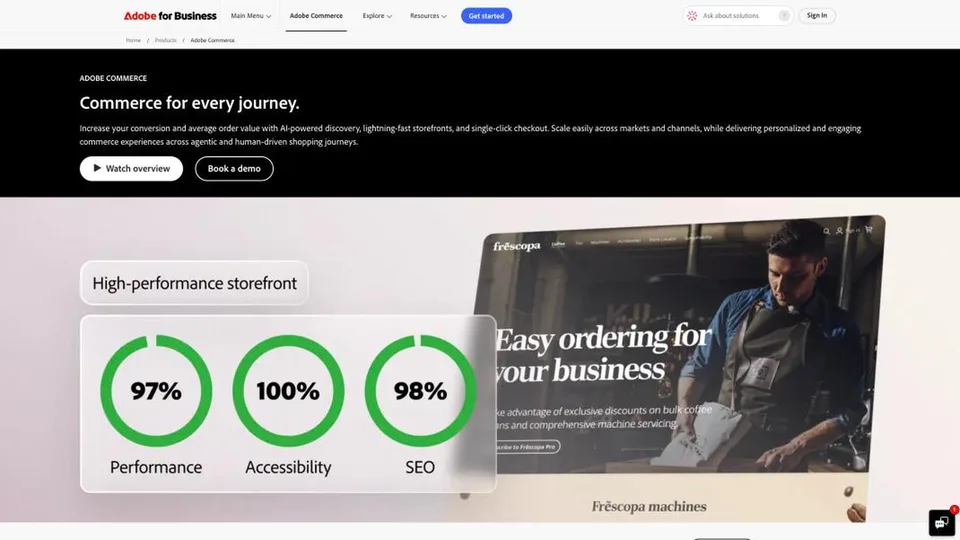
What is Magento (Adobe Commerce)?
Under the hood, Magento is a highly modular PHP application. Almost everything can be replaced or extended with modules, which explains both its flexibility and its reputation as a developer’s tool. A single installation can run several websites, stores and language versions, each with its own prices, inventory and catalog. The shared foundation, Magento Open Source, already covers the core of an online store: catalog, cart, checkout, promotions, multi-warehouse inventory, a visual page editor (Page Builder) and APIs. It is a free download under the OSL 3.0 and AFL 3.0 open source licenses, and its latest version, 2.4.9, supports PHP 8.5.
Adobe Commerce adds features and services reserved for licensed customers on top of that foundation: a B2B edition (company accounts, quotes, negotiated catalogs and prices), AI-powered product search and recommendations, App Builder development tools and vendor support. Three deployment models coexist. Adobe Commerce as a Cloud Service is a SaaS version, updated automatically by Adobe, which you customize through APIs and external apps rather than by touching the code. Adobe Commerce on Cloud is a platform hosted by Adobe where the merchant keeps control of the code and the updates. Finally, there is the on-premises license, installed with your own hosting provider. Adobe also offers Commerce Optimizer, a catalog and merchandising layer that can plug into another back office.
The project was launched in 2007 by Varien, an agency in Culver City, California, led by Roy Rubin and Yoav Kutner; the first stable release came out in March 2008. eBay took control of it in 2011 before selling it to the investment firm Permira in 2015, and Adobe bought it in June 2018 for $1.68 billion. The paid edition, long known as Magento Commerce, was renamed Adobe Commerce in April 2021 and now integrates with Adobe’s other enterprise software, such as Adobe Experience Manager and Adobe Analytics. As of October 31, 2026, the platform powered about 1.6% of ecommerce sites whose technology is identified, according to W3Techs.
Magento (Adobe Commerce) at a glance
- Type
- Ecommerce platform (SaaS, PaaS or self-hosted)
- Founded
- 2007 (first stable release in 2008)
- Founders
- Roy Rubin and Yoav Kutner (Varien)
- Origin
- United States (Culver City, California)
- Owner
- Adobe, since June 2018
- Technology
- PHP, modules and APIs
- Free version
- Yes, Magento Open Source, self-hosted
- Starting price
- Adobe Commerce on quote
What is Magento (Adobe Commerce) used for?
-
Manage large catalogs
configurable or grouped products, custom attributes, inventory spread across several warehouses and advanced pricing rules.
-
Sell to businesses
company accounts with multiple buyers, quote requests, negotiated catalogs and price lists, included in the SaaS version and licensed separately elsewhere.
-
Run several stores
brands, countries and languages in a single admin, with a visual editor to build pages without code.
-
Fit the platform to your business
a vast extension marketplace, REST and GraphQL APIs and, at Adobe, App Builder to connect your ERP, PIM or business software.
-
Accept payments
Adobe’s Payment Services, also available on Magento Open Source, or other payment providers through their modules.
-
Choose how it’s hosted
SaaS managed by Adobe, a cloud platform where you keep the code, or an installation with the hosting provider of your choice.


Magento (Adobe Commerce) review
Good tool
Few platforms go as far as Adobe Commerce once commerce gets complicated. Several brands across several countries, thousands of SKUs with variants, business customers with their own prices and approval workflows: all of this is handled natively, or nearly so, and whatever is missing can be built, since the code is open and the ecosystem of extensions and agencies is still one of the richest on the market. For a company whose online store is a genuine industrial tool, it is a choice that holds up.
That freedom comes at a price, and it isn’t just the license. Magento can’t be run without developers: you need a specialized integrator, hosting sized for the load, updates and security patches applied regularly, and every extension you add makes maintenance heavier. For the paid edition, Adobe publishes no pricing at all: the license is negotiated and depends on your sales volume. Added together, these costs put Adobe Commerce out of reach for most small and mid-sized stores.
The open source version changes the picture a little, without working miracles. Magento Open Source costs nothing to download and is enough to build a solid store, but it demands the same technical skills, without Adobe’s support or the B2B and AI features of the paid edition. It still makes sense for an agency that already knows the technology, much less for a merchant on their own.
There is also the question of the future. The platform is very much alive, with regular releases and a new SaaS offering that finally spares merchants from handling updates. But part of the mid-market has moved to Shopify Plus or BigCommerce, which are simpler to run, and Magento’s share of online stores is shrinking. Our take: a powerful tool that is still relevant for large catalogs and B2B, provided you have the budget and the team, and rarely the right starting point for a store that is just getting started.
Strengths
- Rare functional depth: multi-store, multi-language, multi-warehouse and fine-grained pricing rules.
- A complete B2B toolkit, included in the SaaS version.
- Open code that can be customized without limits, and a free, open source version.
- One of the largest ecosystems of extensions, agencies and developers on the market.
- A choice of deployment: SaaS, managed cloud or self-hosted.
- Integration with Adobe software for content, analytics and personalization.
Weaknesses
- No published pricing for the paid edition, which is negotiated based on sales volume.
- A high total cost: license, hosting, integrator and maintenance.
- Specialized PHP skills are essential, even with the free version.
- Heavy updates and security patches outside the SaaS offering.
- Performance that depends heavily on hosting and on the number of extensions.
- A market share in decline against simpler SaaS platforms. SEO that has to be planned from day one: faceted navigation that multiplies filtered URLs, products reachable at several addresses depending on the category, canonical tags and redirects to configure, or indexing gets scattered.
Is Magento (Adobe Commerce) worth it?
Yes, if you run a large-scale ecommerce business, with a complex catalog, several brands or countries, business customers or tight links with an ERP, and you have the budget and a technical team, in-house or at an integrator (see our ecommerce website design service). That is even more true if your company already uses Adobe’s marketing software. Magento Open Source, for its part, makes sense for an agency or a team that already knows the technology and wants to keep control of all the code.
Not necessarily, if you are new to selling online or your catalog fits in a few hundred SKUs: the development and maintenance costs aren’t justified. Shopify, or Shopify Plus for high volumes, is far lighter to run, and BigCommerce comes close for B2B. To stay open source with less complexity, PrestaShop or WooCommerce are natural alternatives. For very large accounts, Adobe Commerce is mostly compared with Salesforce Commerce Cloud and SAP Commerce.
How much does Magento (Adobe Commerce) cost?
Nothing is listed: Adobe publishes no prices for its paid edition. The license is negotiated with the sales team, and the price depends mainly on sales volume (GMV) and average order value, with options for the number of products or environments. Magento Open Source, on the other hand, is a free download; hosting, development and extensions are what make up the bill.
| Plan | Per month | Included | Who it's for |
|---|---|---|---|
| Magento Open Source | $0 | Complete open source software, installed and hosted by you, without vendor support | Agencies and technical teams that know Magento |
| Adobe Commerce as a Cloud Service | Custom pricing | SaaS version managed and updated by Adobe, core B2B, search and recommendations included | Large brands that want Magento’s power without managing infrastructure |
| Adobe Commerce on Cloud or on-premises | Custom pricing | Full paid edition, hosted by Adobe or by your provider, customizable code, B2B licensed separately | Highly customized projects, heavy integrations with business systems |
Source: official Adobe Commerce pricing page, checked on October 31, 2026.
- No self-serve trial is offered: first contact goes through Adobe’s sales team.
- The Adobe Commerce license depends on tiers of sales volume and average order value; extra product packs and additional environments are paid options.
- With Magento Open Source, budget for hosting, development, paid extensions and maintenance, which make up most of the cost.
FAQ
Answers to questions about Magento (Adobe Commerce)
Are Magento and Adobe Commerce the same thing?
Yes and no. Magento is the original software, bought by Adobe in 2018. Its free, open source version is still called Magento Open Source, while the paid edition, formerly Magento Commerce, has been called Adobe Commerce since April 2021.
Is Magento free?
Magento Open Source is a free download under an open source license. You still have to pay for hosting, development and often extensions. Adobe Commerce, the edition with B2B, AI services and support, is paid and sold on quote.
How much does an Adobe Commerce license cost?
Adobe publishes no pricing and only shares it after a sales conversation. Have your annual sales volume, average order value, number of products and number of environments ready: these are the parameters that set the license. For a project that doesn’t justify that budget, Magento Open Source remains the free route.
What is the difference between Adobe Commerce as a Cloud Service and Adobe Commerce on Cloud?
The first is a SaaS version updated automatically by Adobe, which you customize through APIs and external apps. The second is a platform hosted by Adobe where the merchant keeps control of the PHP code, but has to apply updates and patches themselves.
Is Magento still a good choice in 2026?
Yes, for a complex catalog, B2B or several brands, with a budget and a technical team: the platform ships regular releases and a SaaS offering that spares merchants from handling updates. For a store that is just starting out or a small catalog, its shrinking market share and running costs make the case for a simpler platform.
Information checked on October 31, 2026