
- Web technical
- Testing and monitoring
- Web performance
Pingdom: get alerted the moment your website goes down or slows down
Good tool
Pingdom checks your website every minute from servers around the world and alerts you by email, SMS or push notification as soon as it stops responding. It can also replay a complete user flow, such as logging in, searching or checking out, in a real browser, and measure load times for your real visitors. A veteran of uptime monitoring, it is one of the names web teams mention first when they want to know a site is down before customers start complaining.
What is Pingdom?
The service is split into two building blocks, sold separately. First, synthetic monitoring: you enter an address and Pingdom tests it at regular intervals, as often as once a minute, over HTTP or HTTPS (with, if needed, a word that must appear on the page), but also by ping, TCP, UDP, DNS or on the SMTP, POP3 and IMAP mail ports. Before raising an alert, a second server confirms the outage, then the tool attaches a traceroute and the server’s raw response to the incident to help find the cause. The so-called advanced checks go further: a recorder captures a user flow on the site, which Pingdom replays in Chrome anywhere from every 5 minutes to once a day, and page speed monitoring breaks down how a page loads, resource by resource. The second block, Real User Monitoring, relies on a small script added to your pages: it measures the load time your visitors actually experience, by country, browser or page, and keeps that data for thirteen months.
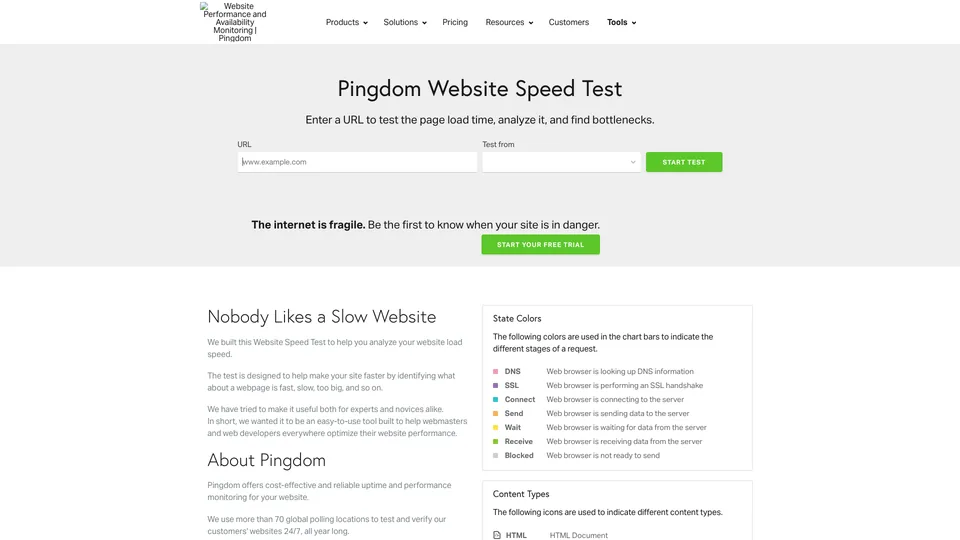
Around that, you get what you would expect from such a service: alerts by email, SMS, mobile app, Slack or webhooks, maintenance windows to mute alerts during an update, public status pages and shareable uptime reports. The online speed test, free and with no account, serves as the shop window for the whole offering.
Pingdom was born in Västerås, Sweden, where entrepreneur Sam Nurmi founded it in 2007. The service quickly made a name for itself, notably through its blog and its studies on the state of the internet. In June 2014, US software company SolarWinds acquired it and gradually folded it into its range of observability tools. SolarWinds itself left the New York Stock Exchange in April 2025, after being bought by the private equity firm Turn/River Capital, its current owner. Pingdom claims more than 850,000 users and businesses and more than 100 probe locations in Europe, the Americas and Asia-Pacific.
Pingdom at a glance
- Type
- Online website monitoring service
- Founded
- 2007
- Founder
- Sam Nurmi
- Origin
- Sweden (Västerås)
- Owner
- SolarWinds since 2014, itself owned by Turn/River Capital since 2025
- Probe locations
- More than 100 worldwide
- Free plan
- No, 30-day trial (free speed test on the side)
- Starting price
- €14.33/month billed yearly, €16 monthly
What is Pingdom used for?
-
Know when your site is offline
a check as often as every minute, confirmed by a second server before alerting, to avoid false alarms.
-
Make sure your key flows work
login, sign-up or checkout flows are recorded once, then replayed in Chrome at regular intervals; for payments, stop before the final confirmation or use a test account and test mode, or you will create phantom orders.
-
Measure speed as your visitors see it
a script in your pages records their real load times, by country, browser and page, over thirteen months.
-
Track a page’s weight and speed
each load is broken down request by request, to spot the image or script slowing everything down.
-
Get the alert in the right place
email, SMS, mobile app, Slack or webhook, with adjustable reminders and delays.
-
Keep customers informed during an outage
a customizable public status page, included in every plan.
-
Report on uptime
shareable reports on uptime and response times, useful when talking to a client or a hosting provider.


Pingdom review
Good tool
Pingdom is one of those services you forget exists until the day it goes off, and that is the highest compliment you can pay a monitoring tool. Checks run from many countries, every outage is verified by a second server before anyone gets alerted, and nobody gets woken up at 3 a.m. over a minor network hiccup. For an online store or an app where every minute of downtime costs money, that reliability is worth a lot.
Its real edge over simpler tools is transaction monitoring. Knowing that the home page responds tells you nothing about the login form or the checkout; Pingdom replays those steps in a real browser and flags the one that breaks. Add speed measurement for real visitors, and you get a fairly complete picture of what a customer experiences, without moving to a much heavier observability suite. That said, the interface shows its age: it works, but that’s about it, and some options take a bit of digging to find.
Price is what gives pause. There is no free version anymore, only a one-month trial, and the bill climbs quickly with the number of sites monitored and advanced checks, especially since real user monitoring is billed separately. For a blog, a brochure site or a freelancer who just wants to hear about outages, that is a lot: cheaper services, some even free for a few sites, handle that basic job perfectly well.
One last thing to keep in mind: Pingdom is one product among many in the SolarWinds catalog. Support and billing go through a large company, with the delays that implies, so check the renewal terms before committing to a yearly plan.
Strengths
- Reliable alerts, confirmed from a second probe location.
- Transaction checks replayed in a real browser, beyond simple uptime.
- Real visitor speed measurement in the same tool.
- A network of more than 100 probe locations worldwide.
- Public status pages and unlimited users included.
Weaknesses
- No permanent free version, only a 30-day trial.
- A bill that climbs fast with the number of checks and pageviews.
- Synthetic monitoring and real user monitoring sold separately.
- An aging interface, less intuitive than newer services.
- Support and billing in line with those of a large software company.
Is Pingdom worth it?
Yes, if your revenue depends on a site or app being available: an online store, a SaaS product, an agency managing sites for clients. Transaction checks and real speed measurement then justify the subscription, and the entry level remains reasonable for about ten sites. It also suits teams that already use other SolarWinds products.
Not necessarily, if you just want to know when a brochure site or a blog goes down. UptimeRobot and StatusCake offer a free plan that covers that need for a few sites, and Better Stack combines monitoring, on-call and status pages in a modern package. At the other end of the scale, Datadog or New Relic are better suited to teams that want to link outages to their server metrics. For a simple one-off speed check, Pingdom’s free test or PageSpeed Insights is enough.
How much does Pingdom cost?
There are no named plans, just two sliders: one sets the number of synthetic checks (and with it the advanced checks and SMS included), the other the volume of pageviews tracked by Real User Monitoring. The two add up, with a lower rate for yearly billing. Pingdom lists its prices in euros only, including for visitors from the United States; here are the main tiers as the official page shows them.
| Plan | Per month | Per month, billed yearly | Included | Who it's for |
|---|---|---|---|---|
| Synthetic Monitoring, 10 checks | €16 | €14.33 | 10 uptime checks, 1 advanced check, 50 SMS | A small business, a few sites |
| Synthetic Monitoring, 50 checks | €66 | €60.50 | 50 uptime checks, 10 advanced checks, 200 SMS | Agencies and online stores |
| Synthetic Monitoring, 100 checks | €120 | €110 | 100 uptime checks, 20 advanced checks, 350 SMS | Large portfolio of sites |
| Real User Monitoring, 100,000 pageviews | €16 | €14.33 | 100,000 pageviews a month, unlimited sites | Site with modest traffic |
| Real User Monitoring, 1 million pageviews | €96 | €88 | 1 million pageviews a month, unlimited sites | High-traffic site |
| Enterprise | Custom pricing | Quote-based offering alongside the slider, from 500,000 pageviews a month | Large accounts | |
Source: official Pingdom pricing page, checked on October 31, 2026; no dollar pricing found on November 6, 2026.
- The synthetic monitoring slider has 22 tiers, up to 30,000 checks at €23,262 a month; the Real User Monitoring slider goes up to one billion pageviews at €19,068 a month.
- The page doesn’t say whether amounts include taxes.
- The free trial lasts 30 days and covers both synthetic monitoring and Real User Monitoring.
- The online speed test remains free, with no account.
FAQ
Answers to questions about Pingdom
Is Pingdom free?
No. Pingdom no longer offers a free plan, only a 30-day trial. Only the online Website Speed Test is free and needs no account. Monitoring starts at €14.33 a month billed yearly, or €16 billed monthly, for 10 checks; Pingdom publishes its prices in euros only.
Who owns Pingdom today?
Pingdom has belonged to SolarWinds since 2014. SolarWinds was acquired in April 2025 by the private equity firm Turn/River Capital and is no longer publicly traded.
What is the difference between Synthetic Monitoring and Real User Monitoring?
Synthetic monitoring tests your site from Pingdom’s servers, even when nobody is visiting: it detects outages and broken flows. Real User Monitoring measures the speed your actual visitors experience, through a script added to your pages. The two are billed separately.
How often does Pingdom check a site?
Up to once a minute for uptime checks. Transaction checks, which are heavier, run at most every 5 minutes and at least once a day.
Is there a free alternative to Pingdom?
To get alerted when a brochure site or a blog stops responding, UptimeRobot and StatusCake offer a free plan limited to a few sites. Pingdom’s speed test is free too, but it doesn’t monitor anything over time.
Information checked on October 31, 2026