
- Website creation
- E-commerce
OpenCart: a free online store you host yourself
Worth a look
OpenCart is open-source e-commerce software that you install with the web host of your choice: catalog, cart, checkout, shipping, customer accounts and order tracking are ready to use, with no subscription to pay. You then extend it with themes and modules, often paid, sold on its official marketplace. Less widespread than WooCommerce or PrestaShop, it remains one of the long-standing open-source e-commerce platforms, valued for being lightweight.
What is OpenCart?
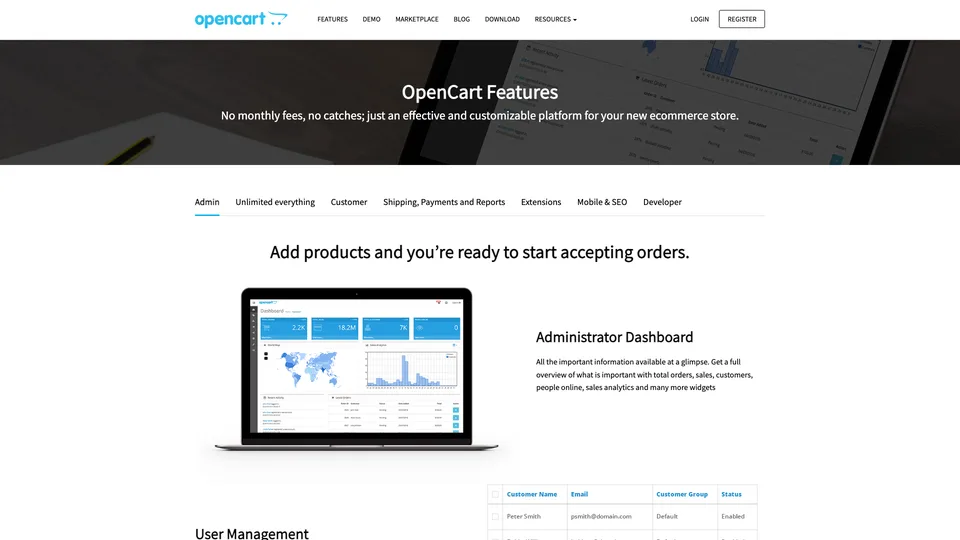
OpenCart installs like any standard website: you download the archive, upload it to a server running PHP and MySQL, and a setup wizard creates the database in a few minutes. Many hosting providers also offer it as a one-click install. Once it is up and running, the software is split in two: the storefront that customers see, and the admin panel, where you manage products, options, inventory, orders, customers, taxes and coupon codes. Out of the box, it handles multiple stores from a single admin, multiple currencies and languages, an affiliate program and reward points. Everything else goes through extensions: the official marketplace claims more than 13,000 modules and themes, mostly sold by independent developers.
The project dates back to 1998, when Christopher G. Mann wrote a first shopping cart in Perl. After it was abandoned, British developer Daniel Kerr took it over in 2005 and rewrote it in PHP; the first stable version came out in 2009. OpenCart is now released under the GPL by OpenCart Limited, a company based in Hong Kong that makes most of its money from its marketplace, paid services and partnerships. Two branches coexist: 3.x, older but still maintained, and 4.x, whose version 4.1.0.4 was released in August 2026.
OpenCart at a glance
- Type
- Open-source e-commerce software, self-hosted
- Project origins
- 1998, taken over in 2005
- Creator
- Daniel Kerr (PHP version)
- Publisher
- OpenCart Limited
- Headquarters
- Hong Kong
- License
- GPL v3
- Technology
- PHP and MySQL
- Free plan
- Yes, the full software
- Costs to plan for
- Hosting, themes and modules
What is OpenCart used for?
-
Manage your catalog
unlimited products and categories, size or color options, downloadable products, customer reviews and multiple stores in a single admin.
-
Design your store
a mobile-friendly theme included out of the box, or one of the many themes sold for a few dozen dollars on the marketplace.
-
Take payments
dozens of payment methods, including PayPal and Klarna, bundled with the 3.x branch but downloaded from the marketplace on 4.x, plus recurring payments for subscriptions.
-
Ship your orders
ready-to-configure carrier modules such as UPS, FedEx and Royal Mail, and tax rules by zone.
-
Drive sales
coupon codes, special prices, quantity discounts, reward points and an affiliate program built in.
-
Add features
thousands of modules on the official marketplace, for one-page checkout, product imports or SEO.
-
Track your business
a dashboard of sales, customers and orders, plus reports on products viewed and purchased.


OpenCart review
Worth a look
At install time, OpenCart is appealing: it costs nothing, runs fast on modest hosting and ships with most of the features a store needs. For a small merchant who is comfortable with web hosting, or who works with a developer, it makes it possible to open a serious store with no subscription and no commission on sales. Its admin panel is clear, and it holds up well with catalogs of several thousand products.
Things get harder when you want to go further. Almost every specific need calls for an extension, and the quality of the marketplace is very uneven: poorly maintained modules, conflicts between extensions, sellers who are hard to reach. The move from version 3 to version 4 made the problem worse, because a good share of the modules written for the old branch don’t work on the new one. In our view, as long as the extensions your store depends on aren’t available for 4.x, 3.x remains the safest choice for a live store.
You also have to accept what self-hosted software involves: security updates, backups and compatibility with new PHP versions are your responsibility. Support from the publisher is limited and billed per job, and the community, still active on the forum, no longer has the energy of WooCommerce’s. Many long-established stores end up migrating to WooCommerce, in fact.
OpenCart is still a good tool for a simple store, run by someone who isn’t afraid to get their hands dirty with code and servers. For a new project that needs to grow, other platforms are the more natural fit.
On the SEO side, OpenCart needs work from the start. Readable URLs aren’t enabled by default and have to be entered product by product, an item filed under several categories is reachable at several URLs, and redirects after a redesign require an extension. None of this is insurmountable, but it is better to plan for it at install time than to fix duplicates once the store has been indexed.
Strengths
- Free and open source, with no subscription and no commission on sales.
- Lightweight and fast, even with a large catalog.
- Well equipped out of the box: multi-store, multi-currency, affiliates, reward points.
- A clear admin panel that non-technical merchants can handle.
- A huge choice of themes and modules, often inexpensive.
Weaknesses
- An uneven marketplace, with modules poorly maintained by their authors.
- Version 3 extensions that are often incompatible with version 4.
- A version 4 seen as less stable than version 3 for a live store.
- Hosting, security and updates entirely your responsibility.
- An ecosystem and community losing steam against WooCommerce.
Is OpenCart worth it?
Yes, if you want an online store with no subscription and a standard catalog, and you have hosting and some technical skills, or a contractor who knows OpenCart. It also still makes perfect sense if your store already runs on it and serves you well: nothing forces you to migrate.
Not necessarily, if you are starting from scratch without a technical background, or if your project depends on many integrations. WooCommerce, also free and built on WordPress, has a far livelier ecosystem; PrestaShop is well established in France and French-speaking countries. If you don’t want to deal with anything technical, a hosted platform like Shopify or Wix spares you server headaches, at the cost of a monthly subscription. Heavier projects will tend to look at Magento (Adobe Commerce).
How much does OpenCart cost?
The software itself costs nothing: OpenCart is a free download, updates included, with no subscription and no fees on sales. The real bill builds up around it: hosting, a theme if you want one, the paid modules your store needs and, where necessary, a developer’s time.
| Plan | Per month | Included | Who it's for |
|---|---|---|---|
| OpenCart (open-source software) | $0 | The full software and its updates, to install on your own hosting | Any store ready to manage its own hosting |
Source: official OpenCart download page, checked on October 31, 2026.
- The “OpenCart Cloud” button on the official site leads to managed hosting from ScalaHosting, a partner recommended by OpenCart: billed monthly according to ScalaHosting’s price list, with a promotional price for the first term and then the full rate on renewal (price list checked on October 31, 2026, subject to change).
- On the marketplace, themes usually cost between $20 and $35, and the best-selling modules around $80 to $130, as a one-time purchase.
- OpenCart also sells one-off services: a version upgrade from $300, a backup for $50, a bug fix from $100.
FAQ
Answers to questions about OpenCart
Is OpenCart really free?
Yes, the software is open source and free to download, with no subscription and no commission on sales. You do, however, need to pay for hosting, and often for a few themes or modules sold on the marketplace.
Should I choose OpenCart 3 or OpenCart 4?
Version 4 is the most recent, but many modules written for version 3 don’t work with it. Before choosing, check that the extensions you need exist for the branch you are targeting.
Is there a hosted version of OpenCart?
The official site offers “OpenCart Cloud,” which is actually managed hosting from its partner ScalaHosting, billed monthly. Otherwise, OpenCart can be installed with most web hosts.
OpenCart or WooCommerce?
Both are free and self-hosted. OpenCart is a standalone, lightweight e-commerce platform; WooCommerce is added to WordPress and benefits from a much larger ecosystem of extensions and service providers.
Information checked on October 31, 2026