
- Website creation
- E-commerce
BigCommerce: selling online at scale, B2C and B2B
Good tool
BigCommerce is a hosted ecommerce platform that lets you open and run an online store without managing a server: catalog, checkout, shipping, promotions and marketplace selling are all handled from the same admin. Its specialty is merchants who already have volume, with heavy catalogs, several storefronts or a business clientele. It is Shopify’s most direct SaaS competitor, clearly aimed at mid-market companies and enterprise accounts.
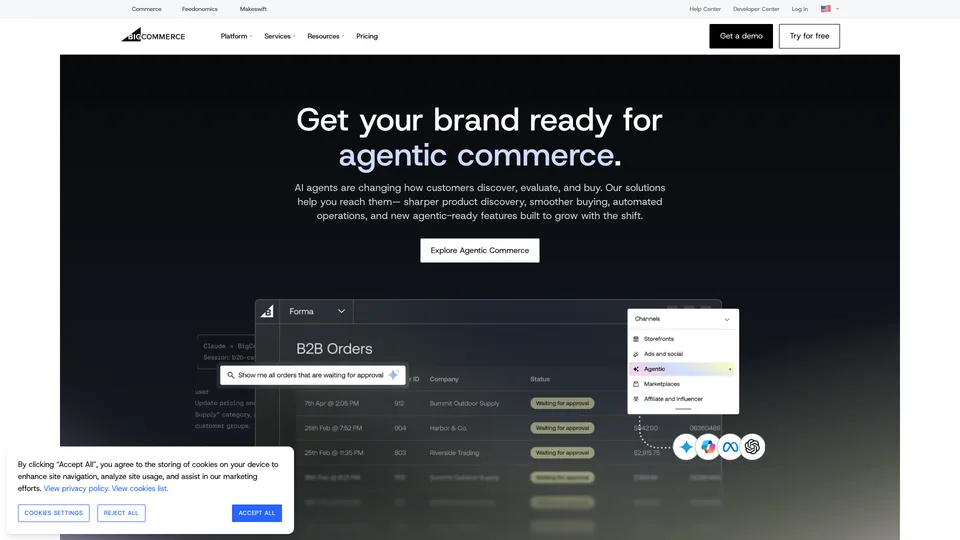
What is BigCommerce?
Like Shopify, BigCommerce runs entirely online: you subscribe, pick a theme, import your products, and the store is hosted, secured and updated by the vendor. The difference lies in what comes out of the box. Coupon codes, gift cards, multi-currency, product reviews, real-time shipping quotes and a blog are built into the very first plan, where other platforms send you to apps. Higher plans add customer groups, abandoned cart recovery, product filtering and, at the top end, customer-specific price lists. For payments, the merchant keeps the choice of provider: about twenty built-in options, including Stripe, Adyen, PayPal and Klarna, carry no extra transaction fee.
The platform also targets more technical projects. Its open APIs let you decouple the admin from the storefront (“headless”), with Catalyst, an official front end built on Next.js, or the Makeswift visual editor. A B2B Edition handles company accounts, quotes and order approvals, and Feedonomics, a product feed service acquired in 2021, syndicates the catalog to Google, Meta, TikTok and marketplaces.
BigCommerce was founded in 2009 in Sydney, Australia, by Eddie Machaalani and Mitchell Harper, and soon set up in Austin, Texas, where its headquarters are today. Listed on the Nasdaq in August 2020, the company changed its name in July 2025: it is now Commerce.com, trading under the ticker CMRC, and brings together BigCommerce, Feedonomics and Makeswift. It generated $342.3 million in revenue in 2025, most of it now coming from enterprise customers, and had 1,079 employees at year-end. Its CEO is Travis Hess.
BigCommerce at a glance
- Type
- Hosted ecommerce platform (SaaS)
- Founded
- 2009
- Founders
- Eddie Machaalani and Mitchell Harper
- Origin
- Australia (Sydney)
- Headquarters
- Austin, Texas, United States
- Company
- Commerce.com, Inc. (Nasdaq: CMRC)
- Revenue
- $342.3M in 2025
- Free plan
- No, 15-day trial
- Starting price
- $29/month billed annually ($39 month to month)
What is BigCommerce used for?
-
Manage a large catalog
products with variants, inventory spread across several warehouses, promotions and gift cards, without relying on apps for the basics.
-
Sell to businesses
company accounts, customer groups, dedicated price lists, quotes and order approval workflows with the B2B Edition.
-
Choose your payment provider
Stripe, Adyen, PayPal, Klarna or about twenty other built-in options, with no transaction fee added by BigCommerce.
-
Build your storefront
ready-made themes, the Makeswift visual editor or a custom front end with Catalyst, in Next.js.
-
Get your products everywhere
feeds to Google, Meta, TikTok, Microsoft and Pinterest through Feedonomics, included as standard, plus marketplace connections.
-
Leave hosting to the vendor
servers, SSL certificate and updates are taken care of, and several storefronts, by brand or by country, can share the same admin.


BigCommerce review
Good tool
On paper, BigCommerce makes a strong case. The platform ships with far more built-in features than average, lets merchants choose their payment provider without penalizing them, and handles without workarounds what other platforms struggle with: large catalogs, B2B sales, multiple storefronts. For a company that already sells well and wants an open technical foundation, with serious APIs and the option to go headless, it is a credible choice.
The catch is the pricing model. The subscription depends on sales over a rolling twelve months, and the platform automatically moves the store up to the next plan as soon as it crosses the cap. A good year can therefore multiply the bill, and that mechanism, on top of price increases and new fees, makes the budget hard to keep steady from one year to the next. Run the numbers over three years before signing, including the cost of apps, since some features considered basic elsewhere still cost extra here.
The ecosystem is the other weak spot. Themes, apps, agencies and tutorials exist, but in far smaller numbers than for Shopify or WooCommerce, and support leaves a mixed impression, especially for smaller accounts. That is no accident: the company now earns most of its revenue from enterprise customers, and its growth has slowed sharply. The small merchant just getting started is clearly no longer the target.
Our take: a serious tool for professional ecommerce, especially for B2B and multi-storefront setups, provided you have the volume and the team to make the most of it. For a first store, there are simpler and less risky options.
Strengths
- Plenty of built-in features from the first plan, with no apps to add.
- Free choice of payment provider, with no transaction fees on the built-in options.
- Complete B2B and multi-storefront tooling, rare at this price point.
- Open APIs and an official headless front end for custom projects.
- Catalog syndication to Google, Meta or TikTok included through Feedonomics. Welcome freedom for SEO, too: customizable URLs with no forced prefix, an editable robots.txt file, and 301 redirects and canonical tags handled natively, where Shopify imposes its own URL structure.
Weaknesses
- A subscription tied to sales, with automatic upgrades to the next plan.
- Price increases and new fees that make the budget hard to predict.
- A much narrower ecosystem of themes, apps and agencies than Shopify’s.
- Uneven support, especially for smaller accounts.
- No free plan.
- A slow-growing company, refocused on enterprise customers.
Is BigCommerce worth it?
Yes, if you already generate substantial online revenue, with a complex catalog, business customers or several brands to manage, and you want a hosted platform that stays open to custom development. It is also a serious option if you want to keep your own payment provider.
Not necessarily, if you are launching your first store or selling small volumes: the sales caps and automatic upgrades quickly add up, and the ecosystem is thinner. Shopify remains simpler, with a much wider choice of apps and service providers. To keep control over hosting and costs, WooCommerce or PrestaShop, both open source, are natural alternatives. For very large projects, BigCommerce is better compared with Shopify Plus, Adobe Commerce or Salesforce Commerce Cloud.
How much does BigCommerce cost?
BigCommerce is sold by subscription, with four plans whose price depends on the store’s sales over a rolling twelve months. Paying yearly cuts the bill by about a quarter. The Performance plan, built for high volumes, is quote-based, starting at $1,499 a month. There is no free plan, only a 15-day trial.
| Plan | Per month | Per month, billed yearly | Sales covered (rolling 12 months) | Who it's for |
|---|---|---|---|---|
| Core | $39 | $29 | Up to $30,000 in sales | Small store getting started on the platform |
| Growth | $105 | $79 | Up to $100,000 in sales | Growing store, abandoned cart recovery |
| Scale | $399 | $299 | Monthly cap ($33,333 in sales), then 0.9% of sales above it | Established merchant, advanced catalog and filtering |
| Performance | Custom pricing | Custom, starting at $1,499 a month | High volumes, B2B, dedicated support | |
Source: official BigCommerce pricing page, checked on October 31, 2026.
- Sales are measured over a rolling twelve months (order value minus 10%); above the cap, the store is automatically moved to the next plan, and to Performance from $2 million.
- No transaction fees with the twenty or so built-in payment providers; with another provider, BigCommerce charges 2% (Core), 1% (Growth) or 0.6% (Scale) of orders. The provider’s own processing fees always apply.
- Additional storefronts are optional: $30 a month (Core, up to 3), $50 (Growth, 5) or $100 (Scale, 8).
- 15-day free trial, no credit card required; without a subscription, your data is kept for 90 days.
FAQ
Answers to questions about BigCommerce
Is BigCommerce free?
No. Only a 15-day trial is available, with no credit card required. After that, subscriptions start at $29 a month billed annually, or $39 month to month.
Does BigCommerce take a cut of sales?
Not with its built-in payment providers, such as Stripe, Adyen, PayPal or Klarna. With another provider, a fee of 0.6% to 2% applies depending on the plan. The payment provider’s own fees are due in every case.
What happens if I go over my plan’s sales cap?
The store is automatically moved to the next plan. On the Scale plan, every month above $33,333 in sales is billed an extra 0.9%, until the move to Performance at $2 million over twelve months.
Are BigCommerce and Commerce.com the same company?
Yes. In July 2025, BigCommerce Holdings changed its name to Commerce.com, listed on the Nasdaq under the ticker CMRC. The ecommerce platform keeps the BigCommerce name, alongside Feedonomics and Makeswift.
Should I choose BigCommerce or Shopify?
Shopify is better for getting started and offers a much wider ecosystem. BigCommerce holds its own for B2B, multiple storefronts and free choice of payment provider, provided you already have significant sales volume.
Information checked on October 31, 2026