
- Email verification
ZeroBounce: check that an email address exists before you write
Good tool
A typo, a mailbox closed two years ago, a spam trap slipped into a contact file: ZeroBounce spots these addresses before they make your emails bounce. You paste an address into the verification field, or import a whole list, and each contact gets a clear status: valid, invalid, “catch-all” or risky. Around this verification, the company has added deliverability tools (blocklists, placement tests, DMARC). ZeroBounce ranks among the best-known email verification services, alongside NeverBounce.
What is ZeroBounce?
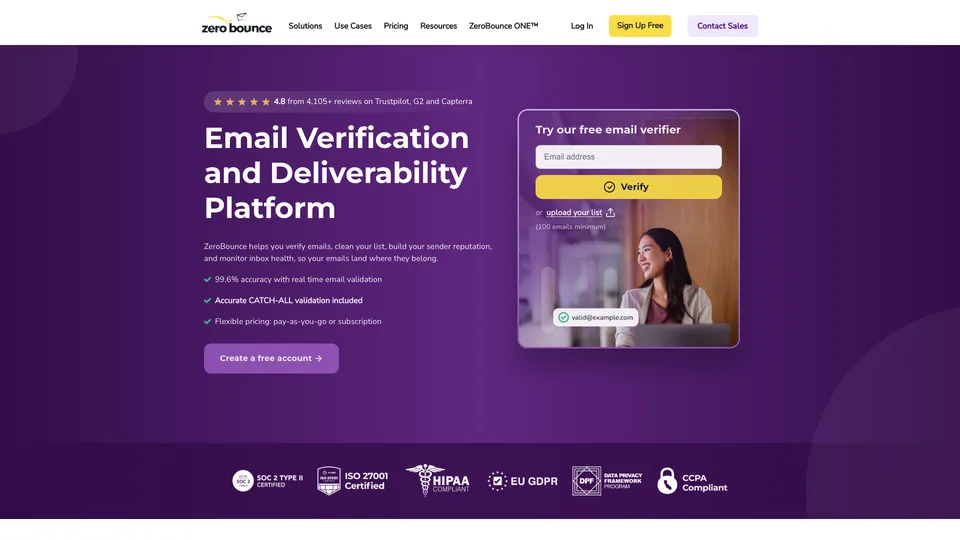
For each address submitted, ZeroBounce checks the syntax, verifies that the domain exists and receives mail, then queries the mail server to find out whether the mailbox is recognized, without sending a message. The verdict comes down to a few statuses: valid (safe to send), invalid (remove it), catch-all (the server accepts everything, so there is no way to tell without sending a real email), unknown (server unreachable or protected), and three categories to avoid: spam traps, addresses of people who often report messages as abuse, and those best left alone (disposable addresses, role-based ones like contact@, toxic ones). “Unknown” results and duplicates aren’t charged.
The service can be used in three ways: one address at a time in the browser, an imported file (100 addresses minimum), or in real time through the API, for example to block a mistyped address in a sign-up form. About forty integrations connect it to email marketing software and CRMs. Over the years, the company has added an AI-calculated quality score from 1 to 10, recent activity data for addresses, a business email finder, and a deliverability toolkit: inbox placement tests, monitoring of more than 200 blocklists, DMARC monitoring, warmup for new mailboxes and a server configuration test.
ZeroBounce was launched by Liviu Tanase, an entrepreneur from Romania who had already founded several companies in his home country before moving to the United States; the company itself sometimes dates its founding to 2015, sometimes to 2017. The business, legally named Hertza LLC, is headquartered in Santa Barbara, California. It claims more than 650,000 customers in more than 200 countries, 99.6% accuracy guaranteed in writing and security certifications such as SOC 2 Type 2 and ISO 27001.
ZeroBounce at a glance
- Type
- Online email verification service
- Founded
- 2017
- Founder
- Liviu Tanase
- Nationality
- American
- Headquarters
- Santa Barbara (California)
- Company
- Hertza LLC
- Customers claimed
- More than 650,000
- Free plan
- Yes, 100 verifications a month
- Starting price
- $39 for 2,000 verifications
What is ZeroBounce used for?
-
Verify an address
paste it into the verification field and find out in seconds whether it is valid, invalid or doubtful.
-
Clean a contact list
import your file and get it back sorted by status, so you keep only safe addresses before a campaign.
-
Filter your forms in real time
through the API or an integration, a mistyped address is rejected at sign-up, before it enters your database.
-
Find a business email address
from a name and a company’s domain, the tool suggests the likely address, already verified.
-
Monitor blocklists
your domains and IP addresses are checked against more than 200 lists, with an alert if you get listed.
-
Test where your emails land
a test message shows whether it reaches the inbox or the spam folder at the major email providers.
-
Check SPF, DKIM and DMARC
the server test and DMARC monitoring flag misconfigured authentication or an unauthorized sender.


ZeroBounce review
Good tool
At its core, ZeroBounce inspires confidence. Verification is accurate on what can actually be verified: dead addresses, typos and disposable domains, the ones that make a send bounce. When it comes to spam traps, the tool can only flag the ones it knows about: these addresses are secret by nature, and no service can guarantee a list is free of them. That is one more reason never to email contacts who didn’t ask for anything. The interface stays simple, importing a file takes a few clicks and support responds quickly, which matters when a campaign is waiting.
A result tells you less than you might think. A “valid” address exists and accepts mail, nothing more: it guarantees neither that the message will reach the inbox nor that the recipient will read it. “Catch-all” domains, common in businesses, remain a gray area that ZeroBounce narrows with its quality score without eliminating it. And the 99.6% accuracy figure is the company’s promise; the comparisons that circulate are often published by competitors and should be read with caution.
The free plan is useful if you only want to check a few addresses a month. Beyond that, small volumes are expensive per address, and pricing only becomes really attractive from several tens of thousands of contacts. Watch your credits, too: an email search uses twenty, and rollover of credits with no expiration date is only guaranteed with the subscription.
The deliverability toolkit is a bonus, but it doesn’t replace specialized tools.
Strengths
- Accurate verification that does a good job of spotting risky addresses (spam traps, disposable addresses, frequent complainers).
- A permanent free plan with 100 verifications a month.
- “Unknown” results and duplicates aren’t charged.
- A fast API and about forty integrations to verify at sign-up.
- Responsive support and solid security guarantees (SOC 2, ISO 27001, GDPR).
Weaknesses
- A high cost per address on small volumes.
- “Catch-all” addresses remain impossible to confirm with certainty.
- A credit-based pricing model that can be confusing, especially the 20 credits per email search.
- Credits only guaranteed not to expire with the subscription.
- Prices published in dollars only.
Is ZeroBounce worth it?
Yes, if you send newsletters or outreach campaigns from a file you didn’t build entirely yourself, or one that has aged. Cleaning the list before sending limits bounces and protects your domain’s reputation. To check an address now and then before writing to someone, the free version is more than enough. Two precautions are still up to you. Verification says nothing about consent: a purchased or scraped file doesn’t become GDPR compliant because its addresses exist, and recipients who didn’t ask for anything will report your messages, which no amount of cleaning can prevent. And a verified list ages: mailboxes close, employees leave. A check is valid for one campaign, not for the year; run it again before every important send.
Not necessarily, if your contacts signed up themselves with double opt-in and your email marketing software already removes addresses that bounce: the gain will be small. For mid-size volumes, it is worth comparing NeverBounce, Bouncer or Kickbox, which also sell verification by credit. And if your concern is your domain’s configuration rather than the quality of your list, a free test like Mail-tester answers that question better.
How much does ZeroBounce cost?
ZeroBounce is paid for in credits: one credit equals one verified address. You buy them pay-as-you-go, in packs whose price per address drops with volume, or through the ZeroBounce ONE subscription, which includes 10,000 credits a month and the deliverability tools. Prices are published in dollars, with payment made in the local currency.
| Plan | Per month | Per month, billed yearly | Verifications included | Who it's for |
|---|---|---|---|---|
| Freemium | $0 | — | 100 a month | Checking a few addresses now and then |
| 2,000-credit pack (one-time purchase) | $39 | — | 2,000 | Cleaning a small list once |
| 10,000-credit pack (one-time purchase) | $129 | — | 10,000 | Small business before a campaign |
| 100,000-credit pack (one-time purchase) | $649 | — | 100,000 | Large contact databases |
| 1 million-credit pack (one-time purchase) | $3,199 | — | 1,000,000 | Platforms and very high volumes |
| ZeroBounce ONE | $99 | $79 | 10,000 a month | Teams that send every month and want the deliverability tools |
Source: official ZeroBounce pricing page, checked on October 31, 2026.
- Packs are one-time purchases, with no subscription. The price per address goes from $0.0195 for 2,000 credits to $0.0129 for 10,000, $0.0065 for 100,000 and $0.0032 for one million. Intermediate tiers exist (5,000 credits for $69, 50,000 for $499…), up to more than 10 million.
- ZeroBounce ONE costs $99 a month, or $79 a month with an annual commitment ($948 a year). The credit volume can be scaled up, unused credits roll over and don’t expire as long as the subscription is active, and subscribers get 15% off packs.
- Without a subscription, expiration rules may apply to credits, depending on the purchase date or account creation date.
- The quality score uses one extra credit per address, and a successful email search uses twenty.
- The free version also includes a placement test, a server test, blocklist monitoring and 10 email searches a month.
FAQ
Answers to questions about ZeroBounce
Can you verify an email address for free with ZeroBounce?
Yes. You can test a few addresses directly on the homepage, and a free account gives you 100 verifications a month, renewed every month.
What does the catch-all status mean?
The domain’s server accepts every address, whether it exists or not. So there is no way to know whether the mailbox exists without sending a real message. ZeroBounce recommends keeping these addresses in a separate group and offers a quality score to estimate how reliable they are.
Does a valid address guarantee my email will reach the inbox?
No. Verification confirms that the mailbox exists and accepts mail. Inbox placement also depends on your domain’s reputation, its configuration (SPF, DKIM, DMARC) and the content of the message.
Do ZeroBounce credits expire?
They don’t expire as long as a ZeroBounce ONE subscription is active. Without a subscription, expiration rules may apply depending on the purchase date or account creation date.
Who is behind ZeroBounce?
ZeroBounce was founded in 2017 by Liviu Tanase. The company, Hertza LLC, is based in Santa Barbara, California.
ZeroBounce or NeverBounce?
Both services sell verification by credit, with a free plan to get started. ZeroBounce provides more detailed statuses (known spam traps, frequent complainers, disposable addresses) and adds a quality score and a deliverability toolkit; NeverBounce remains more bare-bones. At equal volume, the pack price often makes the difference: compare it before you buy.
Information checked on October 31, 2026