
- SEO
- Analytics and reporting
Similarweb: the go-to tool for estimating your competitors’ traffic
Reference
Similarweb estimates the audience of any website without needing access to it: how many visits it gets, where they come from and which pages people spend time on. Just type in a domain name to get an estimate of its audience, its traffic sources (search, social media, ads, referrals) and how they change month after month. Around that core, it has added keyword research, ad analysis and, more recently, brand visibility in AI assistants. It is the name that comes up most often when it comes to measuring the size of a competitor’s website or of an online market.
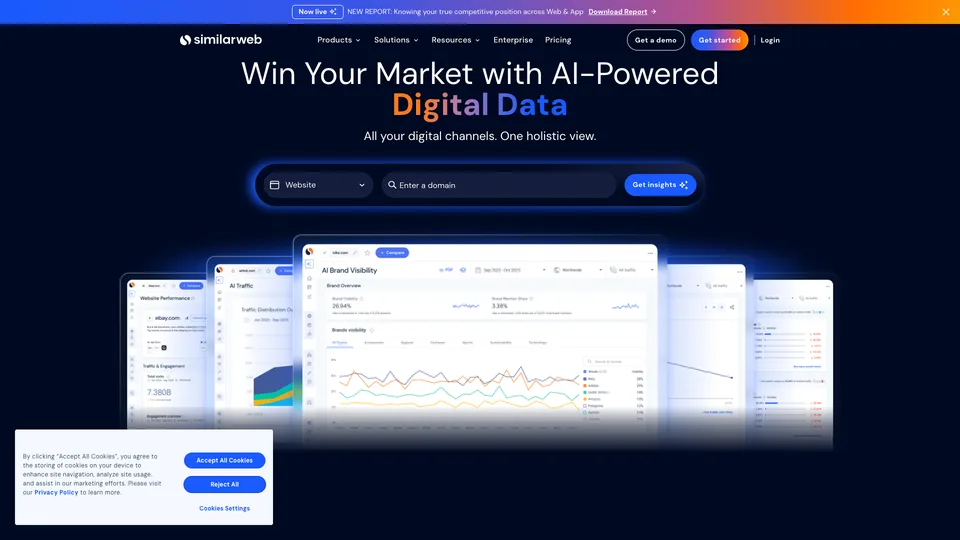
What is Similarweb?
Behind its dashboard interface, Similarweb is first and foremost a huge database on how people browse the web. The company feeds it with four kinds of sources: websites and apps that give it direct access to their analytics, a network of devices running its own products (including its browser extension) that send it anonymized browsing data, public data, and partners that specialize in measurement. From that sample, its models extrapolate the traffic of more than a hundred million websites and four million apps. The figures shown for a given site are therefore statistical projections, not a readout of its actual analytics.
The company was founded in Tel Aviv in 2007 by Or Offer, who wanted to keep an eye on the competitors of his own online business. It made its name with website rankings, then bought several specialists (Rank Ranger for rank tracking in 2022, Admetricks and 42matters for advertising and apps in 2024) to broaden its offering. Listed on the New York Stock Exchange since May 2021, Similarweb generated $282.6 million in revenue in 2025 from more than 6,000 customers. Its founder is handing over to Michael Akkerman, appointed CEO effective November 2, 2026.
Similarweb at a glance
- Type
- Online software (SaaS) and browser extension
- Founded
- 2007
- Founder
- Or Offer
- Origin
- Israel
- Headquarters
- New York and Givatayim (Israel)
- Status
- Listed on the NYSE (SMWB) since 2021
- Revenue
- $282.6M (2025)
- Free version
- Yes, limited overview and extension
- Starting price
- $125/month billed yearly, $199 monthly
What is Similarweb used for?
-
Estimate a website’s traffic
monthly visits, session duration, page views and bounce rate for any domain, with their evolution over time.
-
Compare your competitors
up to five sites side by side, with each one’s share of the audience and alerts when one of them takes off.
-
Break down acquisition channels
the share of traffic that comes from Google, social media, ads, referrals or direct visits.
-
Find keywords
the searches that bring traffic to your competitors and the ones where you are missing.
-
See what others are advertising
an advertiser’s search, display and social ads, its creatives and an estimate of its spend.
-
Track your brand in AI answers
where your brand stands in AI assistants’ answers and the traffic they send to your site.
-
Use the data elsewhere
API, data feeds and an MCP connection for AI agents, reserved for enterprise plans.





Similarweb review
Reference
To find out what a competitor’s audience looks like, Similarweb is still hard to replace. In two clicks, you can see whether a site draws a hundred thousand or ten million visits a month, where its traffic comes from and how it is trending. For preparing a market study, assessing a partner, choosing which sites to buy ads on or spotting a rising competitor, it saves a considerable amount of time.
You still need to know what you are looking at. Similarweb’s figures are estimates, built from a sample of internet users and then extrapolated. They hold up well on large sites and for comparing players with each other, much less on small sites, where the gap with reality can be large in either direction. To know your own site’s real traffic, Google Analytics or Matomo are the reference, along with Google Search Console for the share that comes from Google search; Similarweb is for sizing up others, not for measuring yourself, and its numbers should always be cross-checked with your own tools.
Its home turf remains market research and benchmarking rather than pure SEO. The keyword, ranking and backlink modules are useful, but they lack the depth of specialized suites, and the richness of the data varies noticeably from one section to another. The interface, easy to pick up, also changes very often, to the point that you regularly have to find your way around again.
The price quickly cools enthusiasm. The first plan only gives access to traffic, for a single user and three months of history, and you have to aim much higher to get SEO, advertising or a long history. That positioning suits marketing teams, agencies and analysts who use this data every week; for a small business, the free version and the browser extension already give the useful orders of magnitude.
The free trial calls for vigilance. It requires a credit card and turns into a subscription after seven days, and canceling or getting a refund doesn’t always go smoothly. Note the end date and cancel beforehand if the tool doesn’t win you over.
Strengths
- The estimated traffic of any website, without access to its analytics.
- A very clear view of a competitor’s acquisition channels.
- Quick to learn, with easy exports for a market study.
- A database of rare size, covering websites, apps and advertising.
- A free version and a browser extension that are handy for sizing up a site in an instant.
Weaknesses
- Estimated figures, to be handled with care on small sites.
- A high entry price for a single user and three months of history.
- SEO modules less thorough than those of specialized suites, and reserved for the pricier plans.
- Uneven data depth across sections, and an interface that changes often.
- A trial that turns into a paid subscription, with canceling that can be a hassle.
Is Similarweb worth it?
Yes, if your job is understanding a market: a marketing team keeping tabs on competitors, an agency preparing recommendations, an analyst or investor who wants to know how big an online player really is, an ad network looking for where to place its ads. On that ground, no other tool gives such a broad view of other sites’ traffic.
Not necessarily, if your main goal is improving your own SEO. Google Search Console and Google Analytics, both free, give you your real numbers, and SEO suites like Semrush or Ahrefs cover keywords, links and technical audits better, while offering their own traffic estimates. For a quick one-off look at a competitor, Similarweb’s free version and its extension are more than enough.
How much does Similarweb cost?
Similarweb publishes its prices in dollars, before tax, for three self-serve plans limited to one user; offers for teams and large companies are on quote. Paying yearly brings the bill down considerably, by 16 to 37% depending on the plan.
| Plan | Per month | Per month, billed yearly | Included | Who it's for |
|---|---|---|---|---|
| Free | $0 | — | Overview of a site’s traffic, browser extension | Sizing up a competitor from time to time |
| Competitive Intelligence | $199 | $125 | Traffic, engagement, channels, demographics, alerts; 1 user, 3 months of history | Researchers and analysts |
| Competitive Intel & SEO & AEO | $399 | $333 | Plus: keywords, rank tracking, site audit, backlinks, AI visibility; 6 months of history | Marketing and SEO managers |
| Competitive Intel, SEO & AEO & Ads | $649 | $542 | Plus: search, display and social ads, ad spend | Paid acquisition specialists |
| Businesses & Enterprises | Custom pricing | Multiple users, up to 37 months of history, 100+ countries, API | Teams and large companies | |
Source: official Similarweb pricing page, checked on October 31, 2026.
- The free trial lasts 7 days, with 15 actions a day; it requires a credit card and the subscription is charged when it ends unless you cancel.
- When the trial ends, the free account keeps the free tools and the browser extension.
- AI Studio, custom data feeds, managed services and single sign-on (SSO) are options on enterprise plans, on quote.
FAQ
Answers to questions about Similarweb
Is Similarweb free?
Partly. The site’s public pages and the browser extension give you a free overview of any website’s traffic. To compare several sites in detail, filter by country or export the data, you need a subscription, starting at $125 a month billed yearly.
Is Similarweb data accurate?
The figures are estimates, calculated from a sample of internet users and partner sources. They are useful for comparing sites and following trends, much less precise on small sites. A site’s real traffic is found in its own measurement tools, such as Google Analytics, Matomo or Google Search Console.
How does Similarweb know the traffic of a site it doesn’t own?
It combines anonymous browsing data from a vast network of devices, the analytics some sites share with it directly, public data and partner data, then extrapolates the result to all internet users.
Similarweb or Semrush?
They don’t aim at quite the same thing. Similarweb is first and foremost a traffic and market analysis tool, very strong at measuring the size of a competitor. Semrush is a complete SEO suite, better equipped for keywords, links and technical audits.
Information checked on October 31, 2026