
- Email APIs
SendGrid: getting your app’s transactional emails out, even at very high volume
Good tool
Order confirmations, password reset links, invoices, sign-in alerts: SendGrid takes care of delivering the emails a website or an app sends automatically to its users. The developer connects their code to the API or the SMTP relay, and the platform handles the rest: domain authentication, bounce and unsubscribe management, open and click statistics. A marketing campaigns product rounds out the offering. Up against Mailgun, Amazon SES or Postmark, it is still the service many engineering teams plug in first, including at some very large senders.
What is SendGrid?
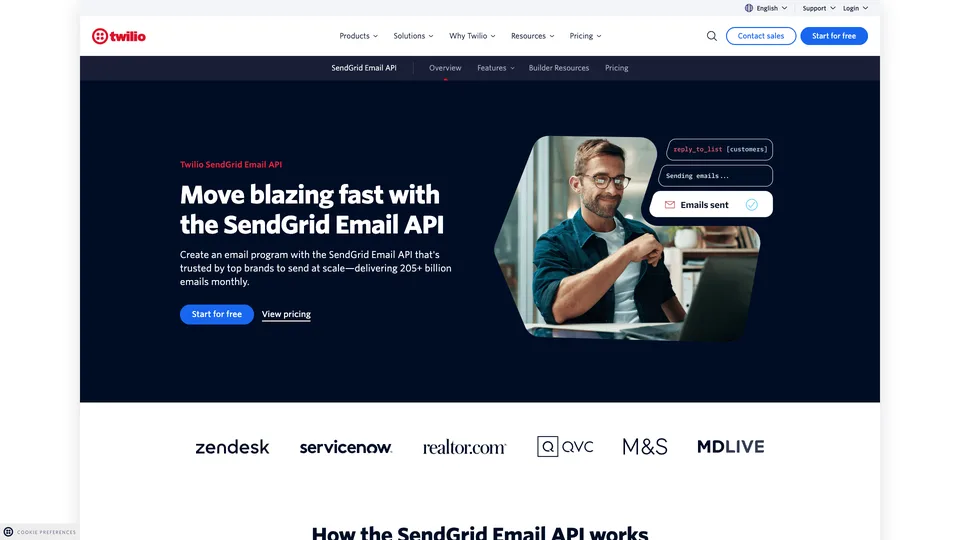
Under the hood, SendGrid is a hosted sending service: instead of running your own mail server, you hand your messages to infrastructure built for volume, which the company says can send more than 205 billion emails a month. Integration goes through a REST API, with libraries for the main programming languages, or through a plain SMTP relay that most CMSs and frameworks can use. Dynamic templates let you write a layout once and fill it in on the fly (customer name, order number). For tracking, webhooks send every event (delivery, bounce, open, complaint) back to the app, and a dashboard shows the activity. Higher plans add a dedicated IP address, email address validation before sending and subuser management, useful for agencies and software vendors. The Marketing Campaigns product, sold separately, brings a drag-and-drop editor, contact lists, signup forms and automations.
SendGrid was founded in 2009 in Boulder, Colorado, by Isaac Saldana, Jose Lopez and Tim Jenkins, and went through the Techstars accelerator. Listed on the New York Stock Exchange in November 2017, it was acquired by Twilio, the US communications platform for developers, for $2 billion: the deal, announced in October 2018, closed in February 2019. The service has since been called Twilio SendGrid, it is headquartered in Denver, and its website has been merged into Twilio’s. In 2025, Twilio dropped the free plan that had made it popular with developers, replacing it with a 60-day trial.
SendGrid at a glance
- Type
- Email sending API and SMTP relay (SaaS)
- Founded
- 2009
- Founders
- Isaac Saldana, Jose Lopez, Tim Jenkins
- Origin
- Boulder, Colorado, United States
- Headquarters
- Denver, Colorado
- Owner
- Twilio, since February 2019
- Stated volume
- More than 205 billion emails a month
- Free plan
- No, 60-day trial (100 emails a day)
- Starting price
- $19.95/month (50,000 emails)
What is SendGrid used for?
-
Send your transactional emails
confirmations, password resets or invoices go out from your app through the REST API or the SMTP relay.
-
Wire sending into your code
official libraries for the main languages, interactive documentation and SMTP compatibility with most CMSs.
-
Authenticate your domain
a setup wizard for SPF and DKIM, branded links and, with a dedicated IP, reverse DNS, so mailbox providers recognize the sender.
-
Keep an eye on deliverability
automatic handling of bounces, complaints and unsubscribes, and a dedicated IP address starting with the Pro plan.
-
Track every message
real-time statistics, a searchable activity history and webhooks that send every event back to your app.
-
Validate your addresses
an API checks that an address exists before sending, with a quota included in the Pro and Premier plans.
-
Run marketing campaigns
with Marketing Campaigns, sold separately: drag-and-drop editor, contact lists, A/B testing and automations.


SendGrid review
Good tool
For getting an app’s emails out, SendGrid was long the default answer, and technically it is still solid: a well-documented API, an SMTP relay that plugs in anywhere, comprehensive webhooks and infrastructure that handles enormous volumes. A development team that has already integrated it has, functionally speaking, no urgent reason to leave.
The picture has darkened, though. Since 2025, there is no free plan anymore: after the 60-day trial, sending stops until you pay. For a small site that only sends a few hundred messages a month, paying nearly $20 for a plan sized for 50,000 emails makes little sense. Deliverability is another point to watch: on the Essentials plans, your messages go out from IP addresses shared with other senders, whose reputation isn’t always spotless. A password reset email that ends up in spam means a customer locked out. So take care of SPF, DKIM and DMARC, and consider the Pro plan’s dedicated IP as soon as your volume justifies it.
The same caution applies to click tracking, which is turned on for most accounts: until link branding is set up, every link in the message is rewritten to a tracking domain shared with all SendGrid customers, whose reputation is out of your hands. Branding links with your own domain, or turning off click tracking on transactional emails, is one of the settings not to put off.
Customer service leaves something to be desired. For small accounts, support is hard to reach and often automated, and account suspensions for suspected abuse sometimes land without a clear explanation, which abruptly cuts off sending for an app in production. Billing and cancellation are also sources of friction. None of this is a dealbreaker for a company that sends a lot and can negotiate dedicated support, but a small business will often have a smoother experience elsewhere.
Strengths
- A proven, well-documented API and SMTP relay, with libraries for most languages.
- Infrastructure that handles very high volumes, with published uptime commitments.
- Detailed webhooks and statistics to track every message.
- Advanced features useful for agencies and software vendors: dedicated IP, subusers, address validation, SSO.
- Transactional and marketing email on the same account, with sending from the European Union available starting with the Pro plan, on a dedicated subuser.
Weaknesses
- No free plan anymore: sending stops after the 60-day trial.
- An entry tier designed for 50,000 emails a month, poorly suited to small volumes.
- Shared IP addresses with uneven reputation on the Essentials plans.
- Distant support for small accounts, and suspensions that are sometimes poorly explained.
- Email API and Marketing Campaigns billed separately, which adds up when you want both.
- Published prices exclude taxes, with overage charges on top.
Is SendGrid worth it?
Yes, if your app sends tens of thousands of emails a month or more, with an engineering team that can set up domain authentication properly. From the Pro plan up, the dedicated IP, subusers and address validation make it a serious tool for a software vendor or an agency managing several clients.
Not necessarily, if you only send a few hundred or a few thousand messages a month, or if an unexpected account suspension would bring your business to a halt. Postmark is known for its transactional deliverability, Mailgun plays in the same league as SendGrid with developers, Amazon SES is very cheap if you are already on AWS, and Brevo, a French company, combines transactional email and newsletters with a free plan. For simple marketing campaigns with no development, a classic newsletter tool will be more comfortable than Marketing Campaigns.
How much does SendGrid cost?
SendGrid is billed monthly, in dollars, based on the volume of emails sent. The Email API, for sending from an app, and Marketing Campaigns, for newsletters, are two separate subscriptions. Each starts with a 60-day free trial, no credit card required, limited to 100 emails a day; there is no longer a permanent free plan.
| Plan | Per month | Included volume | Who it's for |
|---|---|---|---|
| Email API Essentials 50k | $19.95 | 50,000 emails a month | Small app, first regular volumes |
| Email API Essentials 100k | $34.95 | 100,000 emails a month | Growing online store or SaaS |
| Email API Pro 100k | $89.95 | 100,000 emails a month, dedicated IP | Senders who want control over their reputation |
| Email API Pro 300k | $249 | 300,000 emails a month | Software vendor, agency |
| Email API Pro 700k | $499 | 700,000 emails a month | High transactional volumes |
| Email API Pro 1.5M | $799 | 1,500,000 emails a month | High-traffic platforms |
| Email API Pro 2.5M | $1,099 | 2,500,000 emails a month | High-traffic platforms |
| Email API Premier | Custom pricing | Custom volume | Enterprise accounts, dedicated support |
| Marketing Campaigns Basic | $15 | From 5,000 contacts and 15,000 emails a month | Simple newsletters |
| Marketing Campaigns Advanced | $60 | From 10,000 contacts and 50,000 emails a month | Marketing automation, segmentation |
| Marketing Campaigns Custom | Custom pricing | Custom volume | Enterprise accounts |
Source: official SendGrid pricing page, checked on October 31, 2026.
- Prices are shown excluding taxes, in dollars. No annual pricing is published.
- Beyond the included volume, each email is billed as an overage; on Marketing Campaigns, it costs $0.0023 to $0.0075 per additional email or contact depending on the plan.
- Marketing Campaigns scales in tiers: Basic from $15 (5,000 contacts) to $200 a month (100,000 contacts), Advanced from $60 (10,000 contacts) to $900 a month (200,000 contacts).
- Add-ons: extra dedicated IP addresses, extended activity history, email testing credits ($18 for 30 a month, $30 for 60), expert services.
- At the end of the 60-day trial, sending stops until you subscribe to a paid plan.
FAQ
Answers to questions about SendGrid
Is SendGrid still free?
No. Twilio dropped its free plans in 2025. New accounts get a 60-day trial limited to 100 emails a day; after that, you have to move to a paid plan, starting at $19.95 a month for the Email API.
What is a free alternative to SendGrid for small volumes?
Brevo, a French company, still has a free plan that covers a small site’s transactional emails and newsletters. Amazon SES is also very cheap, but requires an AWS account and some setup. For regular volume, Postmark and Mailgun are paid from the start.
What is the difference between the Email API and Marketing Campaigns?
The Email API is for emails sent automatically by an app or a website (confirmations, invoices, passwords), billed by sending volume. Marketing Campaigns is for newsletters, with a visual editor and contact lists, billed by number of contacts. The two are purchased separately.
Is SendGrid owned by Twilio?
Yes. Twilio acquired SendGrid in an all-stock deal valued at about $2 billion when it was announced in October 2018, which closed in February 2019. The service is now called Twilio SendGrid and its website has been folded into Twilio’s.
Do I need a dedicated IP address with SendGrid?
Not to get started, but on the Essentials plans messages go out from addresses shared with other senders. Once your volume is steady and significant, the Pro plan’s dedicated IP means you depend only on your own reputation. It starts with no history at all, though: you need to warm it up by ramping volume in stages over several weeks, which SendGrid automates, then keep sending regularly. A dedicated IP that only sends a few thousand messages a month, or in bursts, builds a more fragile reputation than a well-maintained shared pool.
Information checked on October 31, 2026