
- Website creation
- AI builders
Lovable: build a web app by describing it to an AI
Good tool
With Lovable, you write what you want to end up with, “a booking site for my hair salon with online payments,” and the AI produces the complete app: the pages, the database, user sign-in, and then puts it online. You keep improving it through conversation, message after message, without writing any code. It is one of the most visible players in what is known as vibe coding, widely used to ship a prototype, an internal tool or the first version of a product in a few hours.
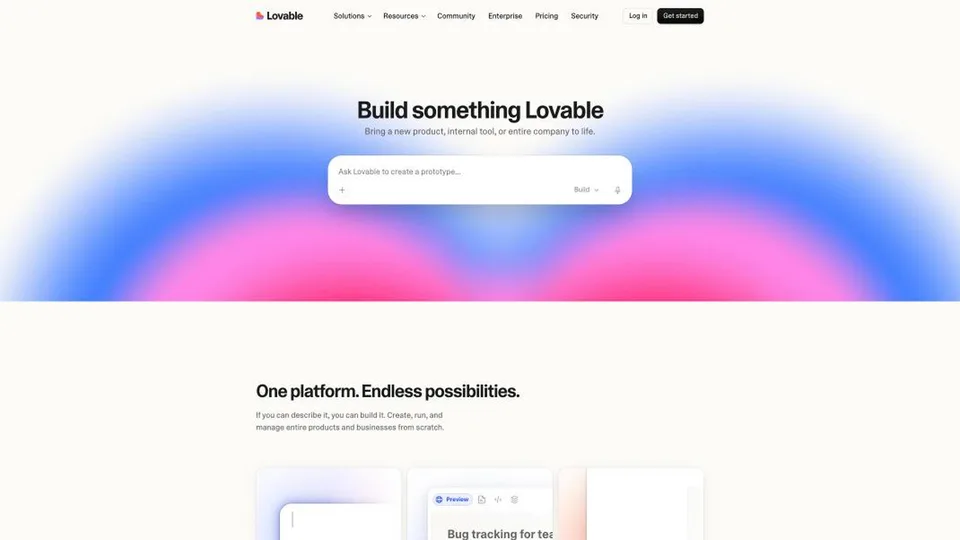
What is Lovable?
Lovable presents itself as an online platform that builds real web apps, with readable code you can take over. The screen is split in two: on the left, the conversation with the AI; on the right, a preview of the app as it takes shape. A “Plan” mode lets you discuss what you want to do before any changes are made. Apps created since May 2026 run on TanStack Start, with server-side rendering, older ones on React and Vite; the user picks neither the framework nor the database. Each project comes with a built-in backend (PostgreSQL database, user accounts, file storage), or can connect to its own Supabase project. You publish in one click to a lovable.app address or, with a subscription, to your own domain name. The code belongs to the user: it syncs with GitHub, GitLab or Bitbucket, and paid plans let you download it. Lovable does not produce native mobile apps.
The company was born in Stockholm in 2023. That same year, Anton Osika had released GPT Engineer, an open source project that generated software from a description; together with Fabian Hedin, he turned it into a commercial version, renamed Lovable and opened to the public in late 2024. Growth was fast: $100 million in annual recurring revenue claimed as early as July 2025, then three funding rounds in just over a year, the latest of which, in August 2026, brought in $400 million at a $13.3 billion valuation. The company says more than 60 million projects have been created since launch.
Lovable at a glance
- Type
- Online AI web app builder
- Founded
- 2023 (public launch late 2024)
- Founders
- Anton Osika and Fabian Hedin
- Origin
- Sweden
- Headquarters
- Stockholm
- Latest funding round
- $400M at a $13.3B valuation (August 2026)
- Free plan
- Yes, 5 credits a day, 30 a month at most
- Starting price
- $25/month (100 credits)
What is Lovable used for?
-
Build an app by describing it
you explain your project in a few sentences, the AI generates the pages and the code, then you refine it message by message.
-
Plan the work with AI
Plan mode helps you think through your app’s structure and approve the approach before any code is touched.
-
Add a database and accounts
the built-in backend handles the PostgreSQL database, user sign-in and file storage, with no server to configure.
-
Accept payments
with the built-in payments on paid plans, or by connecting your own Stripe account to the app.
-
Publish on your domain
one-click publishing to a lovable.app address, or to your own domain name on a paid plan.
-
Stay in control of the code
syncing with GitHub, GitLab or Bitbucket lets a developer pick up your project in their own tools.
-
Check your SEO
a dedicated tab reviews what matters to Google and AI answer engines, free on every plan.


Lovable review
Good tool
Watching an idea take shape in ten minutes is still a striking experience, and that is the whole appeal of Lovable. For a founder who wants to show something to early customers, a product manager testing a user flow or a team that needs a small internal tool, the time savings are real: the resulting interface is clean, the database and user sign-in come with it, and you never have to worry about a hosting provider.
A growing project quickly reveals the limits of the exercise. Beyond the first few dozen exchanges, the AI tends to fix one problem by creating another, and you can end up going around in circles on a bug. Every attempt costs credits, so the bill depends less on what you build than on how many times you have to try again. The credit system, with its daily allowances, rollovers that expire and top-ups, also takes some getting used to. And when things are really stuck, support isn’t always as responsive as you would like.
You also need to know what you are putting online. The generated code is a real starting point, but an app meant for real customers deserves a developer’s review, especially of the database access rules, PostgreSQL’s row level security: in 2025, apps built with Lovable exposed their data because those rules were missing or let any user through. The company has since added security checks, which doesn’t mean you can skip checking yourself.
Finally, for a simple brochure site, Lovable isn’t the most obvious choice: you gain complete design freedom, but you lose the simplicity of a visual editor where you can change a line of text without spending a credit.
SEO calls for the same caution: projects created before May 2026 are React apps rendered in the browser, whose content doesn’t appear in the HTML sent by the server, which Google indexes less well and most AI answer engine crawlers don’t read. Only recent projects get server-side rendering, and an older project doesn’t migrate on its own.
Strengths
- A working, presentable prototype in a few hours, without writing code.
- Database, user accounts, storage and hosting included, with nothing to configure.
- Code that belongs to the user and syncs with GitHub, GitLab or Bitbucket.
- Unlimited users on every plan, with a single shared pool of credits.
- A free plan good enough to judge the tool before paying.
Weaknesses
- Credit usage that is hard to predict, especially when you have to fix the AI’s mistakes.
- Back-and-forth that gets bogged down once the app becomes complex.
- Code that needs a review before going to production, database security included.
- Support that can be slow to respond when a project is stuck.
- A free plan that doesn’t let you publish publicly or use your own domain.
- No choice of framework or database, and no native mobile apps.
Is Lovable worth it?
Yes, if you need to validate an idea, show a clickable prototype to investors or customers, or build an internal tool without pulling in a developer. For $25 a month on Pro, you get a first version online, and a developer can take over the code if the project takes off.
Not necessarily, if you only want a brochure site that you will update yourself: Wix, Framer or Webflow remain simpler and more predictable. The same caveat applies if your app handles sensitive data and no developer can review it.
Among the alternatives, Bolt.new and Replit play on the same field of AI app building, Vercel’s v0 is aimed more at technical users, and AI-assisted code editors such as Cursor suit developers who want to stay in control line by line. For a small site or a modest app, the AI mode of Hostinger’s website builder, which grew out of Horizons, offers a similar service with hosting and the domain included in the package, at the cost of less depth.
How much does Lovable cost?
Lovable charges neither per project nor per user, but per credit: each message sent to the AI uses a fraction of a credit or more depending on how complex the request is (0.50 credit to change a button’s color, 1.20 to add authentication, according to the company’s examples), and a message in Plan mode costs 1 credit. The Pro and Business plans come in tiers of monthly credits, from 100 to 10,000; the prices below are for the first tier. An annual commitment gives you the equivalent of two months free.
| Plan | Per month | Per month, billed yearly | Included | Who it's for |
|---|---|---|---|---|
| Free | $0 | — | 5 credits a day (30 a month at most), invite-only publishing | Trying the tool, testing an idea |
| Pro | $25 | $21 | 100 credits a month, plus 5 a day, custom domain, downloadable code | Freelancers, founders, small teams |
| Business | $50 | $42 | 100 credits a month, plus 5 a day, SSO, roles, security center | Teams sharing a workspace |
| Enterprise | Custom pricing | Volume credits, SCIM, audit logs, dedicated support | Large organizations | |
Source: official Lovable pricing page, checked on October 31, 2026.
- Each higher tier is selected on the plan card; the price goes up with the number of credits, up to 10,000 credits a month.
- Business credits are billed at twice the price of Pro credits; the company specifies that hosting and the apps’ AI features cost the same real amount on both plans, and therefore fewer credits on Business.
- Every plan gets 20 credits a month for hosting (Cloud) and 4 for the AI features built into apps; most small apps stay within this allowance, while the busiest ones draw on the balance.
- Unused monthly credits roll over but expire two months after they are issued (one month after the end of the period on annual billing); daily credits don’t roll over.
- On Pro and Business, one-off or automatic top-ups are available, valid for twelve months. No credits are refunded.
- Students get up to 50% off Pro. No free trial of the paid plans is advertised: the free plan serves that purpose.
FAQ
Answers to questions about Lovable
Is Lovable free?
Yes, to get started: the free plan gives you 5 credits a day, up to 30 a month. It only lets you publish for invited people and without a custom domain. For an ongoing project, expect to pay $25 a month on Pro, or $21 a month billed annually.
How many credits does it take to build an app?
There is no way to know in advance: the cost of each message depends on how complex the request is, from 0.50 credit for a simple tweak to more than one credit for a complete feature. Repeated fixes are what drive usage up the most.
Can you get the code of a Lovable app?
Yes. The code belongs to the user: it syncs with GitHub, GitLab or Bitbucket on every plan, and can be downloaded as a ZIP archive on paid plans. The database is exported separately.
Does Lovable build mobile apps?
Not native apps for the App Store or Google Play. Lovable produces web apps, which you can turn into an app installable on a phone (PWA) or wrap with an external tool.
Who is behind Lovable?
A Swedish company founded in Stockholm in 2023 by Anton Osika and Fabian Hedin, based on the open source GPT Engineer project. It raised $400 million in August 2026, at a $13.3 billion valuation.
Information checked on October 31, 2026